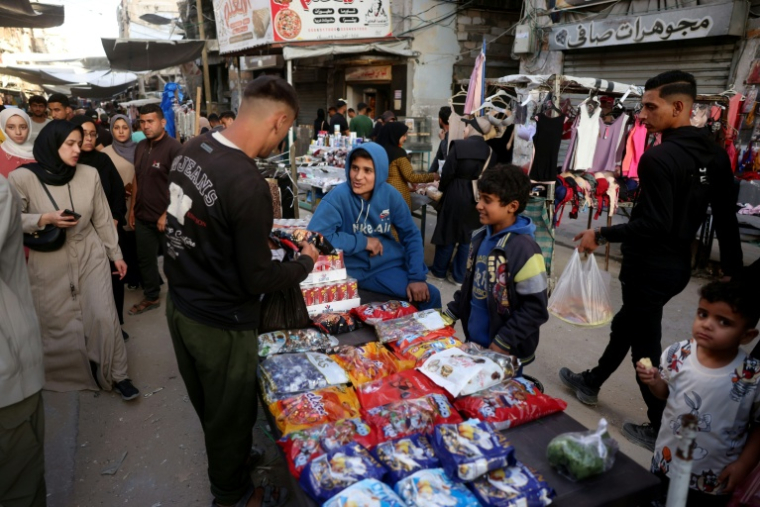
Palestinians do their shopping before Eid al-Adha, the festival of sacrifice, in Khan Younis, in the south of the Gaza Strip, May 26, 2026 (AFP / Bashar Taleb)
For the third year in a row, the inhabitants of Gaza are modestly celebrating Eid al-Adha in the rubble, the ceasefire theoretically in force between Hamas and Israel having changed almost nothing in the exorbitant prices of meat and gifts, usually synonymous with party.
Eid, which began Tuesday evening, “is taking place without the joy that we once knew, because of (…) the rise in prices and our inability to meet the most basic needs of our children”, laments Nadia Abou Shamala, 40 years old.
“I go to the market just to look. When I ask the prices, I return with a broken heart,” laments this Palestinian from the north of the Gaza Strip, displaced for more than two years in Deir el-Balah (center).
NGOs have recently warned of the still “catastrophic” situation in the Palestinian territory, more than six months after the adoption at the UN of a resolution endorsing an American plan which notably provided for the total resumption of humanitarian aid.
However, according to associations, Gazans still lack everything and the aid trucks, which use crossing points all controlled by Israel, are not numerous enough to bring prices down.
In addition, a ceasefire in force since October does not prevent almost daily shootings.
“This Eid is so sad. Every day there are funerals and wakes,” relates Abou Abdallah al-Mossadar, 59 years old. “The truce is just a big lie.”
He and his brother paid 13,000 shekels (3,900 euros) to buy a sheep, usually sacrificed and consumed during Eid.
“We will try in all cases to create joy for the children,” explains the man who before the war worked as a real estate developer, from a wealthy family.
– Up to 4,500 euros per sheep –
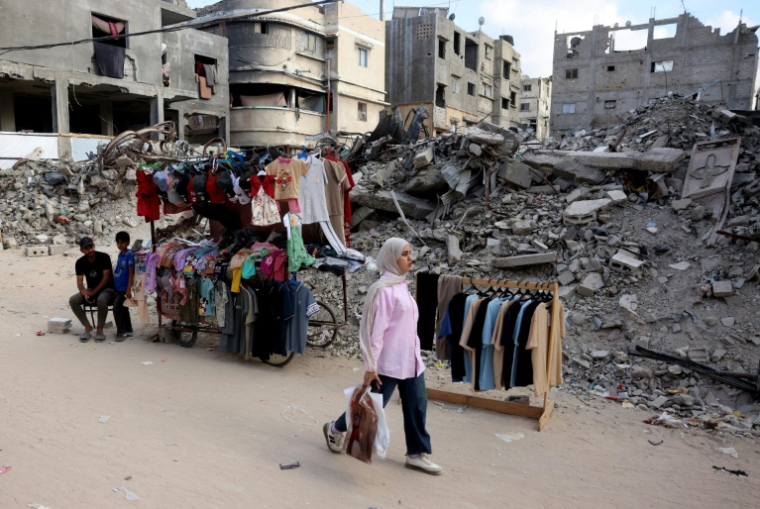
A Palestinian woman walks in front of a clothing stall before Eid al-Adha, the festival of sacrifice, in Khan Younis, in the south of the Gaza Strip, May 26, 2026 (AFP / Bashar Taleb)
According to Muslim tradition, Eid al-Adha commemorates the sacrifice that Abraham (Ibrahim in the Koran) almost made by immolating his son, before the angel Gabriel offered at the last minute to kill a sheep in his place.
“A sheep which was sold for around 1,000 shekels (300 euros) before the war is now worth between 11,000 and 15,000 shekels”, or between 3,300 and 4,500 euros, specifies Raafat Assaliya, spokesperson for the Ministry of Agriculture in Gaza.
According to the Food and Agriculture Organization of the United Nations (FAO), there remains in the territory of 2.1 million inhabitants only a quarter of the sheep compared to before the war, or 15,000 animals.
Ahmed Abou Salem, a 50-year-old resident of Gaza City, said he was “shocked”.
“We had never heard of such prices,” he told AFP. “Families like us, who used to sacrifice an animal every year, cannot even buy a kilo of meat for the children.”
With gas shortages, cooking and preparing meals, at home or in the tents of displaced people, are also a problem, notes Abou Ahmed Wafi, 42 years old.
“In the markets we find mainly kaak (bread), maamoul (pastries) and sweets. We dream of preparing them at home as always, but the prices have risen sharply and there is no cooking gas to cook them,” says this person displaced from the south of the territory.
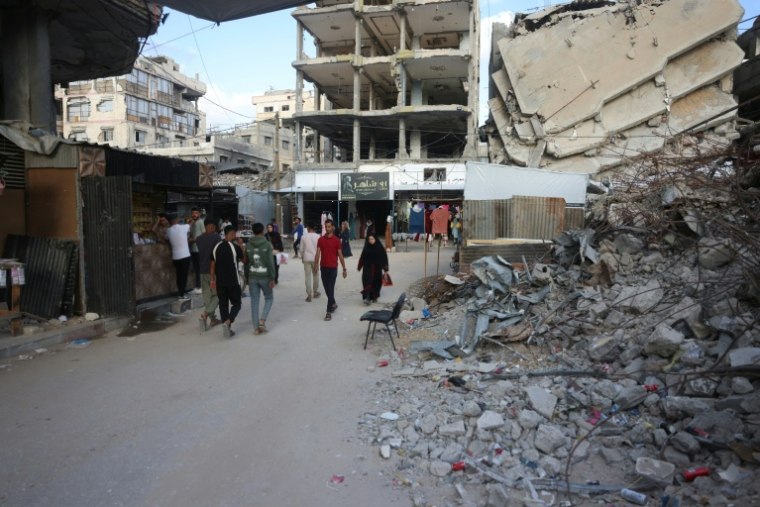
Palestinians walk near destroyed buildings before Eid al-Adha, the festival of sacrifice, in Khan Yunis, in the south of the Gaza Strip, on May 26, 2026 (AFP / Bashar Taleb)
In Khan Younès, also in the south, a family managed to prepare traditional maamoul biscuits, under a makeshift shelter. Sitting on the ground, a woman and her daughter knead the dough, before it is baked in an improvised earth oven.
“We still live in tents, without any atmosphere of joy, only worries, fear and exhaustion, without any of the happiness we once knew,” concludes Nadia Abou Shamala.