-
SpaceX, xAI, Tesla,
-
In just a few years, SpaceX and xAI have become irreplaceable suppliers to the American armed forces, with nearly $6 billion in Pentagon contracts, creating an institutional dependence that makes any rupture politically explosive.
-
The Ukrainian Starlink controversy revealed what this power means in practice: a private actor controls critical infrastructure of American military power.
Control structure
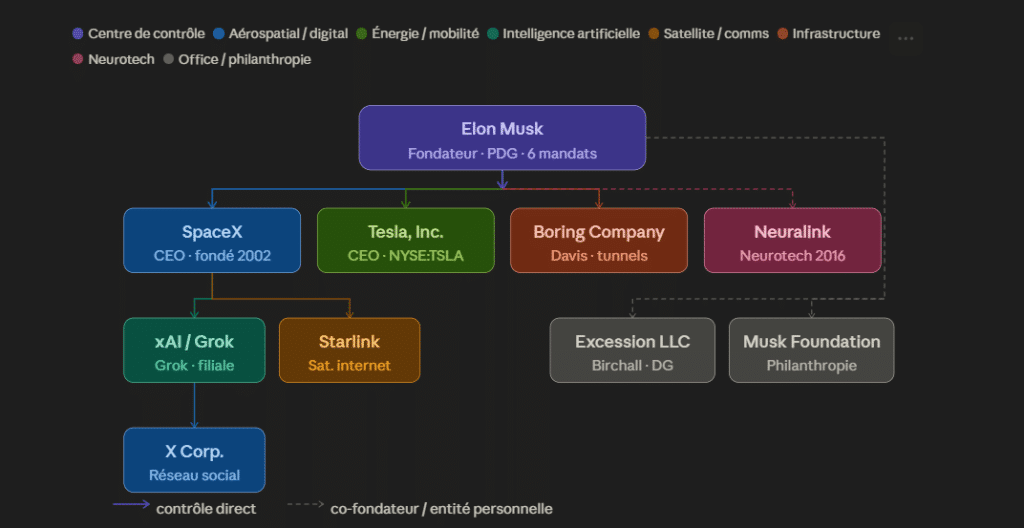
SpaceX is the architectural centerpiece of the empire: Musk holds approximately 42% of the capital, but controls 79% of the voting rights thanks to a structure of shares with differentiated voting rights. The dissociation guarantees him total control of the company without holding the economic majority. This mechanism is the real secret of Musk governance: third party money finances expansion, political control remains intact. This architecture was reproduced in every company he subsequently led.
Valuing the combined whole at $1.25 trillion – SpaceX at $1 trillion and xAI at $250 billion – it is the largest private merger in history. In the process, xAI became a subsidiary of SpaceX, leading to X Corp. in the same chain of control.
“Third party money finances expansion, political control remains intact. This architecture has been replicated in every company Elon Musk has subsequently led. HAS”
Read also: Elon Musk: how high won’t he go?
The operational right arm: Jared Birchall
The least visible figure to the general public is undoubtedly the most transversal of the empire. Birchall is the CEO of Neuralink and Elon Musk’s wealth manager since 2016: as an advisor and right-hand man, he holds executive or administrative roles in The Boring Company, the Musk Foundation, xAI, and manages the family office Excession LLC. He notably orchestrated the loans from Wall Street which allowed Musk to buy Twitter. He also managed the disbursements of the America PAC super PAC which supported Donald Trump’s campaign.
Tesla in the web of cross transactions
Tesla’s annual report filed with the SEC reveals the full extent of the internal financial network: $143.3 million in revenue from SpaceX in 2025 (mainly vehicle sales), and $2 billion invested by Tesla in xAI in January 2026. But with the SpaceX-xAI merger, these xAI shares were converted into SpaceX shares: Tesla shareholders who had voted to invest in an AI company now find themselves in the minority in a rocket company.
Read also: United States: Silicon Valley takes power
Investors: capital mapping
The SpaceX empire was built on a network of American venture capital, certain players of which have been present since the first hours. Among them, Valor Equity Partners deserves special attention: its founder Antonio Gracias sits on the board of directors of SpaceX and has invested in SpaceX, Tesla, The Boring Company and Neuralink. Its unique transversal positioning makes it one of the most central players in the entire ecosystem. Andreessen Horowitz led a $750 million raise in January 2023 at a valuation of $137 billion for SpaceX.
Google and Fidelity jointly invested $1 billion in SpaceX in 2015, when the company’s valuation was just $10 billion. Google now owns around 6.11% of SpaceX, a stake slightly diluted to around 5% after the merger with xAI in February 2026. These are currently the only two shareholders exceeding the 5% reporting threshold: Musk (around 40%) and Google.
Military contracts: the structural dependence of the American state
This is perhaps the most underestimated vector of power in the Musk empire. In a few years, SpaceX and xAI have become irreplaceable suppliers to the American armed forces, creating an institutional dependence that makes any break politically explosive. SpaceX is poised to become the main supplier of launchers for the US armed forces, with nearly $6 billion in contracts with the Pentagon through 2030 – this is the first time that SpaceX has overtaken the Boeing/Lockheed Martin consortium, which until then held a near-monopoly on this market.
Since 2003, Elon Musk’s companies have received $13.5 billion in federal benefits from the Department of Defense (DoD), including at least $9.5 billion in direct funding. In April 2025, SpaceX was awarded a $5.9 billion contract to support the U.S. Space Force’s rocket launches and satellite operations through 2029. Gwynne Shotwell, CEO of SpaceX, said the company has about $22 billion in government contracts in total, with about $15 billion coming from NASA.
“When Trump threatened to cancel all of Musk’s government contracts, analysts concluded that such a move would likely have shut down the Space Force’s NSSL program. A private actor has become a critical infrastructure of American military power. HAS”
Read also: Terafab by Elon Musk: the space economy at the service of the American hyperpower
Starshield: the classified spy satellite program
In 2021, SpaceX signed a classified $1.8 billion contract with the National Reconnaissance Office (NRO), the US agency responsible for spy satellites, to develop hundreds of satellites under the Starshield program. This contract was not revealed until 2023. The Space Force is now contracting with SpaceX for a new military satellite communications network called MILNET, which will be integrated into a network combining commercial and military satellites. Starshield generated approximately $3 billion in U.S. government revenue in 2025, including a $537 million contract for services in Ukraine.
xAI: military AI, a new front
In July 2025, xAI was awarded a contract worth up to $200 million from the DoD Chief Digital and Artificial Intelligence Office (CDAO), alongside Anthropic, Google and OpenAI, to deploy advanced AI capabilities aimed at addressing national security challenges.
The DOGE-contracts paradox
When Donald Trump threatened to cancel all of Musk’s government contracts during their public falling out, analysts concluded that such a decision would likely have shut down the Space Force’s NSSL (National Security Space Launch) program, as the US military’s dependence on SpaceX’s Falcon rockets is now structural. This is not a detail: it means that a private actor has become a critical infrastructure of American military power.
Read also: Strategic colony on Mars: is the United States aiming for “astropolitical domination”?
The Ukrainian question: when a private actor controls strategic access
A revealing episode: the controversy over Musk’s decision to restrict Ukrainian forces’ access to Starlink in the disputed territory of Crimea directly influenced the drafting of the Starshield contract by the DoD. A US military official said the contract likely contains clauses preventing Musk from unilaterally cutting service, whatever the circumstances.
“The controversy over Starlink in Crimea directly influenced the DoD’s drafting of the Starshield contract. A US military official said the contract likely contains clauses preventing Musk from unilaterally cutting service. HAS”
Read also: United States: Silicon Valley takes power