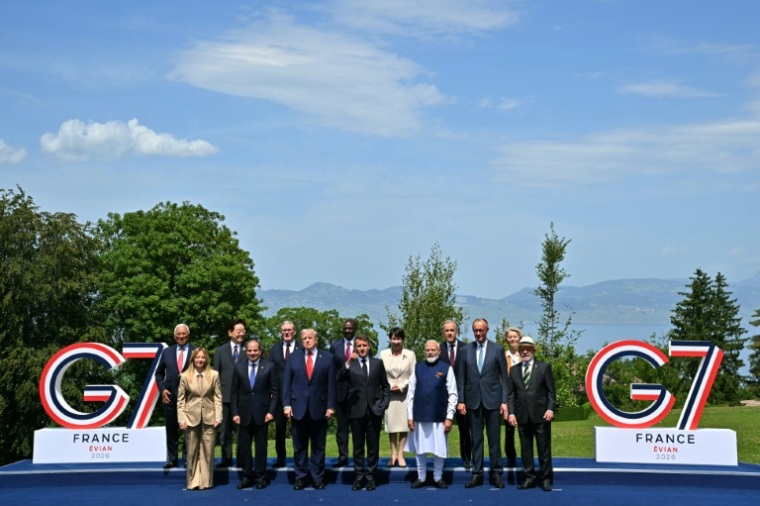
Family photo of G7 leaders and participants gathered in Evian, June 16, 2026 in France (AFP / Mandel NGAN)
The leaders of the G7, led by Donald Trump, showed their desire on Tuesday during a summit in Evian to intensify pressure on Russia via sanctions to stop the war in Ukraine.
The Seven – Germany, Canada, the United States, France, Italy, Japan and the United Kingdom – also discussed with Middle Eastern countries ways to support the reopening of the Strait of Hormuz and the return of stability to Lebanon after the agreement between Tehran and Washington.
The most anticipated announcement came from the American president, who said he wanted to reestablish certain sanctions weighing on Russian oil, suspended for a while to counter the surge in crude prices caused by the conflict against Iran.
“We will soon be in a position” to reintroduce them, he assured, while traffic in the strait, through which a fifth of world hydrocarbon exports pass, is timidly resuming. These exports constitute the main source of financing for the Russian war effort since the invasion of Ukraine in 2022.
Donald Trump, who was totally absorbed by the conflict in Iran in recent weeks, also promised to “do everything” to help end the war in Ukraine.
American-mediated peace negotiations have been completely bogged down since the start of the conflict in the Middle East on February 28.
So many declarations received with relief by his peers, while the American president has often shown himself to listen more to the Russian Vladimir Putin than to the Ukrainian Volodymyr Zelensky, whom he welcomed with unparalleled harshness in February 2025 in the Oval Office.
Zelensky félicité
The G7 leaders are “united”, “they note that there is a dynamic on the ground” in favor of Ukraine and agree to “increase the pressure” on Russia and deliver more anti-aircraft defense means to kyiv, a French diplomatic source had previously outlined.
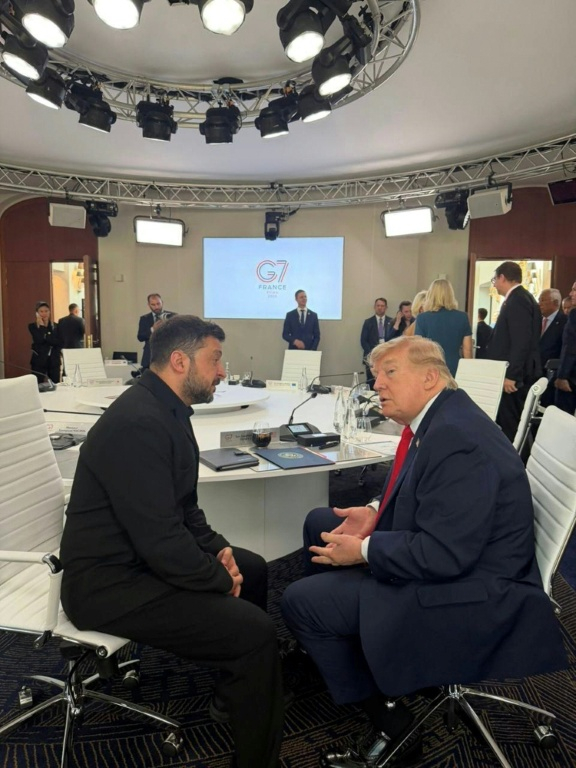
Photo released by the press service of the Ukrainian presidency, June 16, 2026, shows Ukrainian President Volodymyr Zelensky (l) and US President Donald Trump (r) during a conversation at the G7 summit in Évian (UKRAINIAN PRESIDENTIAL PRESS SERVICE / Handout)
A sign of his good disposition, Donald Trump also met for about twenty minutes separately with the Ukrainian president and was due to see him again in the afternoon. Their last meeting was on December 28 in the United States.
The American president congratulated him for the “performance” of the Ukrainian army on the ground and he recognized that the “dynamic” was Ukrainian, according to a participant.
“It’s great that everyone understands that Russia is not going to win and that we must put pressure on Putin to put an end to this war,” welcomed the Ukrainian president, whom Emmanuel Macron invited to stay until the end of the summit on Wednesday.
Multiplying the signs of attention, the French president went to meet him upon his arrival at the Royal Hotel, on the banks of Lake Geneva, where the high mass of this club of great industrialized powers was held this year.
“Demining”
The American president will have the honors of the Château de Versailles on Wednesday for a dinner. “And Versailles isn’t gold plated, it’s heavy,” he rejoiced.
British Prime Minister Keir Starmer announced that the United Kingdom would supply enriched uranium to Ukraine for its nuclear power plants and impose new sanctions on Russia.
The head of the Canadian government did the same with sanctions targeting the ghost fleet of oil tankers in the service of Russia, its energy revenues, its defense industry and the actors of disinformation.
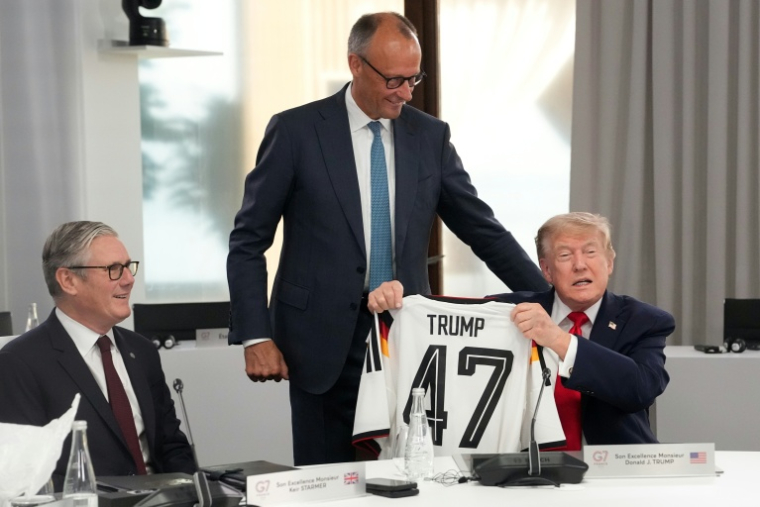
American President Donald Trump (d) shows the German football jersey flocked with his name offered by German Chancellor Friedrich Merz (c) in the presence of British Prime Minister Keir Starmer, June 16, 2026 at the G7 summit in Evian (POOL / Thibault Camus)
And Friedrich Merz offered a German football jersey printed with his name to the American president, two days after his birthday.
The G7 leaders and their counterparts from Egypt, Qatar and the United Arab Emirates then congratulated themselves during a lunch on the Iranian-American agreement, a “very nice deal” according to a diplomatic source.
They insisted on the “need to have visibility on the Iranian threat”, to diversify hydrocarbon supply routes to reduce dependence on the Strait of Hormuz, with supporting maps, and a “multinational effort to support the Lebanese army”.
The United States is “asking us to make mine clearance capabilities” available in the Strait of Hormuz, said a European source, specifying that French and German boats were notably mobilized for this purpose.
Donald Trump had, however, shown little interest the day before in the international maritime mission set up by Paris and London to guarantee the return to freedom of movement in the region, once peace has returned.
On Wednesday, on the last day of the summit, the G7 will receive several “world tech leaders” for a lunch where regulation will be discussed, or the ban on social networks for those under 15 or 16 years old. Debates which promise to be tense with Donald Trump.