Â
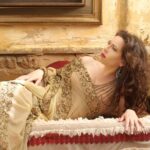
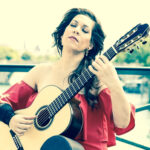
Can you tell us about your instrument, the classical guitar?
The classical guitar is the Spanish guitar. But this is not entirely true, because it has existed for hundreds of years in all European countries, notably in Italy, Portugal (where it is called violão), and in England since the Elizabethan era. There have been works for lute and baroque guitar since the Renaissance. It is the same instrument with slight differences depending on the country. In the 20th century, the electric guitar arrived with its modifications for other styles of music, but it is still the same instrument. With which I travel a repertoire which goes from the baroque to the present day.
Currently I am on tour in Israel with the Barrocada Ensemble Haifa. But I have also had the chance to create numerous works for today’s composers who write for solo guitar or for guitar and orchestra.
What is the closing program for the 21st Festival of Jewish Cultures on June 29?
At the Festival of Jewish Cultures, we will revisit the Mediterranean repertoire and this will range from Spanish melodies, Judeo-Spanish to Ladino, to South America, notably Argentina and Brazil, countries where the Spaniards and the Portuguese brought their music, based on this music Spanish Baroque.
The musicians who accompany me have known each other for a long time: Pierre Baillot plays the oud and also the ancient flute, and Edmundo Carneiro is a master of Brazilian percussion. And we are lucky to have the immense French baritone Laurent Naouri joining us. This is a program that we had already performed, with a few changes, with a soprano, at the 25th Jerusalem oud festival in 2024.
The music is partly composed and partly improvised, created on stage from very complex scores. Each concert is therefore very different.
The festival opens with the Jerusalem Orchestra. Have you ever had the opportunity to play with them as a soloist?
Many times. They accompanied my first album, *The Jewish Soul*, 25 years ago, where we played four symphonic works for guitar and orchestra, two of which were composed for me. The album was released by Warner, allowed us to tour together and was even named classical album of the year at the United States.
We found ourselves at the Jerusalem Festival, where we created new concertos. This opening concert is going to be a sublime concert!
What is your relationship to Sephardic language and culture?
I grew up in Israel and lived most of my life in France. My Jewish culture is of every color possible and imaginable, with a classical and European heart. Ladino is not in my roots, but I have a deep cultural and musical interest: at the time when I began working on this repertoire, I collected recordings often made by old singers.
I revisited this popular repertoire with composers sometimes French or Israeli, but also Russian, Argentinian and Brazilian. It’s amazing what Ladino and Judeo-Spanish culture can bring us today.
The theme of this 21st edition of the festival is “Tempo”. What will the concert be like?
Tempo is at the heart of our concert. We will go through rhythms and tempos from all universes: Brazilian rhythms that make it impossible to stay in place, but also Argentinian, Spanish baroque or contemporary.
The heart of the concert is made up of these rhythms which intertwine and inspire each other. The tempo itself has evolved throughout history. Very ancient rhythms from the time of the Moors in Spain, played on the oud, cross the Atlantic to Latin America.
This is why we will start with Ladino songs, before going to the Spanish repertoire and up to the Latin American repertoire. In Brazil, the Portuguese influence was added to the African rhythm. All these layers overlap and it is fascinating to follow the threads of inspiration and the stories that lead to contemporary rhythms.
How do you match the beats of the oud and the guitar?
More than ten years ago, I created a trio called “Cousins”. There was my contemporary guitar, a flamenco guitar and a Moroccan oud player. We were doing research on rhythm and harmonies. On the oud, it was Nabil Khalidi, an immense master.
As we were creating works, I offered to quickly teach him European notes. He got upset: “Why do you want me to learn scores? Am I a bad musician?”
The ear and the score do not function in the same way in Eastern and Western music. We must find a mathematical way to find the balance between the western 2/4 and more complex cycles on the eastern side.
You are releasing a new album on June 19, entitled “Valse” (Indesens Calliope Records), including Barrios, Piazzolla and Tansman. Can you tell us about it?
It’s the first album I’ve released since the start of the war. It’s a journey around the world with these three times.
The waltz, which has existed since the 17th century, is present in all European countries and has crossed the Atlantic to Latin America. It’s a solo album (except a *Libertango* with Edmundo Carneiro) with great French, German, English, Spanish, Russian, Venezuelan, Mexican composers… a repertoire from the four corners of the world for guitar.
This is a nice answer to those who say that the guitar is a Spanish instrument. And then it’s beautiful music for dancing, for dreaming, towards summer.
The ensemble you are playing with this June 29 is called “Les Enfants d’Abraham”. Like “Cousins”, is it also a political message?
I believe that we are all cousins, that is to say humans with common traits. We see it clearly in our music: there are Ladino songs that I know in Hebrew, my colleagues play them in Spanish or Arabic. Andalusian music is our common root.
Just as we can bond through history and friendship in the past, we can do so in the future. What is happening now is dramatic and I think it is our role as artists, through our music, our writings, our books, our paintings, each through our channels of expression, to find a way to share our lives. This is crucial. And it’s so beautiful! Why not do it?
You are currently on tour in Israel. Is cultural life still alive there despite everything?
There are very difficult times. We are in a permanent state of war. Flights are often stopped. Every time there are more tense moments, all cultural life stops. However, there is no intermittence in Israel. Projects that we have been preparing for months are stopped. It was the same during Covid.
Large Israeli companies have seen many tours canceled, with reactions that have nothing to do with their creation abroad and in Israel. We try to keep our heads above water. In difficult times, we put our emotions into music and creation: it’s the only way I know to cope.
Every household in Israel has been affected by loss and violence since October 7. Music is essential to mentally and psychologically survive these tragic moments.
« `




/2022/12/02/638994d9d5adf_61168cfc8256bf7ea5ef3720-1.png "DIRECT. War in the Middle East: Tehran responds after American strikes on Iran by targeting American bases")
:quality(80)/outremer%2F2026%2F06%2F09%2F6a282a2e29ded424102029.jpg "Handball : Metz remporte la première ligue des champions de lhistoire du handball féminin français avec deux Ultramarines")