lediplomate.media – printed on 05/31/2026
By Giuseppe Gagliano, President of the Centro Studi Strategici Carlo De Cristoforis (Côme, Italy)
Moscow seeks in China the route that Europe has closed to it
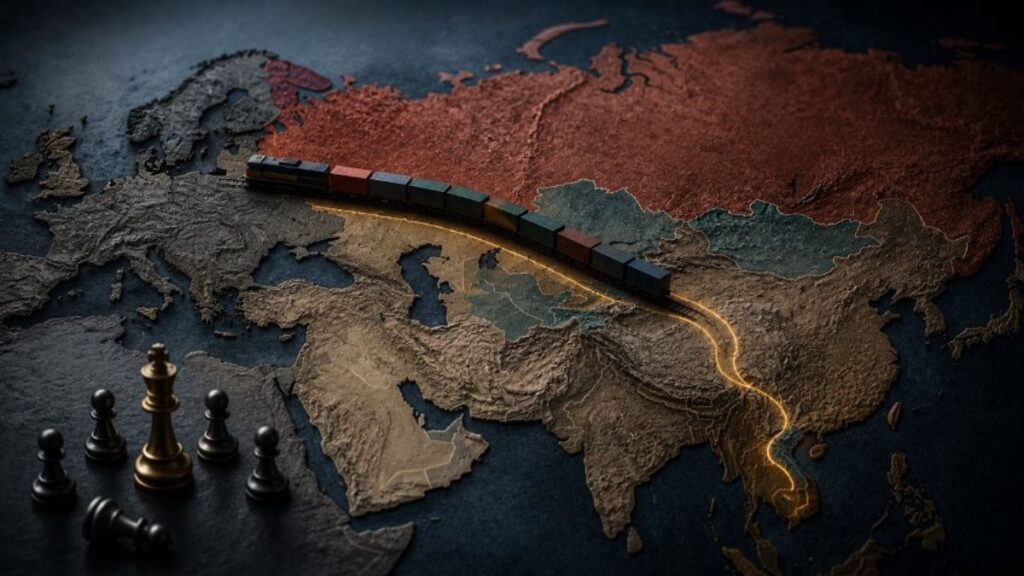
Russia is not just planning a highway. It seeks to construct a new geography of power. The corridor along the Caspian Sea to Iran, South Asia and the Persian Gulf is much more than a $40 billion infrastructure. This is Moscow’s material response to Western isolation, sanctions, the loss of European markets and the need to transform its Eurasian space into an alternative logistics system.
When Russian Deputy Prime Minister Marat Khousnullin claims that Moscow is discussing financing, technologies and participation in the construction of the eastern branch of the International North-South Transport Corridor with Beijing, he is in reality describing a growing dependence. Russia needs China not only as an energy buyer and political partner, but also as a financier, builder and technological guarantor of its logistical reconversion.
Before 2022, Russia still looked to Europe as its major commercial and industrial outlet. After the war in Ukraine, this world closed. Exports passing through Western countries have increased from around 40% to a share of between 20% and 25% by 2024. At the same time, traffic passing through Iran and Central Asia has more than doubled. This is the sign of a profound change: Russia can no longer afford to be a Eurasian power with infrastructures oriented towards the West.
The North-South Corridor: an old idea that has become a strategic necessity
The initial agreement between Russia, Iran and India dates back to 2000. At the time, the International North-South Transport Corridor was intended as a major trade route capable of connecting the Persian Gulf, India and South Asia to Russia and from there to Europe. It was an ambitious project, but not urgent. For more than twenty years, it remained suspended between political declarations, infrastructural delays, financial insufficiency and mutual mistrust.
The war in Ukraine transformed it into a necessity. Today, Moscow is no longer just looking for an additional trade corridor. She is looking for a line of economic survival. The M6 federal highway on the Caspian Sea, 1,381 kilometers long, which connects Moscow to Astrakhan, should become the northern trunk of a network capable of projecting towards Kazakhstan, Turkmenistan, Iranian ports, Afghanistan and Pakistan.
The estimate of a 15-20% reduction in delivery times between Moscow and Iran compared to current multimodal routes is not a technical detail. It is an element of geoeconomic competitiveness. In times of sanctions, each day gained, each customs bypassed, each section controlled by friendly countries is worth as much as a diplomatic concession.
China as bank, workshop and silent arbiter
The problem is that Russia no longer has sufficient internal resources to finance this transformation on its own. Hence the demand for Chinese capital and technology, through state banks and perhaps the Asian Infrastructure Investment Bank. Beijing already has a strong presence in Kazakhstan, Uzbekistan and Turkmenistan. Its commercial and infrastructural networks, born with the New Silk Road, cross precisely the space that Moscow traditionally considers as falling within its zone of influence.
This is the Russian strategic contradiction. To escape Western pressure, Moscow must rely ever more on China. But the more it relies on China, the more it reduces its autonomy in Central Asia. The corridor to the Gulf could therefore be born as a Russian project, but actually operate within a Chinese financial and logistical framework.
Beijing has no interest in saving Russia for free. It has an interest in obtaining privileged access to roads, raw materials, markets, ports, railway and highway nodes. China can finance infrastructural sections, provide technologies, bring its construction companies, but in exchange it consolidates its position in the heart of Eurasia.
Moscow wants to open a route to the South. Beijing wants to ensure that this path does not escape its continental architecture.
Economic scenarios: logistics as a response to the financial war
This case shows that sanctions do not wipe out trade. They hijack it. The West has sought to shrink Russian economic space; Moscow responds by looking for new routes, new intermediaries, new banks, new ports, new hinge countries. The result is a permanent logistical war.
Russia aims to increase the share of goods transported by friendly countries to 80%. It is an immense objective, which requires not only roads and bridges, but compatible customs, available banking systems, insurance, alternative currencies, efficient ports, reliable political controls and a chain of states ready to run the risk of irritating Washington and Brussels.
This is where the limitation of the project manifests itself. Infrastructure can be built, but political trust is not paved like a road. The case of Kyrgyzstan, which suspended the activities of 50 companies accused of operations at risk of sanctions, is a strong signal. Even countries formally close to Moscow fear secondary sanctions. No one wants to become the next target of Western financial pressure.
Russia can therefore draw up an anti-sanctions network, but each node of this network remains vulnerable. All it takes is for a Central Asian government to tighten controls, for a bank to fear exclusion from the Western financial system, for a company to be suspected of circumvention, and the corridor loses its fluidity.
Also read: DECIPHERED – Putin receives Araghchi: Iran seeks Moscow, Gulf becomes center of global crisis
Strategic and military evaluation: the corridor as operational depth
On a military and strategic level, the North-South Corridor is not only used for trade. It serves the operational depth of Russia. A stable route to Iran, the Persian Gulf and South Asia allows Moscow to reduce its dependence on Western passages and the Black Sea, increasingly exposed to confrontation with NATO and the war in Ukraine.
A more efficient land and road connection along the Caspian can facilitate the movement of dual-use materials, industrial components, civilian technologies that can also be used in the military sector, vehicles, fuels and strategic goods. In the context of a long war, logistics becomes an essential part of military capacity. It is not enough to produce weapons: you have to obtain components, maintain them, transport them, replace what is consumed.
The link with Iran then has a particular value. Moscow and Tehran share an interest in reducing their vulnerability to the Western system. Iran, already accustomed for decades to living under sanctions, has networks, methods, intermediaries and adaptation capacities that have become valuable for Russia. Russia, for its part, offers geopolitical mass, energy, armaments and diplomatic weight.
The Caspian corridor can therefore become a backbone of Russian-Iranian cooperation. Not necessarily a formal alliance, but a convergence of needs: both countries need alternative paths, alternative markets and instruments to resist Western pressure.
Central Asia: the disputed backyard
The real battle, however, is being played out in Central Asia. Kazakhstan, Kyrgyzstan, Tajikistan, Turkmenistan and Uzbekistan are no longer simple outskirts of the former Soviet space. They have become territories of competition between Russia, China, the United States, the European Union, Turkey, Iran and the Gulf monarchies.
Moscow continues to consider them as part of its sphere of interest. But this claim seems less and less automatic. China invests there, builds, buys resources, finances infrastructure. The West seeks access to rare earths and critical minerals. Turkey offers cultural, political and economic links. Local countries seek to maximize profits without being locked in by anyone.
The comments of Russian Deputy Foreign Minister Mikhail Galuzin on maneuvers by the United States and the European Union to access critical minerals in Central Asia reveal Moscow’s nervousness. Russia fears that competition over rare earths and strategic metals do not become the pretext for the creation of Western infrastructures at its borders. It is not just about economics. It is about the control of space.
Rare earths, lithium, copper, uranium, metals necessary for batteries, semiconductors, electric vehicles, renewable energies and defense systems have become the new oil of technological transition. Whoever controls these materials controls part of the military and industrial production of the future.
The geoeconomics of critical minerals
Central Asia thus enters a large part of the world’s supply chains. The United States and the European Union want to reduce their dependence on China, which dominates much of the processing and refining of rare earths. To achieve this, they are looking for alternative markets and agreements with resource-rich countries.
But this strategy faces two obstacles. The first is geographical: extracting ores is not enough, they must be transported, refined, insured, integrated into complex industrial chains. The second is geopolitical: in Central Asia, no power operates in a vacuum. Each Western investment is read by Moscow as a strategic penetration and by Beijing as a potential threat against its industrial domination.
Russia, although weakened, does not want to be pushed aside. China, although dominant, does not want to share too much. The United States and Europe, although interested, arrive late and must convince governments who do not want to openly choose a side. This is where resource diplomacy is born, made up of agreements, pressure, incentives, implicit threats and infrastructure.
Also read: DECIPHERED – Iran, the war that is wearing America out?
The Russian paradox: fleeing the West by entering the Chinese orbit
The proposed corridor to the Persian Gulf reveals the central paradox of Russian strategy. Moscow wants to escape dependence on the West, but risks falling into an even more structural dependence on China. Europe bought energy and offered technology, capital and markets. China buys energy on favorable terms, finances selectively, builds infrastructure and demands influence.
Russia can present this turning point as the birth of a new multipolar order. But Russian multipolarism risks being asymmetrical: Moscow talks about sovereignty, Beijing accumulates levers. Russia brings territory, resources and necessity. China brings capital, technology, industrial capacity and strategic patience.
In this relationship, the North-South Corridor can become an instrument of emancipation with regard to the West, but also a channel of subordination to Chinese power. It is not said that Moscow does not know this. Simply, in this phase, she does not have many alternatives.
The Persian Gulf as an outlet and as an issue
The link to Iran and the Persian Gulf takes on even greater weight in light of the crisis in the Strait of Hormuz. If Hormuz becomes the subject of tensions, tariffs, threats of closure and negotiations between Iran, Oman and the United States, each land route capable of bringing Russia, Iran, Central Asia and South Asia together acquires strategic value.
The Gulf is not just energy. It is finance, logistics, ports, access to the Indian Ocean, links with India, Pakistan, the Middle East and East Africa. For Moscow, reaching the Gulf means at least partly circumventing European isolation. For Tehran, this means becoming an indispensable hinge between Russia and southern markets. For Beijing, this means integrating another piece of Eurasia into its network of continental and maritime corridors.
The war in Ukraine, the Iranian crisis, sanctions, competition over rare earths and the reorganization of energy routes are therefore not separate phenomena. These are chapters of the same transformation: the world is no longer divided only according to ideology or military alliances, but according to corridors, ports, raw materials, currencies, insurance and the capacity to avoid or impose sanctions.
A new map of Eurasian power
Russia is seeking Chinese financing for a route to the Gulf because the old trade order is no longer enough for it. Europe is no longer the natural center of its trade. The Black Sea is dangerous. The Baltic is politically hostile. Western roads are monitored. Central Asia is necessary, but is no longer docile. Iran is useful, but also subject to pressure. China is indispensable, but never disinterested.
This is the new condition of Russia: a great military power, a major energy exporter, but increasingly forced to negotiate its economic mobility. It is not enough to have resources. You have to be able to move them. It is not enough to have goods. You have to be able to insure them, pay for them, exchange them, deliver them.
The 40 billion corridor towards the Persian Gulf is therefore a road, but also a confession. He says that Western sanctions have not completely isolated Moscow, but have forced it to redesign its living space. He says China is not just a tactical ally, but the financial infrastructure of Russian resilience. He says Central Asia is now the center of global competition. Finally, he says that geography, which globalization claimed to have surpassed, has once again become the main language of power.
Russia is not just looking for a corridor. She is looking for a way out. But today, every way out is through someone else. And in the Russian case, this someone else is more and more often called China.
Also read: ANALYSIS – Iran – Israel: Behind the missiles, the silent war on world roads…
#Energy, #Russia, #Sanctions, #Geopolitics, #Geoeconomics, #NorthSouthCorridor, #INSTC, #Caspian Sea, #PersianGulf, #Iran, #China, #Moscow, #Beijing, #CentralAsia, #TradeRoutes, #Logistics, #InternationalTransport, #NewSilkRoad, #BRI, #Eurasia, #WesternSanctions, #SanctionCircumvention, #EconomicWarfare, #LogisticsWarfare, #RussianEnergy, #EurasianTrade, #India, #Pakistan, #Afghanistan, #Kazakhstan, #Turkmenistan, #CriticalMinerals, #RareLands, #DetroitDrmuz, #EnergySecurity, #RussianPower, #ChineseDependence, #IranRussia, #MultipolarOrder, #EurasianStrategy