May 26, 2026May 26, 2026
The pressure exerted by Washington to extend the Abraham Accords shows that this strategy today goes far beyond the sole Israeli-Arab question
By Victoria G. Corera
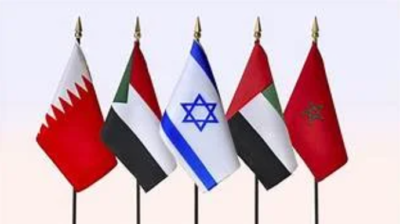 The Abraham Accords were initially presented as a simple process of diplomatic normalization between Israel and several Arab countries. A few years later, they increasingly appear as one of the pillars of the new American geopolitical strategy in the Middle East and North Africa.
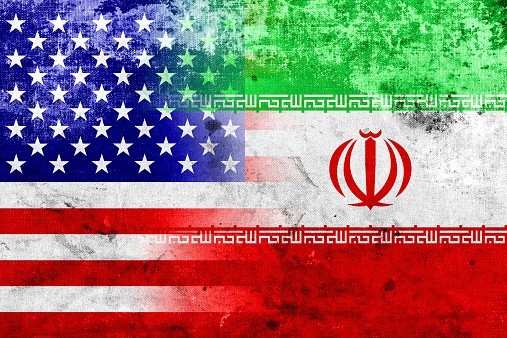
Donald Trump’s recent statements regarding Iran confirm this. The former US president now openly links regional stability and the de-escalation of tensions to the expansion of the Abraham Accords to new Arab states. This logic reveals an important change: alliances with Israel are gradually becoming a structuring element of the new regional order supported by Washington.
In this context, Western Sahara occupies a special place.
Morocco obtained American recognition of its sovereignty over Sahrawi territory in 2020 in exchange for the normalization of its relations with Israel. The decision marked a significant break with decades of official discourse based on United Nations resolutions and the principle of self-determination.
Since then, Rabat has considerably strengthened its cooperation with Israel in the security, military and technological fields. Western Sahara has thus become one of the first concrete examples of an international issue directly integrated into the geopolitical logic of the Abraham Accords.
For Washington, Morocco today represents an essential strategic partner in the Maghreb and on the African Atlantic coast. For Israel, Rabat also constitutes an important regional ally in a context marked by tensions with Iran and the restructuring of the Middle East.
The problem is that this development gradually tends to relegate international law itself to second place. The more the Abraham Accords become a central instrument of new regional alliances, the more certain historical issues – from Western Sahara to Palestine – risk being treated primarily from the angle of security and strategic interests.
This is precisely what gives this development today a much broader dimension than just the Sahrawi conflict.
The Abraham Accords no longer concern only regional diplomacy. They are now participating in an attempt to redefine the political balances of the Middle East and part of North Africa around new alliances supported by the United States.
And Western Sahara is already part of this new geopolitical reality.
Abraham Accords, Iran, Israel, Western Sahara, Trump