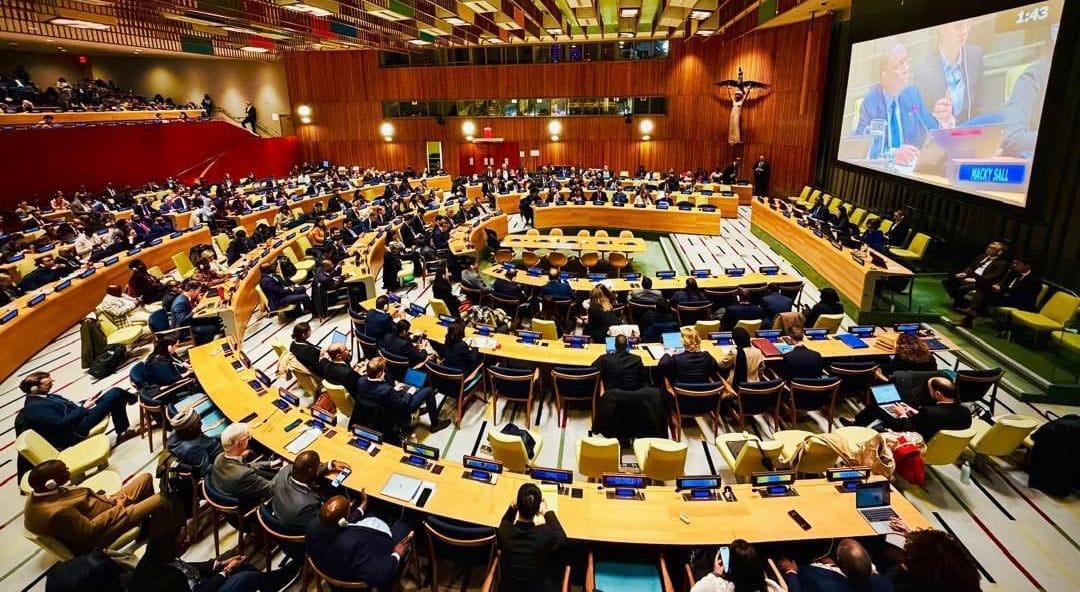
At a time when the United Nations increasingly resembles an organization paralyzed by crossed vetoes and the extreme polarization of the great powers, the profile of the next Secretary-General is of capital importance. In this complex quest for a head of global diplomacy, the candidacy of Macky Sall emerges with singular relevance.
However, it would be tempting, and profoundly simplistic, to label him as “the candidate of Africa.” The reality of his career outlines a completely different ambition: that of the synthetic candidate par excellence, capable of rising above the fray to unite an international community fragmented.
What characterizes the former Senegalese president on the world stage is above all a posture of strategic neutrality. In a fractured world, he has this rare advantage of being able to sit at the same table as the Americans, the Chinese and the Russians, being listened to by everyone. The facts speak for themselves. In the midst of the Russian-Ukrainian crisis, while he was president of the African Union, Macky Sall did not remain confined to the role of observer. He used this centrality to establish himself as the decisive co-promoter of the agreement on secure wheat transportation corridors, narrowly avoiding a devastating famine in the east of the African continent.
This ability to hear divergent positions to forge a consensus for action is the mark of a man who defends inclusive multilateralism. It is also this same diplomatic tenacity which made it possible, under his mandate, to obtain historic progress: the obtaining for Africa of a seat as a permanent member within the G20.
Observing his candidacy, we read the culmination of a great Senegalese diplomatic tradition, assumed and modernized. The man is a direct continuation of the founding fathers of the nation. He draws on the “integral universalism” of Léopold Sédar Senghor, borrowing this rigor and state pragmatism from Abdou Diouf. Macky Sall synthesizes this heritage to propose today a true inclusive universalism, a doctrine where each nation, small or large, finds its place in global governance. It also follows in the wake of Abdoulaye Wade, initiator of the large infrastructure policy which profoundly transformed and modernized the country under the presidency of Macky Sall.
A UN Secretary-General must first prove that he knows how to put out fires. In this area, the international experience of the former current president of ECOWAS speaks for him. Before claiming to appease the world, Senegal was able, under its leadership, to pacify and stabilize its own immediate neighborhood. Dakar was the driving force behind the return to constitutional order and democracy in Gambia, while playing an essential stabilizing role in Guinea-Bissau.
Today, the UN no longer needs yet another divisive bureaucrat, nor the standard-bearer labeled with a specific bloc. With his proven ability to speak to all capitals and his concrete experience in resolving crises, Macky Sall embodies this point of balance essential to putting multilateralism back on track.