
Cruise Ships Redefining Global Industrial Map
In 2024, 34.6 million passengers took a cruise, half of France’s population! The cruise industry is booming and surpassing pre-COVID levels.
Behind this growth is a well-oiled and relatively simple mechanism: more ships, larger ships, higher profits.
The global fleet has around 515 active ships, with a total capacity of nearly 700,000 beds, and this is far from over as between 2024 and 2028, 56 new cruise ships will enter service.
More than 21% of the ships now carry over 3,000 passengers, making gigantism the norm rather than the exception.
Fortunately, the Chantiers de l’Atlantique in Saint-Nazaire are among the few places in the world capable of producing these massive ships!
A Booming Cruise Ship Industry Despite Adversities
Gigantism: Maximizing Floating Cities’ Profitability
Modern cruise ships are not just boats, they are compact cities on water. Restaurants, theaters, water parks, themed districts – everything is designed to keep passengers onboard and maximize every square meter.
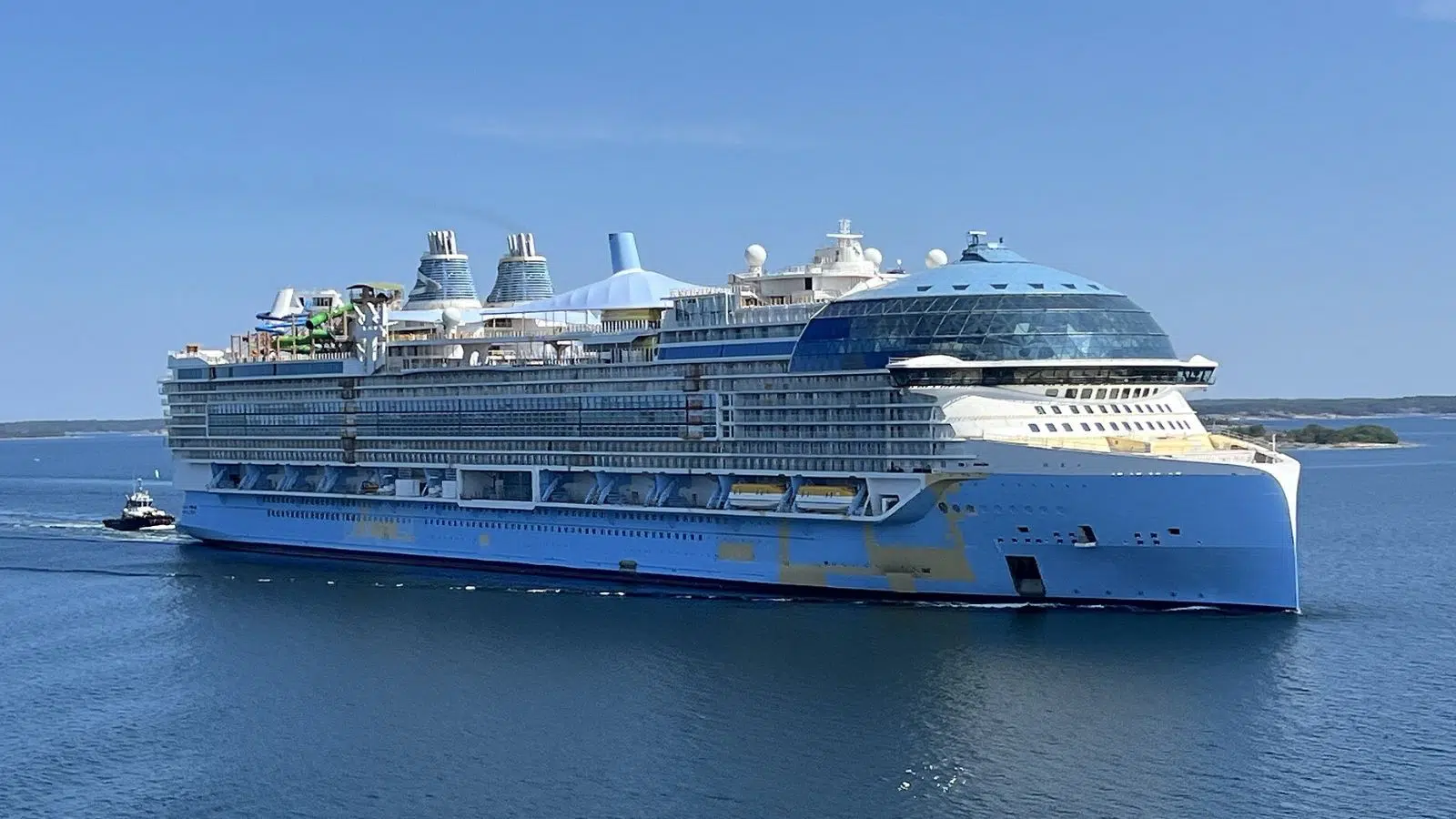
Ships like the Icon of the Seas weigh 250,000 gross tons (25 times the Eiffel Tower) and stretch over 365 meters in length. Onboard, there are thousands of passengers served by a crew that sometimes exceeds 2,000 people.
Why go so big? Because the economic equation is straightforward:
- More passengers = more revenue per trip
- Fixed costs spread over a larger number
- A differentiated experience hard to replicate
The cruise ship becomes a product in itself, almost a destination.
World’s Top 10 Dominated by The Royal Caribbean
Eight out of ten ships belong to The Royal Caribbean. It’s no longer domination, it’s an empire crushing everything in its path.
Established in 1968 and based in Miami, the company now operates 26 ships, all named ending with “of the Seas.” Its fleet tells the story of modern gigantism, from the Grandeur of the Seas launched in 1996 to the Icon of the Seas put into service in 2024. The flagship of Royal Caribbean has more than tripled in tonnage in less than thirty years. A lineup of new ships is underway, with Legend of the Seas expected in 2026, Hero of the Seas in 2027, and a fifth Icon in 2028 whose name is yet to be revealed.
Behind, MSC Cruises is trying to keep up with slightly smaller but technologically advanced ships.
Two Cruise Ships Ordered in Finland
Royal Caribbean has confirmed the order of two new Icon-class cruise ships from Meyer Turku, with deliveries scheduled for 2029 and 2030. The framework agreement also secures production slots for Royal Caribbean until 2036. In other words, the company is not only expanding its fleet but also reserving the rarest industrial capacities in the world.
The Icon program becomes the backbone of its strategy, with several units already in service or under construction, each representing one of Europe’s most massive industrial projects. For the Finnish shipyard, this is far from insignificant – about 13,000 jobs depend directly or indirectly on this activity, injecting over 1 billion euros into the local economy each year.
The Real Lock: European Shipyards
The global production of these “sea giants” is concentrated among three major players who build nearly 90% of cruise ships.
Building a 200,000-ton ship involves thousands of engineers, ultra-complex logistics chains, and rare infrastructures, and only a few shipyards in Europe truly master this, with limited production rates that sometimes explain why orders are planned over more than ten years.
Chantiers de l’Atlantique in Full Swing
Chantiers de l’Atlantique is also benefiting from the cruise industry’s enthusiasm and has a full order book well beyond 2030. Several major programs are underway: four World Class ships for MSC Cruises between 2029 and 2031, two Discovery-class ships for Royal Caribbean until 2032, and four fueling vessels for the French Navy by 2029. Additionally, the shipyard is already working on the design phase of the future next-generation aircraft carrier (PANG).
An Environmental Challenge
Despite the glamour of onboard pools and illuminated decks, the ecological impact is far less appealing. In Europe alone, 214 cruise ships emitted around 7.4 million tons of CO2 in 2023.
Some giants exceed 95,000 tons of CO2 per year, equivalent to the emissions of a city with 20,000 residents. Faced with this pressure, operators are turning to LNG, shore electrification, and alternative fuels.
However, even these solutions have their limits, especially methane leaks, with a warming potential 80 times higher than CO2. The industry now aims for net-zero emissions by 2050, but a question remains: can we truly reconcile ever-larger ships with a significant reduction in their environmental footprint?
Sources:
- DIRM Mediterranean: Monitoring Cruise Activity in 2024
- Transport & Environment: The Largest Cruise Ships Have Doubled in Size Since 2000
- Southampton Cruise Centre: Top 10 Biggest Cruise Ships for 2026
- Géoconfluences: Cruises, Cruise Tourism
- Ouest-France: More and More Cruises Worldwide
Featured Image:
Aerial view of Chantiers de l’Atlantique in Saint-Nazaire, one of the world’s largest sites for civilian shipbuilding.
Credit: Jibi44 (September 16, 2018, Personal work)



/2026/06/09/6a27b1a1baf76104937226.jpg "\"This is today’s war\" : in Ukraine, ground robots outline the vision of a war without soldiers")


