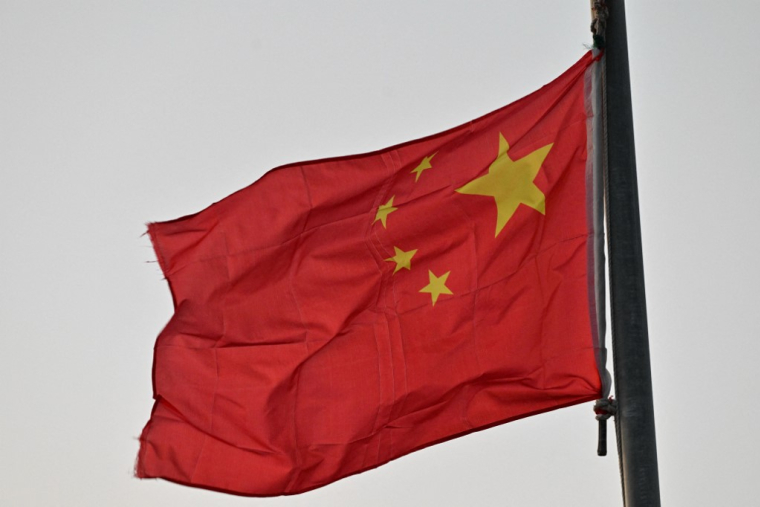
(AFP / ADEK BERRY)
China maintained vigorous international trade in May, with results better than expected despite the war in the Middle East, with its exports to the United States even showing a significant boost in the wake of Donald Trump’s visit.
Exports, the engine of China’s growth, increased by 19.4% year-on-year in May and imports jumped 27.4% over the same period, the Customs administration said.
These data are better than the forecasts of a panel of economists interviewed by Bloomberg, who expected an increase of 15% for exports and 26% for imports.
Exports to the United States jumped 35.4% over one year: they totaled $39 billion in May, compared to $28.8 billion in the same month in 2025, in the midst of a battle over customs duties.
These figures are made public less than a month after the visit to China of the American president, who came to work to continue the relative relaxation observed since October 2025 by the two leading economic powers in the world after months of fierce trade war.
Chinese exports to the United States fell by 20% in 2025 due to customs duties and multiple mutual restrictions, while China recorded a record global trade surplus of nearly $1,200 billion.
A summit of Chinese and American leaders in October in South Korea made it possible to drastically reduce reciprocal punitive customs duties.
A new summit in May in Beijing continued the momentum. In the wake of Mr. Trump’s trip, the Chinese Ministry of Commerce indicated that Beijing and Washington had agreed to “discuss a framework agreement providing for reductions in reciprocal customs duties on products of equivalent value”, covering “30 billion dollars or more” on both sides. else.
“Stay vigilant”
Zhiwei Zhang, president of the consulting company Pinpoint Asset Management, noted the vitality of Chinese trade “despite global economic uncertainty and the appreciation of the renminbi” against most currencies against the backdrop of the crisis in the Middle East.
“This strong growth in exports testifies to the competitiveness of Chinese companies on the international market and helps to partly offset the weakness in domestic demand,” he wrote in a note.
However, he urges us to “remain vigilant in the face of the risk of a potential escalation of trade tensions between China and its main trading partners, such as Europe.”
The European Union is actively working to rebalance its trade relations with China. Protecting critical industries from Chinese competition is expected to be on the agenda of a summit of G7 heads of state in France and a summit of EU leaders in Brussels later this month.
The United States proposed at the beginning of June to impose additional customs duties on 60 economies, including China and the European Union (EU), which would insufficiently combat the importation of goods produced by forced labor.
Experts note that China currently appears to be better resisting the crisis in the Middle East than others. They expect exports to remain at a good level in the near future, supported by strong demand for semiconductors and green technologies.
But China is starting to suffer the backlash. Manufacturing activity remained stable in May after two months of growth, its growth being hampered by weak demand against a backdrop of soaring energy costs.
Dependence on international trade remains a factor of uncertainty for the Chinese economy with weak domestic demand, the persistence of the real estate crisis, the indebtedness of local authorities, excess production capacity, deflationary pressures and high youth unemployment.
/2022/12/02/638994d9d5adf_61168cfc8256bf7ea5ef3720-1.png "DIRECT. War in the Middle East: Tehran responds after American strikes on Iran by targeting American bases")

:quality(80)/outremer%2F2026%2F06%2F09%2F6a282a2e29ded424102029.jpg "Handball : Metz remporte la première ligue des champions de lhistoire du handball féminin français avec deux Ultramarines")