
US Defense Minister Pete Hegseth during the Shangri-La Dialogue in Singapore on May 30, 2026 (AFP / JAM STA ROSA)
The United States affirmed on Saturday that it had the means to return to war against Iran, after having assured that a peace agreement would only be possible if its “red lines” were respected.
US Defense Minister Pete Hegseth said the United States was “fully capable” of resuming hostilities against Iran “if necessary”.
“Our stocks are largely fit for purpose,” he told a defense forum in Singapore.
Tehran and Washington have been engaged for weeks in indirect discussions with a view to putting a lasting end to the war in the Middle East, but their outcome is uncertain, particularly after this week’s clashes, the most serious since the truce came into force on April 8.
“Iran must accept that they will never have a nuclear weapon,” Donald Trump wrote on Friday on his Truth Social network, after sources in Washington mentioned the day before a framework agreement providing for a 60-day extension of the ceasefire.
The US president also called for Iran’s stockpile of highly enriched uranium to be “DESTROYED”.
The United States and Israel, whose joint attack on Iran on February 28 triggered the war, accuse Tehran of wanting to acquire atomic weapons, which it refutes.
– “Red lines” –
Iran, for its part, insists on tackling the nuclear issue later, after signing the memorandum of understanding currently under discussion.
Another point of dispute: the Strait of Hormuz, a strategic passage for global hydrocarbon trade, almost blocked by Iran since the start of the war.
It “must be opened immediately” and Tehran must commit to demining it, Mr. Trump said on Friday, whose country is imposing a blockade on Iranian ports.
The American military command for the Middle East (Centcom) said on Saturday that it had stopped a cargo ship sailing under the Gambian flag and trying to reach an Iranian port, using a missile fired at its engine room.
And according to contacts with Iranian sailors cited by the Tasnim news agency, the United States continues to prevent Iranian commercial ships from circulating.
Friday evening, a White House official told AFP that “President Trump will only sign an agreement if it is good for America and his red lines are met.”
– “Special Situation” of Ormuz –
Reacting to Mr. Trump’s remarks, the spokesperson for the Iranian Ministry of Foreign Affairs, Esmaïl Baghaï, indicated that “exchanges were continuing” with the United States.
He also defended “the special situation” of the Strait of Hormuz, due to its location in the territorial waters of Iran and Oman.
As a result, only Iran and Oman are “authorized to decide” on its management, Iranian MP Alireza Salimi told the Isna news agency.
In Tehran, residents disillusionedly follow these exchanges. “Both sides are making comments intended to satisfy their supporters. It is difficult to know who is telling the truth,” comments Ali, a 49-year-old Iranian from Tonekabon, on the Caspian Sea.
The war has left thousands dead, and is shaking the world economy by driving up oil prices.
The International Monetary Fund (IMF) and the World Bank (WB) warned on Friday of a risk of an oil shortage this summer if maritime traffic in the Gulf does not quickly return to normal.
– “Collective punishment” –
Among its demands from Washington, Tehran is asking for the release of billions of dollars in Iranian assets frozen by the United States.
Iranian state television said on Saturday, citing an unofficial transcription of the text, that the memorandum of understanding discussed provides for the release within 60 days of 12 billion dollars.
Iran is also demanding an end to the fighting in Lebanon where its ally, Hezbollah, and Israel have been clashing since March 2, despite a truce in force since April 17, but not respected.
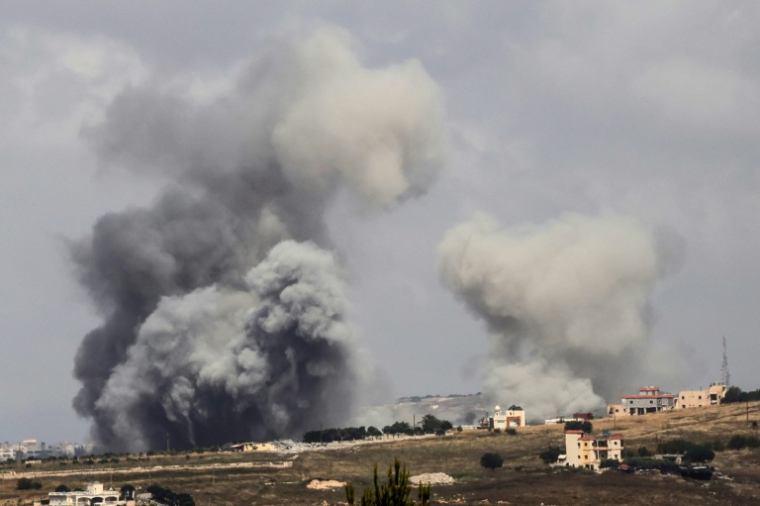
Photo taken from the Marjayoun region in southern Lebanon shows smoke rising after an Israeli airstrike on the village of Kfar Tibnit on May 30, 2026 (AFP/-)
The Israeli army, which is advancing deep into southern Lebanon, has intensified its strikes in recent days in its neighbor, where it says it is targeting Hezbollah, which fires on Israeli positions in Lebanon and in the neighboring country.
Accusing Israel of pursuing a “policy of scorched earth and collective punishment”, which “will bring neither security nor stability”, the Lebanese Prime Minister, Nawaf Salam, however defended on Saturday, in a televised speech, the negotiations with Israel, seeing “the least expensive path” for Lebanon.
Military officials from the two countries met on Friday in Washington, as a prelude, according to the Pentagon, to a new session of political negotiations, on June 2 and 3, with a view to a security agreement. Hezbollah is fiercely opposed to these talks.
According to the latest official report, Israeli strikes have killed 3,371 people in Lebanon since the start of the war.
/2026/06/10/6a29bb5ed6751787079179.jpg "Greeted by jubilant crowds in Barcelona, Pope Leo XIV says Christians cannot \"promote war\"")