As Beijing accelerates its space race, the United States is worried about seeing its supremacy challenged. So much so that a recent report from the Mitchell Institute for Aerospace Studies estimates that the US military should prepare to deploy troops to space stations and, ultimately, to the Moon, in order to protect its strategic interests.
These are images that we thought were reserved for science fiction – and we think among others of the excellent For All Mankind series, but which could soon become very real. For the Mitchell Institute for Aerospace Studies, closely linked to the American military world, via the Air & Space Forces Association (AFA), the “Space Force” of the American army should prepare to deploy troops on active duty on the Moon and in space stations, in order to counter China’s growing ambitions in the space and military domain.
In its latest report, the American study group believes that it is becoming essential to launch a real human spaceflight program with a strategic vocation, while redefining the federal directives governing these missions. The objective: to compete with Chinese advances, in particular Beijing’s stated ambition to send taikonauts to the Moon by 2030.
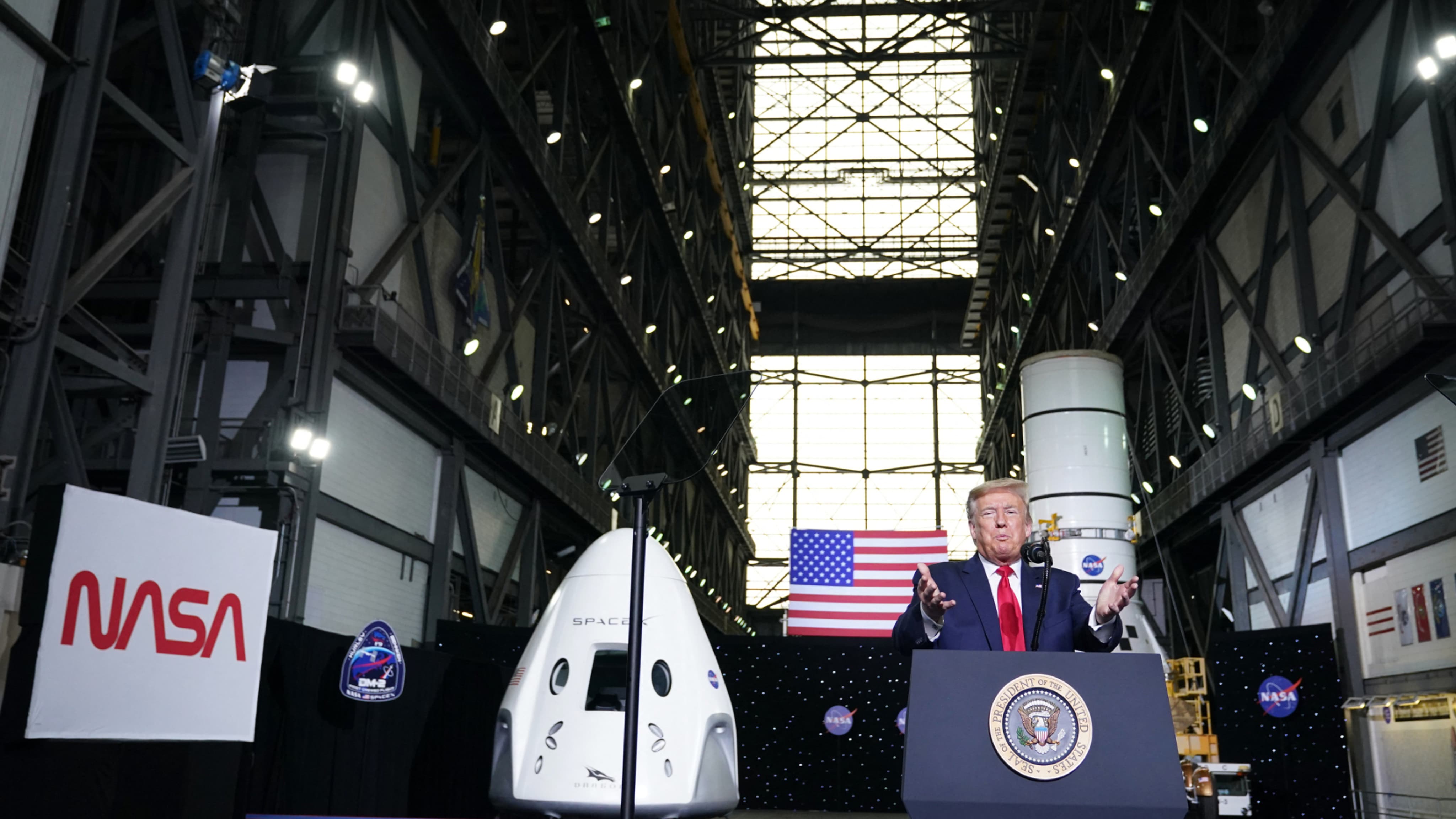
Because China is accelerating. Just this weekend, three astronauts blasted off from the Gobi Desert bound for the Tiangong space station, as part of the Shenzhou-23 mission. One of them must also remain in orbit for a year, illustrating the rapid rise in power of the Chinese space program.
A technological and legal headache?
This 22-page report advocates blurring the traditional boundary between space exploration and militarized operations, by encouraging federal authorities to integrate “space and lunar habitation”, as well as “combat capabilities and a national defense approach in the development of spaceflight inhabited”.
Space, however, is not a territory that can be conquered so easily… the Moon even less so. The deployment of troops, even limited, in current conditions is more of a technological and human puzzle than a simple battle plan.
Added to this is a binding legal framework: the Space Treaty of 1967, to which both the United States and China are parties, imposes “peaceful” use of the Moon and prohibits the establishment of military bases as well as armed maneuvers. The treaty also provides for the prohibition of placing nuclear weapons or any other weapon of mass destruction in orbit around the Earth, to install them on the Moon or any other celestial body, as well as to store them in space.
Possible $71 billion budget
Kyle Pumroy, retired colonel and author of the report, however, calls for reconsidering these standards in the face of new strategic realities. “So I don’t think that sending soldiers to the Moon constitutes a violation, but the question of whether or not we violate the Outer Space Treaty is important,” proclaims the former soldier.
“However, the most urgent thing is to modernize this treaty so that it recognizes the economic potential of the Moon, the exploitation of its resources, in particular its ice, and that it allows the use of the Moon as a launch base to reach Mars and other destinations.”
Whether or not it will one day send soldiers to the Moon, the United States Space Force (USSF) continues its rise in power. Created on December 20, 2019, this branch of the American armed forces dedicated to military operations in space has seen its resources significantly increase.
Its proposed budget for 2027 would reach around $71 billion, more than double that adopted for 2026. A dynamic welcomed by Donald Trump, who claims the creation of this force. During his State of the Union address, the US president emphasized the strategic role of the USFF, describing it as “a formidable fighting force”.