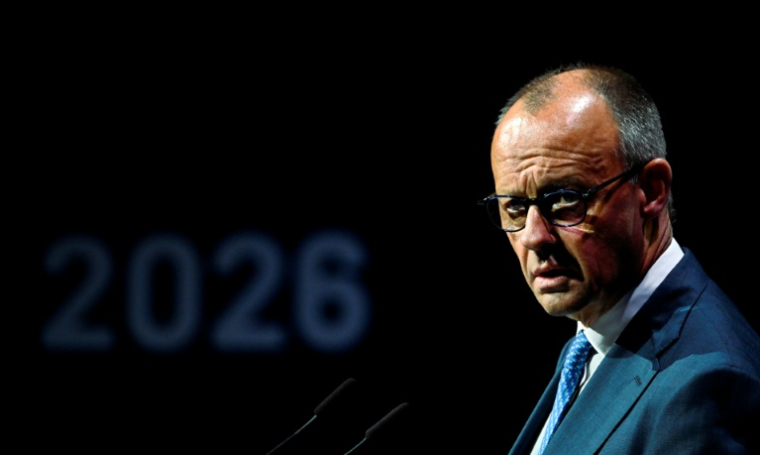
German Chancellor Friedrich Merz in Berlin on May 20, 2026 (AFP / Tobias SCHWARZ)
Germany, Europe’s largest economy, experienced robust growth in activity at the start of the year, but the negative effects of the war in Iran should weigh on the current quarter, even if bosses and consumers seem a little more confident.
Between January and March, the gross domestic product (GDP) increased by 0.3%, the statistics institute Destatis said in a press release on Friday, confirming a first estimate from the end of April.
Germany has thus, for once, supported the growth of the euro zone, whose GDP increased by only 0.1% over the same period compared to the previous quarter, according to Eurostat, while that of France stagnated.
“After the slight growth recorded at the end of 2025, the German economy has also started the year 2026 in a positive way,” comments Ruth Brand, president of Destatis, in a press release.
Rising exports have “supported economic activity”, she adds.
The manufacturing industry, which is experiencing a deep crisis, rebounded by 0.7% over the quarter, driven in particular by the automobile sector and transport equipment, according to the statistical institute.
Public spending has also increased, while private household consumption has not taken off, in a climate of high uncertainty.
“The composition of growth, combined with the obvious consequences of the war in the Middle East, new uncertainty and rising energy prices, does not speak in favor of the short-term outlook,” comments Carsten Brzeski, economist at ING.
– “Situation fragile” –
Two indicators published on Friday, however, seem to bring a slight wind of optimism.
The morale of German entrepreneurs recovered slightly in May for the first time since the start of the war in the Middle East, defying the expectations of analysts surveyed by Factset, in particular because the short-term outlook has improved, according to the IFO barometer published Friday.
Companies’ order books remain high, which “would constitute a good basis for a recovery if, for example, energy prices fell or if the general climate improved”, comments Jens-Oliver Niklasch, at LBBW.
This is not yet the case, and if the German economy is “stabilizing for the moment”, “the situation remains fragile”, warns Clemens Fuest, president of the IFO.
Furthermore, consumer morale should improve in June, after months of decline, a sign that the desire to buy is returning, according to the GfK barometer published Friday.
The effects of the conflict in the Middle East, however, continue to “weigh on the general trend and remain visible in consumer morale”, nuance Rolf Bürkl, expert at GfK, in a press release.
On Thursday, the Federal Bank of Germany said it expected stagnation in the German economy in the current quarter, while the European Commission halved its forecast for German growth for the year, to 0.6%, falling more or less to the level expected by Berlin (0.5%).
At its lowest point in public opinion after a year in office, the government of Chancellor Friedrich Merz has promised to accelerate structural reforms, including unpopular ones, to support the sluggish economy for three years.