– Advertisement –
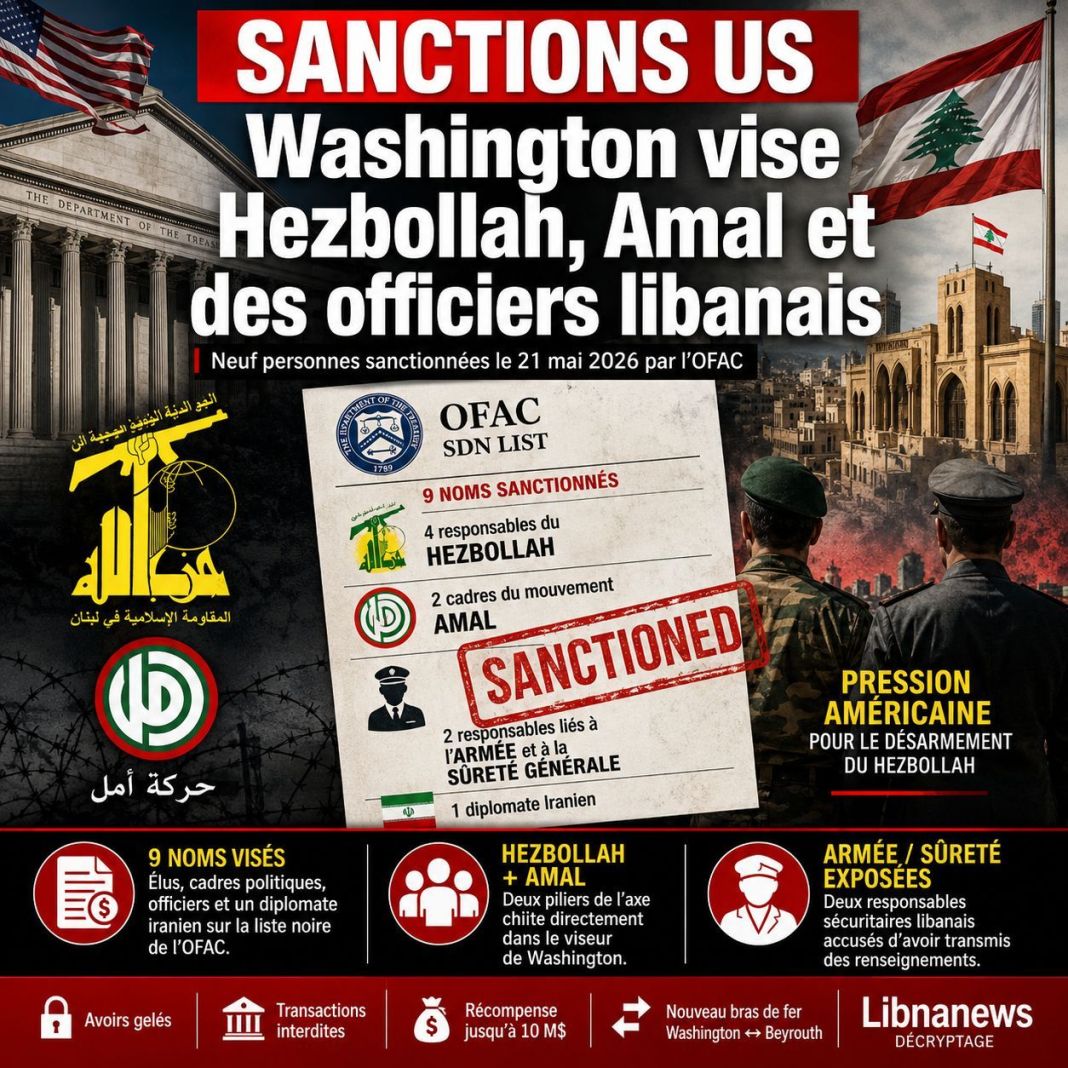
A new set of US sanctions places Hezbollah, the Amal movement and officials linked to the Lebanese army at the center of a standoff between Washington and Beirut. The United States has placed nine people on the OFAC blacklist, accusing them of helping Hezbollah preserve its influence in institutions, hindering its disarmament and hampering ongoing diplomatic efforts. The decision, announced on May 21, 2026, targets deputies, political executives, two Amalist officials, an Iranian diplomat and two Lebanese security officials.
The measure is first striking by its scope. It does not only concern Hezbollah’s financial or military networks, already targeted on numerous occasions by Washington. It also affects elected officials, an allied movement represented at the heart of the Lebanese political system and officials attached to security institutions. The United States presents this approach as a response to what it describes as an infiltration of on the contrary, the parties concerned see it as political pressure intended to impose the disarmament of the movement under American and Israeli constraint.
The case comes within a sensitive timetable. Military and security discussions must continue in Washington around the southern front, the ceasefire, the Israeli withdrawal and the place of Hezbollah in the Lebanese equation. Israel demands guarantees on the disarmament of the party. Beirut calls for an end to strikes, an end to incursions and the return of Lebanese authority to border areas. US sanctions therefore add financial and political pressure to a file already marked by war, population displacements and the fragility of institutions.
US sanctions: names linked to Hezbollah
The US Treasury has designated Mohamed Abdel-Mottaleb Fanich, also known as Mohammad Fneich. A former minister and former deputy, he is presented by Washington as the head of the executive council of Hezbollah. The American authorities accuse him of participating in the administrative and institutional reorganization of the movement, with the aim of maintaining its armed presence in Lebanon. His career embodies the link between Hezbollah’s partisan structure, its political establishment and its internal apparatus. He was elected to Parliament in 1992 in the Loyalty to the Resistance bloc, before occupying the Youth and Sports portfolio.
The list also includes Hassan Nizammeddine Fadlallah, Hezbollah MP since 2005. Washington recalls his past role in media close to the party, notably Al-Nour and Al-Manar, already sanctioned by the United States. The American authorities mainly accuse him of defending the political line of the movement and opposing calls for disarmament. In the current context, his name has particular significance. A few days before the announcement, he had accused Washington and Israel of seeking to use the Lebanese army against Hezbollah. This position is in line with the party’s discourse, which refuses to dissociate its weapons from Israeli strikes and the territories still occupied.
Ibrahim al-Moussawi is also among those targeted. Head of Hezbollah’s media commission and deputy, he represents the party in the political and communications battle. The American Treasury presents him as a long-time official, responsible for publicly defending the movement’s line. Its registration illustrates Washington’s desire to target not only operational actors, but also those who carry Hezbollah’s political narrative. This logic is part of a broader strategy: reducing the margin of elected officials and executives who defend the maintenance of an autonomous military structure vis-à-vis the state.
The fourth designated Hezbollah official is Hussein al-Hajj Hassan. An MP since 1996 and a former minister, he is one of the party’s best-known faces in Parliament. The United States accuses him of being a key figure in opposition to disarmament. His reaction was immediate. In a statement relayed by the Arab press, he denounced an attack on the sovereignty of Lebanon, in particular because the sanctions also affect officials linked to the army and General Security. He claimed that Washington was seeking to intimidate the Lebanese military delegation expected at the Washington discussions, and presented these sanctions as an “honor” for those targeted.
Amal directly implicated
The US sanctions then target two executives of the Amal movement, a political ally of Hezbollah and a group led by the President of Parliament, Nabih Berry. Ahmad Asaad Baalbaki is presented by Washington as Amal’s security director. American authorities accuse him of having coordinated shows of force with Hezbollah officials in order to intimidate political adversaries in Lebanon. This accusation places Amal in a security register, and no longer just a political one. It exposes a formation which has played a role of institutional mediation for decades, while remaining linked to the Shiite axis dominated by the Amal-Hezbollah tandem.
Ali Ahmad Safawi, also designated by OFAC, is described as the commander of an Amalist structure in southern Lebanon. Washington claims that it coordinated its action with Hezbollah and took instructions from the party in operations against Israel. The United States also accuses him of having led Amalist forces in joint operations with Hezbollah. These accusations are serious. They suggest that Washington considers part of Amal’s security apparatus as an active partner of Hezbollah, and not as a separate actor. For Amal, this reading amounts to contesting its national role and its anchoring in institutions.
The Amal movement rejected the sanctions against Ahmad Baalbaki and Ali Safawi. In a press release, he described them as unacceptable and unjustified. The movement believed that they were primarily aimed at Amal himself, his political role, his attachment to national causes and the protection of the state and institutions. This reaction seeks to shift the debate. Amal is not only responding to accusations of security cooperation with Hezbollah. He presents the American measure as an attack against its political legitimacy and against a major component of the Lebanese institutional balance.
The Lebanese army and General Security exposed
The most sensitive aspect concerns the two Lebanese security officials. Khattar Nasser Eldin, brigadier general and head of a department of General Security, is targeted for having, according to Washington, shared important information with Hezbollah during the ongoing conflict. The OFAC attaches it to the General Directorate of General Security, a central institution in the control of borders, administrative security files and internal balances. The fact that a current official is sanctioned gives the decision a different significance. It calls into question the capacity of the State to control its own intelligence circuits.
Colonel Samir Hamadi, also mentioned under the spelling Samer Hamadi, is presented as head of the Dahiyeh branch within the intelligence directorate of the Lebanese army. Washington also accuses him of having provided information to Hezbollah. Geographic accuracy is important. The southern suburbs of Beirut remain the party’s main political and security stronghold. The accusation of a military official assigned to this area fuels American suspicions of porosity between certain official structures and Hezbollah. It also places the Lebanese army in a delicate position, as it depends on significant international support and must preserve its national image.
No detailed institutional reaction from the Lebanese army or General Security was clearly published in the elements available at the time of writing. This caution can be explained by the sensitivity of the file. Publicly defending the sanctioned officials would open a direct confrontation with Washington. Disavowing them too quickly could, conversely, cause internal tensions and fuel the idea of foreign pressure on institutions. The relative silence of the security authorities shows the difficulty of the moment. The army must remain a central actor in the return of the state to the south, without appearing as an auxiliary of an American or Israeli strategy.
The Iranian diplomat in the same list
Mohammad Reza Sheibani completes the list. An Iranian diplomat and designated Iranian ambassador to Lebanon, he was declared persona non grata by the Lebanese Ministry of Foreign Affairs after his approval was withdrawn. Washington accuses him of being linked to Iranian support for Hezbollah. His case adds a regional dimension to the decision. The United States is not only targeting Lebanese actors. They also recall that Hezbollah remains, in their eyes, an organization supported by Iran and inserted into a broader regional strategy. In the current sequence, this signal is addressed as much to Tehran as to Beirut.
Financial pressure with political significance
The legal consequences are classic in the American sanctions regime. The property and interests of the persons concerned who are in the United States or under the control of American persons are frozen. Entities owned 50% or more by these people are also blocked. Transactions with them are prohibited for U.S. nationals and entities unless specifically authorized. The effects may, however, extend beyond American territory. Foreign banks, wire companies and financial intermediaries often avoid dealing with individuals on the SDN list for fear of exposure to secondary sanctions.
The State Department also reactivated the financial dimension of the file. He recalled that a reward of up to $10 million could be paid for information enabling the disruption of Hezbollah’s financial mechanisms. This component complements political and security targeting. Washington wants to isolate the party on several fronts: its elected officials, its allies, its presumed institutional relays and its financing circuits. The message is designed to produce a deterrent effect. It targets those named, but also anyone the United States considers to be potential facilitators.
The reactions of Hezbollah and Amal
Hezbollah denounced the sanctions as an attempt at intimidation. In its reaction, the party affirmed that the decision would have no effect on its strategy or its political positions. He accuses Washington of supporting the Israeli offensive and of seeking to obtain through financial pressure what Israel would not have obtained through military force. The movement presents the people targeted as leaders committed to the defense of Lebanon. He also insists that disarmament cannot be discussed as long as Israeli strikes continue and violations of sovereignty do not stop.
This line responds to the American position, which demands the state’s monopoly on armed force. Washington believes that a stable and sovereign Lebanon requires the complete disarmament of Hezbollah and the reestablishment of the government’s exclusive authority over security issues. Hezbollah rejects this approach, which it considers dictated by Israeli interests. The disagreement is therefore not only about a sanction. It concerns the very definition of sovereignty. For the United States, it goes through the state and the army. For Hezbollah, it also involves armed resistance as long as Israel remains a direct threat.
The American decision may also complicate the role of Nabih Berry. The President of Parliament remains one of the few officials capable of maintaining channels with Hezbollah, Amal, the executive and foreign actors. By targeting two Amal officials, Washington indirectly affects a space for mediation. The movement has been an obligatory interlocutor during several Lebanese crises, including on issues linked to the south. Increased tension with Amal could make any internal discussion on security, army deployment and guarantees demanded by foreign powers more difficult.
Beirut faces a reduced margin
For the Lebanese government, the main challenge is to avoid a double loss of control. On the one hand, it must convince its Western partners that it can restore state authority and prevent any autonomous armed action. On the other hand, it must avoid a brutal internal confrontation with Hezbollah and Amal, whose political and social base remains strong. US sanctions accentuate this constraint. They push the executive to clarify its position, but also reduce its room for maneuver. Any decision on disarmament, control of the south or security reform now risks being read through the prism of American pressure.
The immediate scope of the sanctions will depend on the actual assets of the targeted individuals, their banking relationships and their international exposure. But their political impact is already visible. They name the actors that Washington considers to be obstacles to peace and disarmament. They isolate Hezbollah parliamentary officials, implicate Amal, target an Iranian diplomat and shed harsh light on two Lebanese security officials. They therefore transform a financial list into an instrument of diplomatic pressure. The next meeting will be played out in the military discussions expected in Washington and in the way in which Beirut will protect, or reorganize, its security decision-making circuits.
– Advertisement –