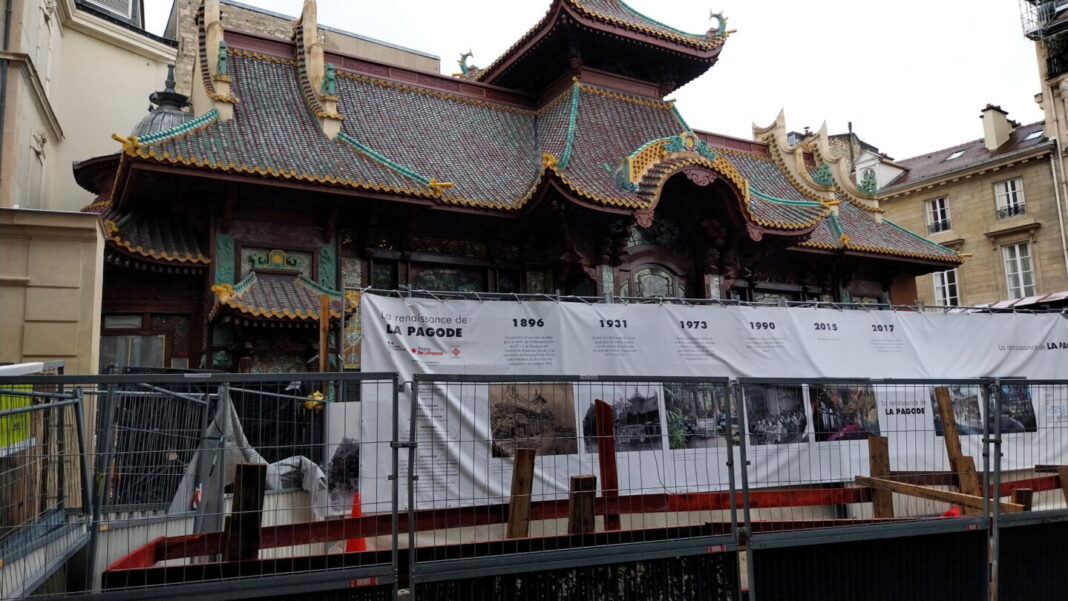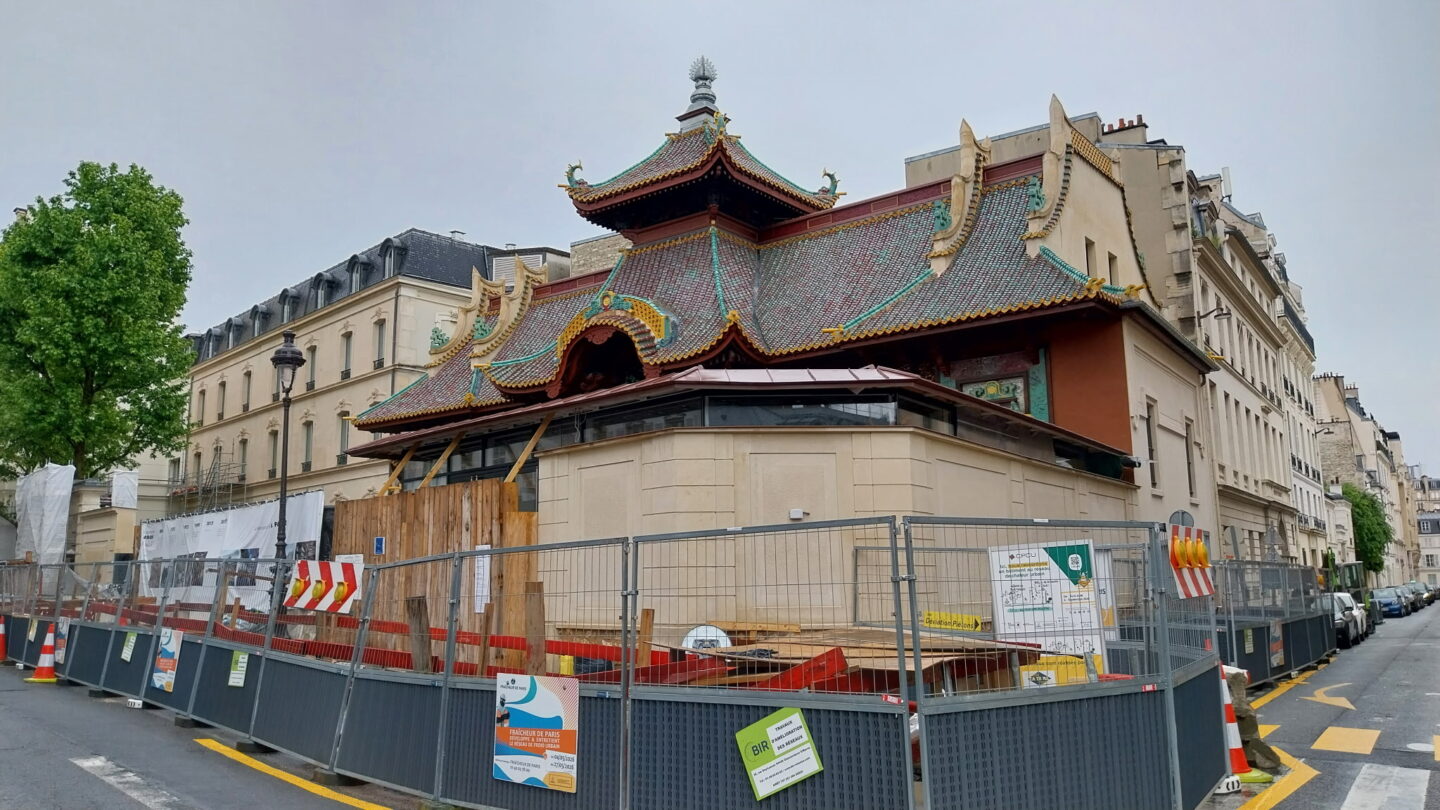
Located at 57 bis rue de Babylone, at the corner of rue Monsieur, in the 7th arrondissement of Paris, the La Pagode cinema is the subject of a huge restoration and extension project. The reopening, once hoped for in 2025, now seems postponed. In the meantime, the computer-generated images from its future projection rooms maintain impatience around this unique place, a spectacular vestige of Parisian Japonism and a mythical temple of arthouse cinema.
Built in 1896 by the architect Alexandre Marcel, La Pagode is one of the most unique witnesses of Japonism which fascinated Europe at the end of the 19th century. Hidden behind the elegant facades of the 7th arrondissement, near the Bon Marché, the Rodin Museum and the private mansions of Rue de Babylone, the building seems to emerge from another world. Raised roof, crafted wood, exotic decor, enclosed garden, Japanese silhouettes. Paris has long hosted one of its Asian dreams there.
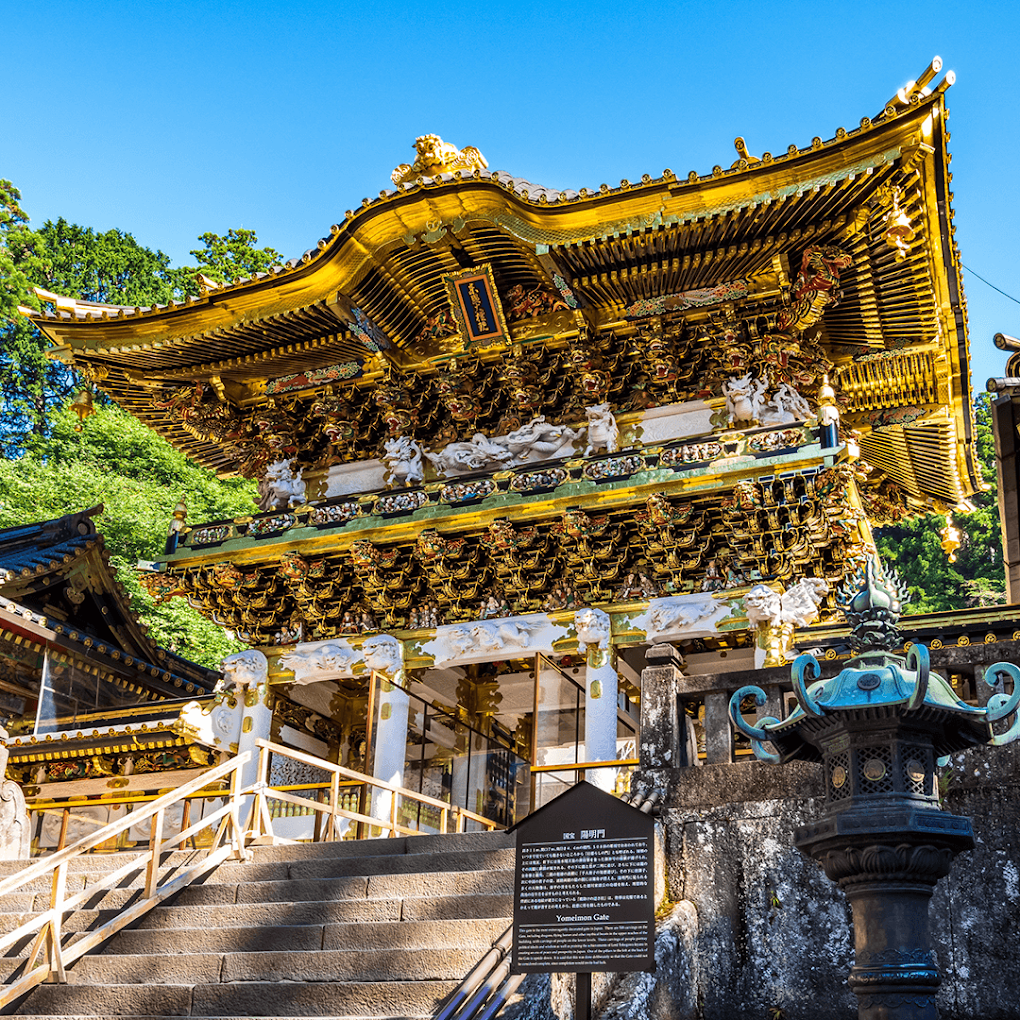
The architect Alexandre Marcel was particularly inspired by the Tōshō-gō sanctuary in Nikkō, Japan, a center of Japanese sacred architecture from the 17th century. In Belle Époque Paris, the Far East was as much an imagination as a style. We collect prints, screens, lacquers, ceramics. Artists, decorators, architects and the upper class are passionate about this recomposed elsewhere. The Pagoda was born from this fervor.
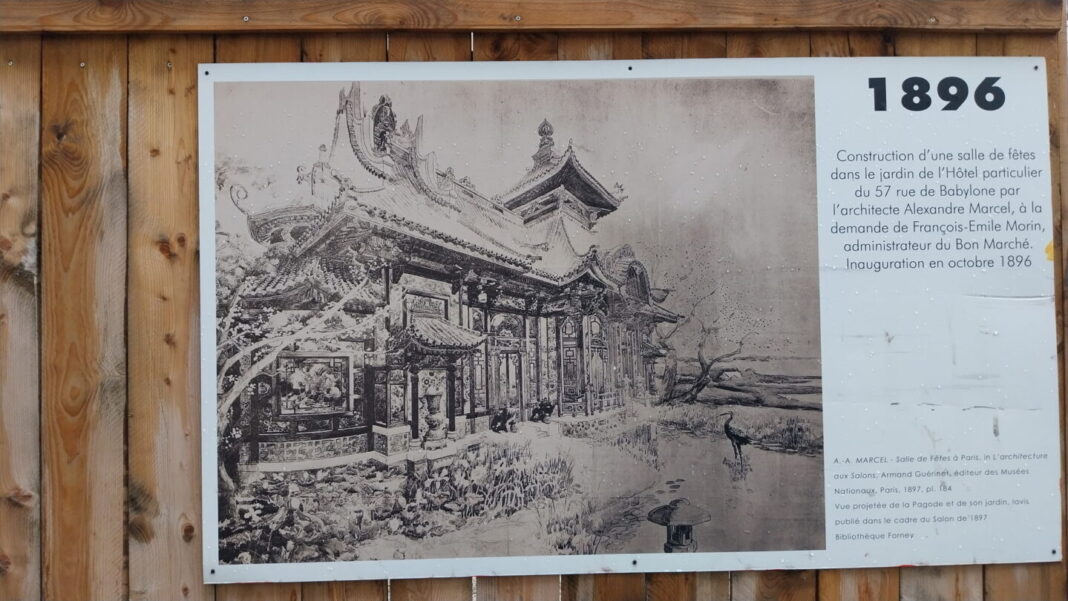
Tradition reports that François-Émile Morin, one of the directors of Le Bon Marché, commissioned this pavilion for his wife, Amélie Suzanne Kelsen, a great lover of Asian art. The Pagoda was not yet a cinema, but a sumptuous party hall. Receptions, dinners and social evenings were held there. Decors and elements from Asia participated in this refined staging, both intimate and theatrical.
The story adds a touch of the novel to this already romantic architecture. Shortly after the inauguration, the wife of François-Émile Morin left her husband for another man. The gift of love then becomes a backdrop of abandonment, then a place of celebration, before gradually falling asleep. The Pagoda closed as a reception hall in 1927. Four years later, in 1931, it was reborn in another form. It becomes a cinema.
This second life will make its legend. The Pagoda is becoming one of the most endearing places for Parisian cinema lovers. People come here for its architecture, its garden, its atmosphere, but also for its programming. The place accompanies the rise of auteur cinema, hosts demanding works, films in original version, filmmakers who have reached adulthood. Luis Buñuel, Jean Renoir, Jean Cocteau, then François Truffaut, Claude Chabrol, Jean-Luc Godard or Éric Rohmer find there a setting to measure up to their modernity.
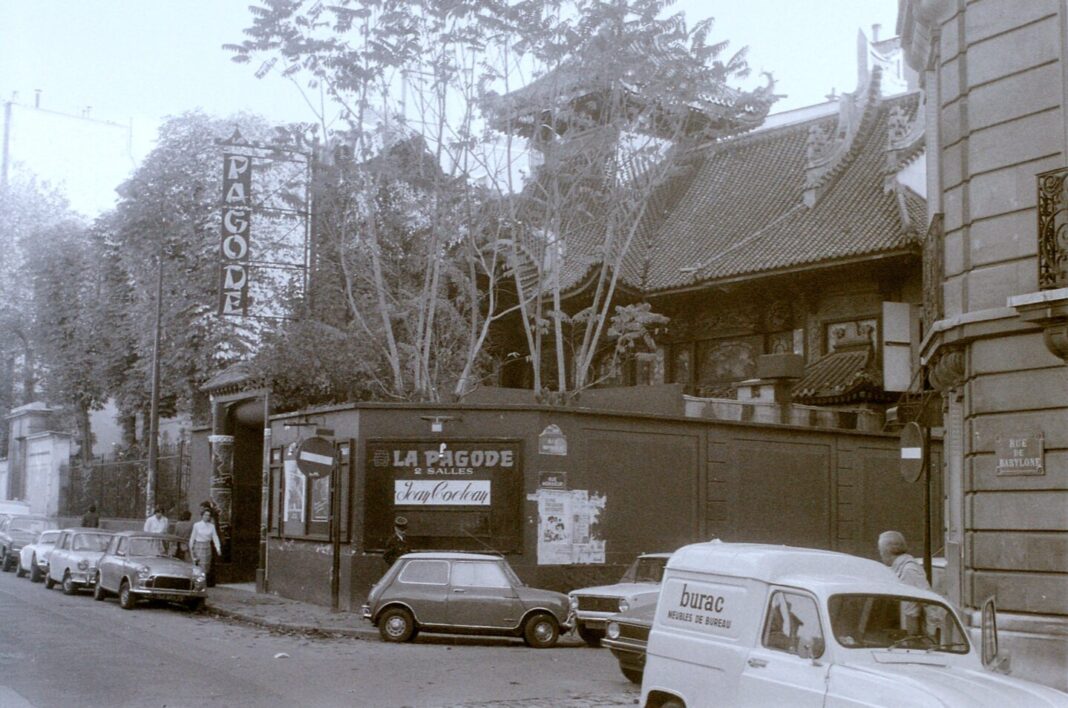
In the 1960s and 1970s, La Pagode fully belonged to the mythology of cinema-loving Paris. People come here as much to see a film as to enter a world. The Japanese room, the woodwork, the garden, the tea room make up a rare experience. The place has something of a refuge, of a secret shared by generations of spectators. In Paris, few cinemas have so blended the pleasure of the place and that of the screen.
But the decades pass and the building gets tired. Cinema is experiencing several periods of uncertainty, conflicts and closures. After difficult years, La Pagode closed its doors in November 2015. Many feared that this fragile monument of Parisian cinema would disappear definitively from the cultural landscape.
The purchase of the place in 2017 by American businessman Charles S. Cohen revives hope. Producer, distributor and exhibitor, founder of Cohen Media Group, Charles S. Cohen presents himself as a lover of French cinema and cinematic heritage. His project is ambitious. It is not only a question of saving the Pagoda, but of restoring it, expanding it and transforming it into a contemporary cultural facility, without stripping it of its identity.

The restoration is entrusted to the Loci Anima agency of Françoise Raynaud and to Pierre-Antoine Gatier, chief architect of historic monuments. The project is delicate, because La Pagode is not a simple old cinema. Its facades, its roofs, its large Japanese room and its garden are part of an extremely sensitive heritage ensemble. Restoring La Pagoda means working on a rare monument, but also adapting it to contemporary uses of projection, reception, accessibility, comfort and security.
The project provides for a profound restructuring. The Pagoda must go from two to four projection rooms, thanks to the creation of two additional rooms in the basement. The whole must offer around 400 to 450 places depending on the presentations of the project, while retaining the art house vocation of the place. The ÃŽle-de-France Region indicates that the operation also aims to modernize insulation, improve energy consumption and create a landscaped green space.
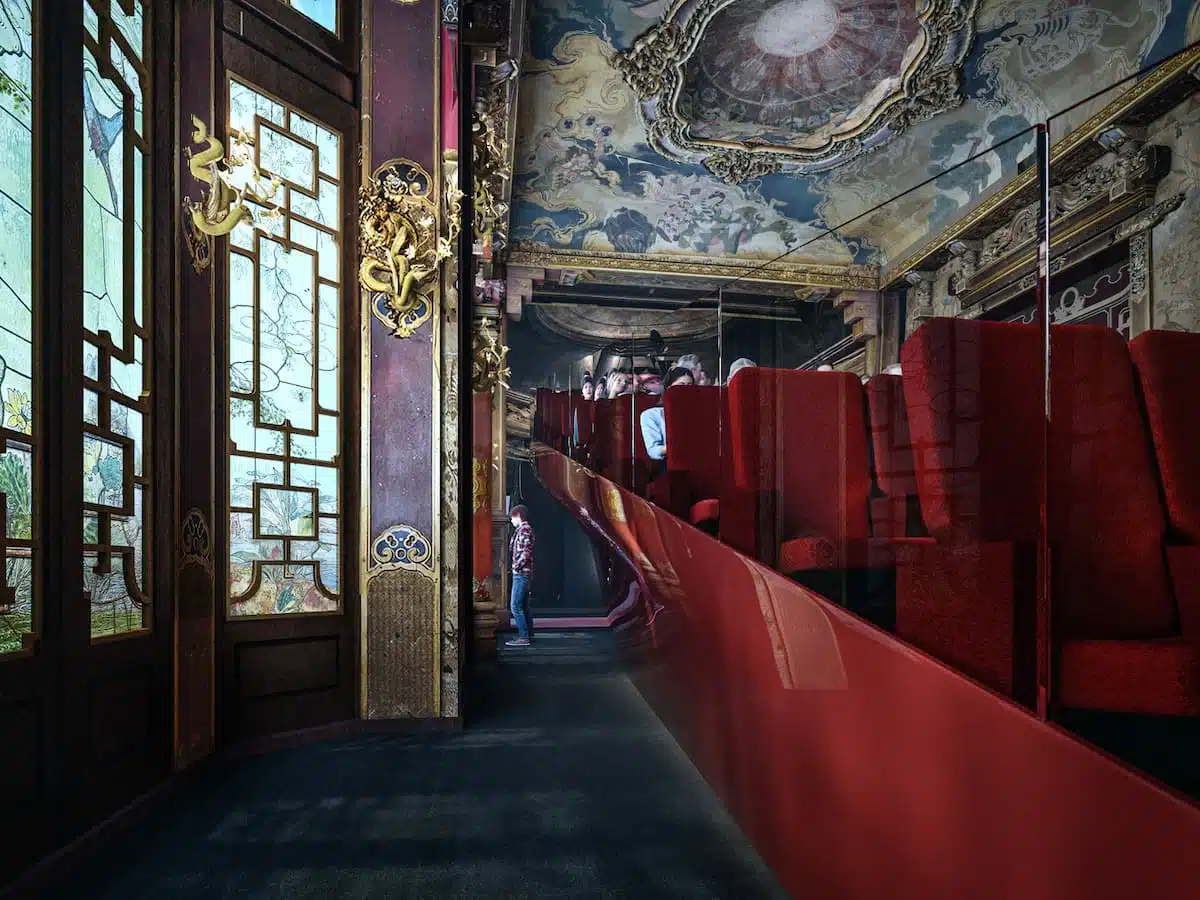
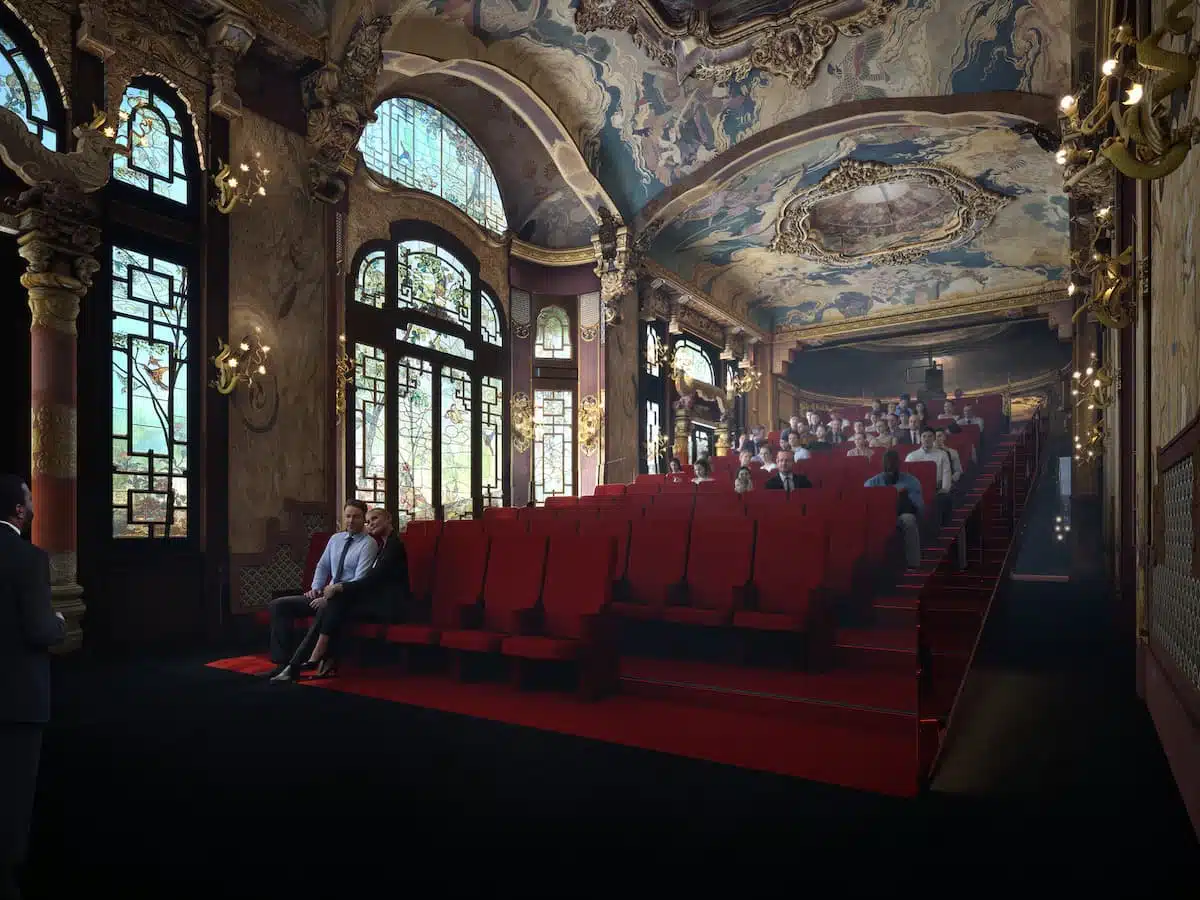
However, this project has not been a smooth ride. The cutting down of old trees in the garden in 2020 caused great emotion among local residents and heritage defenders. Those responsible for the project defended the technical necessity of certain works, in particular to allow the underground extension and landscape reconstruction. The controversy recalled how La Pagoda remains an emotional place. One does not touch with impunity a decor which belongs to the sensitive memory of Paris.
The reopening, announced several times, has been postponed. Municipal documents mentioned a gradual end to the work in 2024 and 2025. The most recent information now indicates a delay, leaving us waiting for a rebirth at the end of 2026 and beginning of 2027. Behind the palisades, the Japanese roof is already reappearing in places. The computer-generated images distributed by the Loci Anima agency offer a glimpse of beautiful projection rooms, sober, elegant, designed to bring this monument into the 21st century.
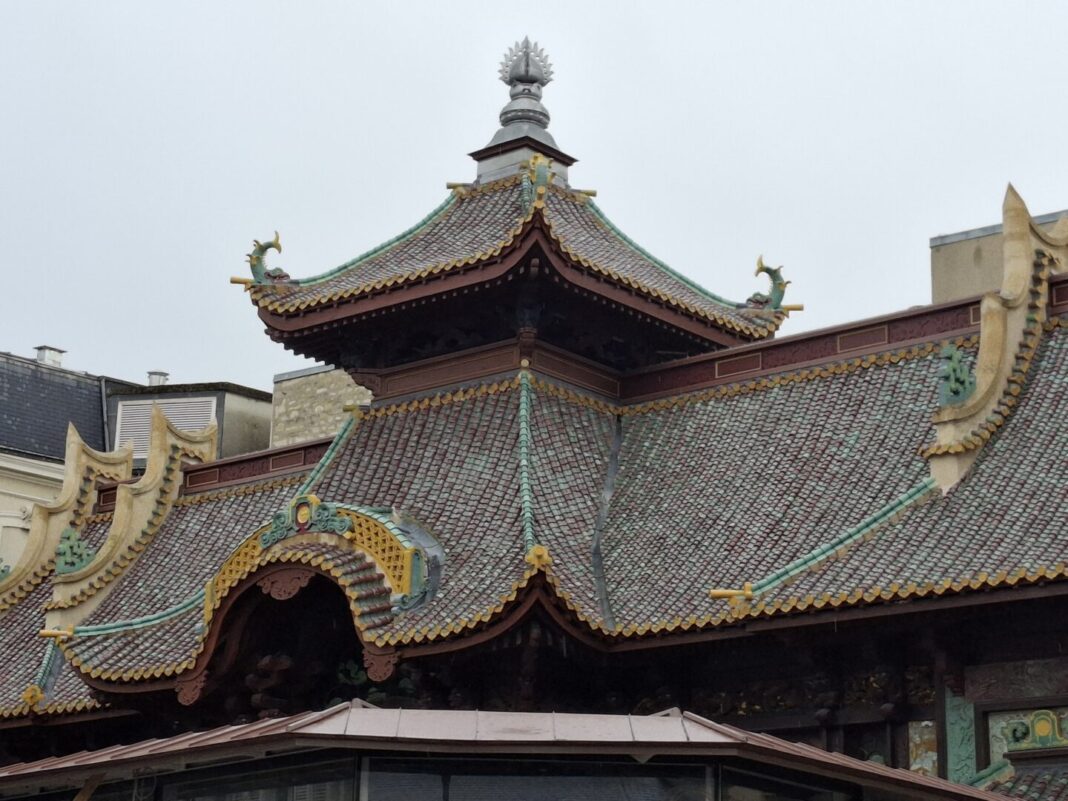
The future Pagoda will have to succeed in a difficult equation. Rediscover the dazzling place without freezing it in nostalgia. Protect the decor without making it a dead museum. Welcoming today’s spectators without erasing those of yesterday. In a capital where so many independent cinemas have disappeared or become commonplace, this rebirth is eagerly awaited. It could give the 7th arrondissement a unique cinema, but also remind us that the cinema is still a place, an architecture, an atmosphere, a way of collectively inhabiting images.
The Pagoda is not just a picturesque building. It summarizes part of Parisian cultural history. It recounts the Japonism of the Belle Époque, the decorative dreams of the bourgeoisie, the birth of arthouse cinema, the love of moviegoers for atypical places, then the contemporary tensions between heritage, economy, ecology and renovation. Its reopening will therefore be more than good news for cinema lovers. She will be a test. Will Paris be able to revive its rare places without dissolving them in a simple real estate operation?
The Pagoda
57 bis rue de Babylone, at the corner of rue Monsieur
75007 Paris