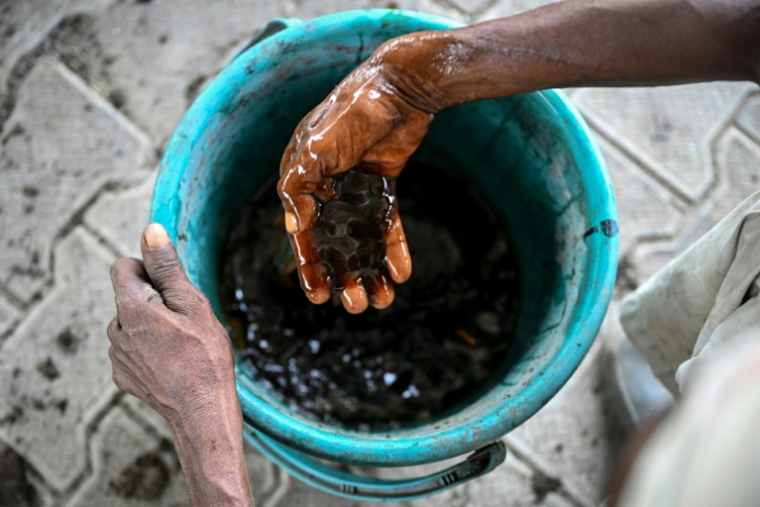
A man prepares a syrup intended for the manufacture of organic fertilizer in a biofertilizer factory located in Bharatpur, India, June 9, 2026 (AFP / Arun SANKAR)
Under a shed in a village in northern India, women mix cow dung, unrefined sugar and chickpea flour to produce natural fertilizer, an initiative intended to address fears of fertilizer shortages.
As the monsoon approaches, a favorable period for sowing, demand for this fertilizer is increasing, against a backdrop of concerns about the supply of phosphates – essential for the manufacture of chemical fertilizers – since the start of the war in the Middle East.
India uses around 63 million tonnes of chemical fertilizers each year, making it one of the largest consumers in the world.
Inputs of organic origin are attracting growing interest among farmers, driven by uncertainties over supply, the promotion of sustainable agriculture by the Indian government and increased awareness of land degradation.
To date, this remains a modest market, estimated at around $150 million (130 million euros), but which is growing at around 10% per year according to industry estimates, with more and more farmers experimenting with alternatives.

Farmers use biofertilizers in a field on June 9, 2026 in Bichpuri, India (AFP / Arun SANKAR)
“We started thinking about what could benefit small farmers, as awareness of land degradation intensifies…, explains Kamlesh Devi, 57, director of the Tappal Samriddhi Mahila Kisan cooperative which owns this organic fertilizer production unit in the state of Uttar Pradesh.
Created last year as part of a government program, it has around 1,050 members, exclusively women spread across 92 villages in this state.
“Farmers who own small areas have difficulty obtaining enough fertilizer,” she explains to AFP.
Their organic fertilizer, made from local raw materials, was developed based on traditional knowledge of manure manufacturing.
No immediate results
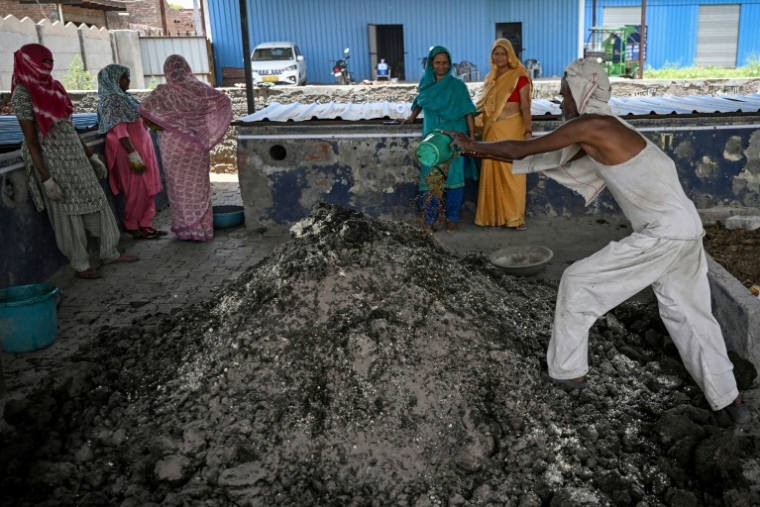
A worker works on the manufacture of natural fertilizer at a biofertilizer factory in Bharatpur, India, June 9, 2026 (AFP / Arun SANKAR)
Since the start of the year, some 200 farmers, mainly based in villages not far from Tappal, have received their fertilizer.
“Farmers are worried, especially about the availability of urea” and some have started to stock up, says Amit Chauhan, farmer and village head of Bharatpur.
Rumors of a possible shortage prompted Kishan Prasad, a farmer from a nearby village, to stockpile 40 bags of urea for his rice crops.
The biofertilizer produced in Tappal is sold for 300 rupees ($3.13) for a 40 kg bag, compared to 266 rupees ($2.78) for a subsidized 50 kilo bag of urea and around 1,350 rupees ($14.10) for 50 kg of phosphate fertilizer.
Neetu, a 28-year-old farmer, explains that she used the biofertilizer on her millet crop, which allowed her to reduce the urea input by about a third without affecting yields.
“For rice too, I plan to reduce the use of chemical fertilizers,” she confided.
Experts, however, stress that natural fertilizers alone cannot meet India’s needs.
“Biofertilizers are eco-friendly and cost-effective complements to chemical fertilizers,” says Brijesh Mishra, senior scientist at the Indian Agricultural Research Institute.
But their use remains limited, partly because their effects are not immediate and require an application adapted to each culture.
“Farmers often expect immediate results and sometimes use only one type of biofertilizer, which limits its effectiveness,” he explains.
“Different crops require different combinations and the benefits gradually increase over time,” he said.
Globally, emissions linked to fertilizers represent around 5% of annual emissions, according to a study by researchers at the University of Cambridge published in 2023.
For the residents of Tappal, whose company contributed to their emancipation, the objective is more immediate.
According to Suman, another director of Tappal Samriddhi Mahila Kisan, “our soils were once much healthier, we just want to get back to that state.”