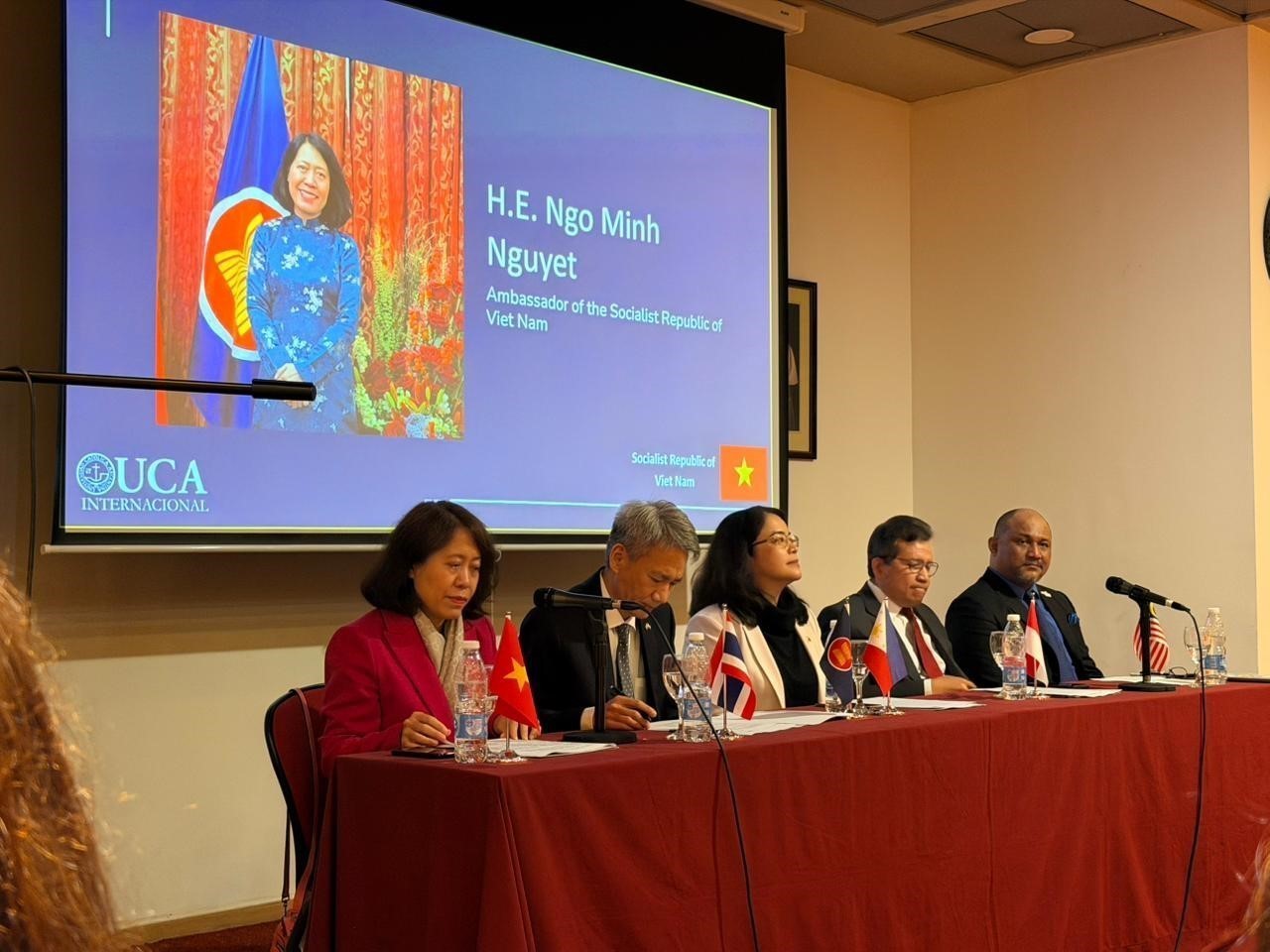
Vietnamese Ambassador to Argentina, Ngo Minh Nguyet (first from left). Photo: VNA
Vietnam remains firmly attached to a foreign policy based on independence, autonomy, multilateralization and diversification of its external relations, declared Vietnamese Ambassador to Argentina, Ngo Minh Nguyet, during a meeting held on June 2 between professors, teachers and students from the Argentine Catholic University (UCA), the ambassadors of Vietnam, the Philippines, Indonesia and Thailand, as well as the interim charge d’affaires of the Malaysian embassy in Buenos Aires.
This event was part of the activities of the ASEAN Committee in Buenos Aires for the year 2026.
Responding to questions on relations with the great powers, Vietnam’s ambassador to Argentina, Ngo Minh Nguyet, highlighted the model of “strategic autonomy” adopted by Vietnam, which consists of cooperating with all the great powers without concluding a military alliance, without aligning itself in inter-state rivalries, while by preserving its ability to defend its national interests.
The diplomat also recalled Vietnam’s constant defense policy based on the principle of “four no’s”: no military alliance, no alignment with one country against another, no foreign military bases on national territory and no use or threat of use of force in international relations.
According to her, Vietnam is currently the only country to maintain comprehensive strategic partnerships with the five permanent members of the United Nations Security Council: the United States, China, Russia, the United Kingdom and France. This position allows him to dialogue with all parties without being perceived as belonging to any bloc.
The ambassador considered that competition between great powers constituted an objective reality of international relations. However, Vietnam does not approach its relations with these countries from a security angle and does not choose sides. The country thus maintains good relations with both the United States and China, in the interest of all parties and in the service of regional peace and stability.
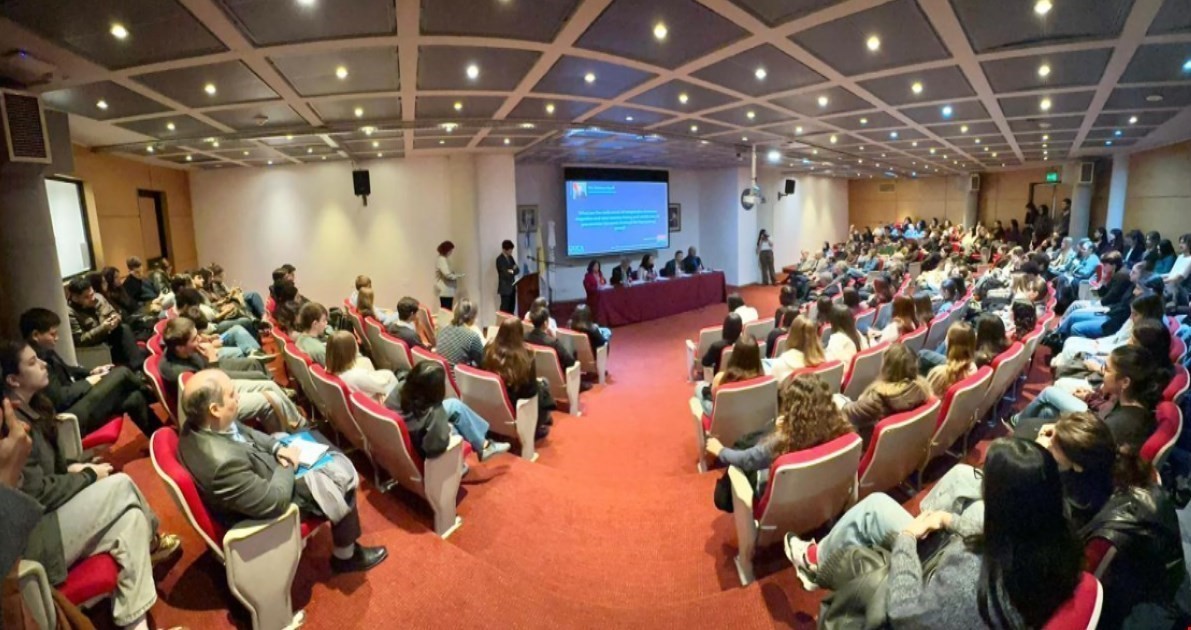
During the meeting. Photo: VNA
Regarding the students’ questions on relations between ASEAN and the great powers, the diplomat expressed her confidence in the central role of ASEAN, which she considers essential to regulate strategic rivalries, maintain dialogue, prevent conflicts and strengthen mutual trust.
For her part, the Philippine Ambassador to Argentina, Grace T. Cruz-Fabella, Chair of the ASEAN 2026 Committee in Argentina, presented the main lines of ASEAN, one of the most dynamic economic regions in the world, whose GDP exceeds 4,000 billion dollars and is based on three major pillars: industry, services and agriculture. She also recalled the success of the 48th ASEAN Summit, organized last May in Cebu, Philippines.
The ambassadors of Indonesia and Thailand as well as the Malaysian charge d’affaires, for their part, answered the students’ questions concerning the prospects for economic and commercial cooperation between ASEAN and Argentina.
On this occasion, during a working session with representatives of the university, the rector of the UCA, Miguel à ngel Schiavone, considered that the visit of the ASEAN Committee to Buenos Aires constituted an important opportunity to strengthen mutual understanding between Argentina and South Asia. South-East, promote dialogue between diplomats and students and explore new avenues of academic cooperation.
The Director of International Relations and Academic Cooperation at UCA, Verónica Muñoz, for her part underlined that internationalization was among the strategic priorities of the establishment. The university is currently developing student and teacher exchanges with numerous partners around the world, while strengthening its international programs and academic cooperation projects. The UCA particularly wishes to deepen its links with Asia and ASEAN countries.
Founded in 1958, the Argentine Catholic University is one of the leading private universities in Argentina and Latin America. It has several campuses and offers bachelor’s, master’s and doctoral courses in various fields such as human and social sciences, law, economics, engineering, medicine and theology.