lediplomate.media – printed on 05/24/2026
By the editorial staff of Le Diplomate media
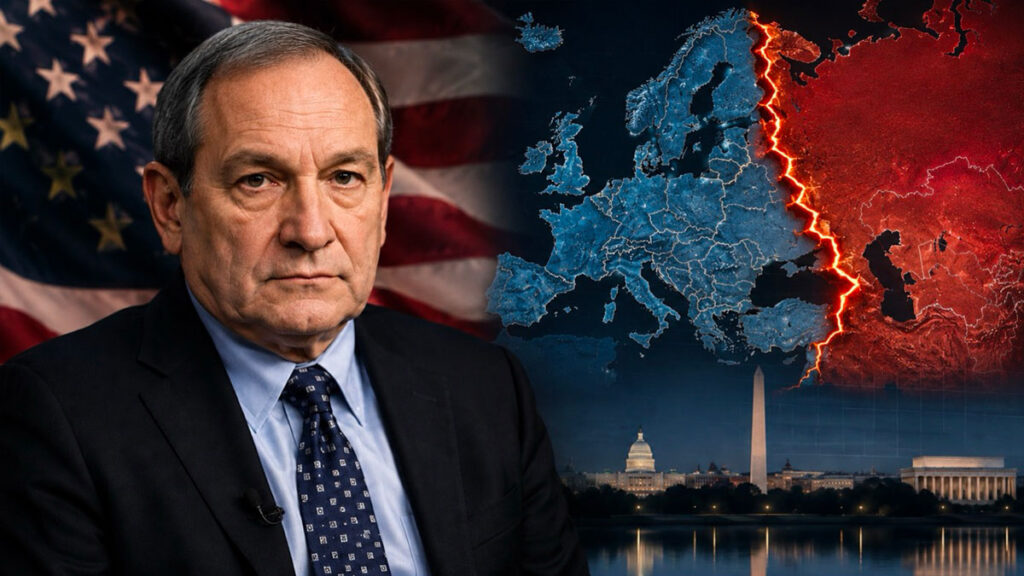
A key analyst of American international relations, George Friedman has become one of the most influential faces of realist geopolitics across the Atlantic. Founder of Stratfor then of Geopolitical Futures, advisor listened to in certain American strategic circles, he has developed for several decades a cold and imperial reading of the world. At the heart of his thinking: a constant obsession with American power in the face of the major historical risk of a rapprochement between Germany and Russia, a geopolitical matrix inherited from classic British strategies and Mackinder’s Heartland theories. Portrait of an intellectual revealing the deep vision of the American Empire.
George Friedman: an intellectual shaped by history and the Cold War
George Friedman was born in 1949 in Budapest into a Jewish family that had fled Nazism and then Soviet Communism. This double historical experience – Hitlerian totalitarianism then Soviet domination – profoundly marks his vision of the world.
His family emigrated to the United States when he was still a child. Very early on, Friedman developed a fascination for power relations, empires and global geopolitical dynamics.
He studied political science at the City College of New York before earning a doctorate at Cornell University. Initially an academic, a specialist in political philosophy and Marxism, he gradually moved towards strategic analysis and international relations.
In the 1990s, following the fall of the USSR, he founded Stratfor, often presented as a “private CIA”. This geopolitical intelligence company provides analyzes and advice to multinational companies, investors and sometimes to certain circles close to American power.
Friedman is clearly part of the Anglo-Saxon realist tradition: states are guided neither by morality nor by ideologies, but by their permanent strategic interests. His thinking is part of a profoundly imperial vision of the role of the United States in the world.
Unlike universalist neoconservatives wanting to export democracy everywhere, Friedman adopts a colder and pragmatic approach: above all preserve American domination and prevent the emergence of systemic rivals.
This posture explains why his analyzes are often listened to in certain American strategic circles, even if he does not officially occupy any major political position.
America’s geopolitical obsession: preventing the union of Germany and Russia
At the heart of George Friedman’s thinking is a simple but fundamental idea: the main strategic danger for the United States would be the emergence of a great Eurasian power capable of combining German technology and industry with Russian natural resources and strategic depth.
This vision directly takes up the major fundamentals of classic British and then American geopolitics: preventing the unification of the Eurasian Heartland theorized by Halford Mackinder.
For Friedman, the history of the two world wars and then the Cold War can be read through this fundamental logic: preventing a dominant continental power from controlling Europe and Eurasia.
In several now famous conferences, Friedman even states that:
“The paramount interest of the United States, for which we have fought wars for a century, is the relationship between Germany and Russia. HAS”
This statement perfectly sums up the classic American geopolitical matrix.
From this perspective, the United States historically acts like the British before them: an external maritime power whose objective is to prevent the emergence of a dominant continental bloc in Eurasia.
Friedman thus considers that NATO, the strategic encirclement of Russia and the control of European balances first respond to this deep and permanent geopolitical logic.
His reading of the war in Ukraine fits largely into this pattern: preventing any lasting rapprochement between Berlin and Moscow and maintaining European strategic dependence on Washington.
This vision reflects an assumed brutal realism. Friedman almost never talks about morality, democracy or universal values. For him, international relations are first and foremost balances of power structured by geography.
China, Islamism and the future of the American Empire
George Friedman’s thinking becomes even more interesting when he prioritizes the threats against the United States.
Unlike some Western elites obsessed with Islamist terrorism after September 11, Friedman considers that radical Islamism does not represent an existential threat to the United States.
According to him, terrorism can strike, destabilize or provoke peripheral wars, but it has neither an industrial base, nor demographic depth, nor technological capacity allowing it to compete sustainably with a superpower.
In his eyes, the real historical danger remains the appearance of a continental power capable of challenging American hegemony over Eurasia.
This is why Friedman attaches increasing importance to China.
However, unlike other alarmist analysts, he has long considered that Beijing remains confronted with structural fragilities: demographic aging, commercial dependence, internal imbalances and energy vulnerability.
For Friedman, China is certainly a major rival, but it remains above all a regional power seeking to secure its immediate environment more than a global empire comparable to the United States.
His thinking here reveals a fundamental constant of American strategy: the United States perceives itself as a global thalassocracy whose absolute priority remains control of the seas and global trade routes.
In this logic, American naval domination remains the key to world order.
Friedman thus appears as one of the best intellectual reveals of contemporary American geopolitical psychology: fear of the Eurasian Heartland, refusal of any dominant continental power and obsession with maintaining American maritime hegemony.
*
*Â Â Â Â Â Â Â Â Â Â Â Â Â Â *
George Friedman or the cold lucidity of the American Empire
George Friedman is not just another geopolitical analyst.
It is the intellectual product of a long Anglo-American strategic tradition based on realism, the balance of power and the permanent fear of Eurasian unification.
Its importance lies less in the absolute accuracy of all its forecasts than in what it reveals about the mental structures of the American strategic establishment.
For Friedman, the United States is not an “indispensable nation” invested with a universal moral mission; they are a maritime empire rationally seeking to preserve its global supremacy.
And it is precisely this assumed realism – sometimes cynical – which today makes George Friedman one of the most influential American geopolitical thinkers and the most revealing of Washington’s deep strategic vision.
#GeorgeFriedman,#Stratfor,#Geopolitics,#United States,#Washington,#Russia,#Germany,#China,#NATO,#Ukraine,#Eurasia,#Heartland,#Mackinder,#Empire American,#International Relations,#Cold War,#Maritime Power,#Geostrategy,#Europe,#Berlin,#Moscow,#Realpolitik,#Geopolitical Analysis, #InternationalPolitics,#USA,#Thalassocracy,#AmericanHegemony,#Diplomacy,#GlobalConflict,#WarInUkraine,#ThinkTank,#GeopoliticalFuture s,#AmericanStrategy,#MultipolarWorld,#Empire,#WorldPower,#SamuelHuntington,#FrancisFukuyama,#InternationalSecurity,#WorldOrder