lediplomate.media – printed on 05/22/2026
Par H16 – Son blogÂ: https://h16free.com
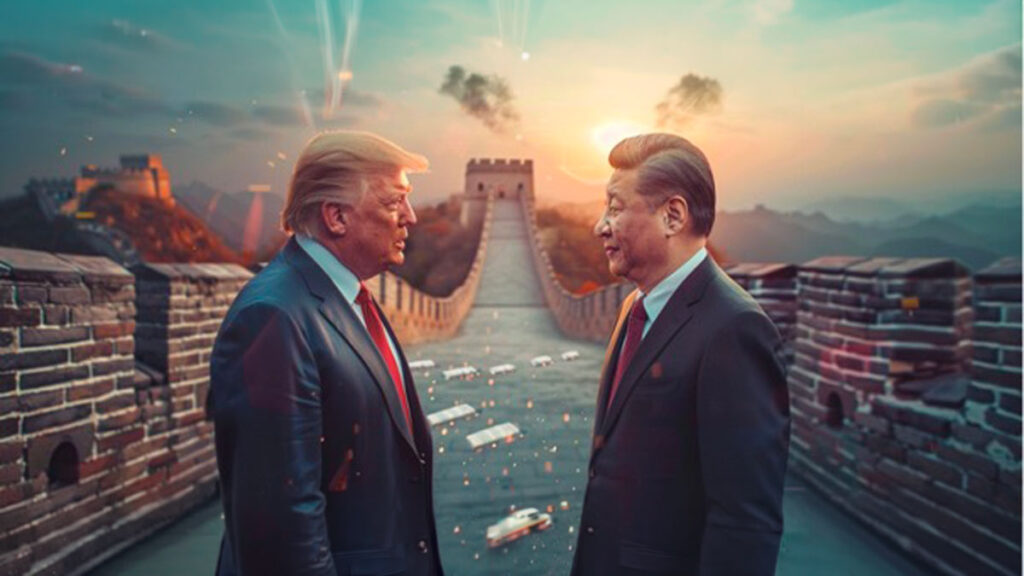
Donald Trump’s visit to China is not insignificant: it confirms the installation between Washington and Beijing of a pragmatic power policy assumed by both camps. In several respects, this meeting strengthens the American position and establishes a clear role for China, its first partner but geopolitical rival.
Before getting into the substance, let us note the obvious: almost all the major Western headlines explained that Trump arrived in Beijing “in a position of weakness”, came “begging” for Chinese help to get out of the Iranian conflict, and was trapped on the question of Taiwan. The Washington Post described Xi as “appearing like a superpower peer”; MSNBC speaks of a president who left “empty-handed”; ABC News repeats the analysis that “Trump needs China more than the other way around”; and most editorials highlight Xi’s warning about Taiwan as if it were the main outcome of the visit.
This reading does not stand up well to examination of the facts.
On Taiwan first, the Atlantic Council soberly notes that Trump avoided the trap set by Beijing by refusing to commit Washington to the slightest concession, Marco Rubio recalling that American policy remained unchanged. Chinese insistence on Taiwan is not a sign of strength: it is an attempt to frame the summit, widely relayed by the Western press, which agreed to discuss on the terrain chosen by Beijing rather than on that where the real balance of dependencies is at stake, that is to say energy, critical inputs and finance.Â
It is precisely in these three areas that Trump has major levers, and it is there that the real arbitrations at the summit took place.
Energy: Hormuz, Trump’s lever that Beijing is suffering
The press insisted a lot on the fact that China was demanding an end to the conflict with Iran and the reopening of the Strait of Hormuz. This is correct, but the angle is revealing: it is not a favor that Beijing would grant to Washington but reflects a structural dependence, and it is this which creates American leverage.
As a reminder, between 45 and 50% of the crude imported by China passes through Hormuz, making China the world’s leading importer of hydrocarbons. A prolonged blockage of the Strait is strangling its economy. The United States is the world’s leading oil producer and net exporter of LNG. As Marco Rubio summarized, closing Hormuz amounts to “economic suicide” for China. It is indeed a balance of power and not a service provided. And the fact that Trump and Xi left with a joint agreement on keeping the Strait open and on the non-nuclearization of Iran shows in which direction the convergence has taken place: it isBeijing which aligned itself with Washington’s positionnot the other way around.
Helium: the lever that reverses Chinese strategy
Helium constitutes the second massive energy lever… and undoubtedly the most underestimated.
The United States dominates world production; China imports 85% of its helium, including 54% from Qatar alone and around 40% from Russia. However, the Iranian strikes on Ras Laffan at the beginning of March removed almost a third of the world’s supply in one fell swoop and QatarEnergy estimates the time necessary for a return to full capacity to be several years.
However, there is no viable substitute for helium in the manufacturing of semiconductors, optical fibers, medical imaging or cryogenic applications. Domestic 6N prices in China have jumped 110% since late February, and most suppliers have suspended spot quotations.
Helium is not just another consumable: it is a critical input in Beijing’s technological war on chips and AI. Without alternative,China must turn to American suppliersbrutally reversing its strategy of reducing its logistical risks initiated since 2018. This is a considerable asset in any negotiation, especially since the shortage window will be lasting.
Rare earths: a Chinese counter-lever in the process of erosion
Beijing maintains a strong card: the near-monopoly on the refining of rare earths (around 60% of extraction, more than 85% of refining, and up to 90% for certain heavy rare earths essential to permanent magnets). In April 2025, in retaliation for the “Liberation Day” tariffs, China introduced an export licensing regime that caused magnet exports to the United States to fall by 93%.
But this card is weakening.
Trump has increased bilateral agreements with Saudi Arabia, Japan and Australia to develop production capacities outside China, accelerated the exploitation of American deposits, launched a national strategic stockpile called “Project Vault” and negotiated access to local resources with Greenland.
The takeover by USA Rare Earth of the Brazilian group Serra Verde (one of the few producers and refiners of heavy rare earths outside China) illustrates the depth of the maneuver. Over the horizon of this decade, the Chinese monopoly on light rare earths should be loosened; heavy rare earths will remain sensitive for longer, but the trajectory is clear.
Dollar: the lever that China has failed to neutralize
The third American lever, the most discreet but perhaps the most structuring, is financial.
Despite a decade of efforts to internationalize the yuan (creation of CIPS in 2015, swap agreements, digital yuan, payments in yuan with Russia and certain Gulf states) the results remain modest. The yuan’s share of global SWIFT payments fell to 2.71% in February 2026, compared to 51% for the dollar; the yuan’s share of world reserves is 1.93%, compared to nearly 57% for the dollar. And worse,the yuan has fallen since November 2025and a possible Russian re-dollarization would make it lose even more.
This means two very concrete things.
On the one hand, China continues to finance a significant portion of its foreign trade in a currency over which it has no control and whose network of banking correspondents relies on American institutions.
On the other hand, secondary type American sanctions remain an instrument within Washington’s reach, including on oil flows from Iran to China.
Foreign Policy moreover recognizes without detour, under a cover however not very Trumpist, that “Beijing can’t easily afford to escalate any economic struggle with Washington(“Beijing can’t really afford to escalate an economic conflict with Washington”). The dollar is the most structural weapon that Trump has, and it is also the one that the press talks about the least.
Technology and AI: controlled de-escalation
It is in this balance of power truly favorable to the United States that Trump went to see Xi.
The presence in the delegation of Elon Musk (xAI, SpaceX), Jensen Huang (Nvidia) and Tim Cook (Apple) is, in this respect, telling: this is not a begging trip that we accompany with the bosses of the most strategic companies of the moment. These leaders have in fact laid the foundations for AI governance, with a communication channel, a stated desire for de-escalation and the reduction of friction likely to trigger an uncontrolled race. Nvidia will be able to sell its chips, within a certain limit, to Chinese companies but it is a gesture that looks less like a concession than a framework where Washington keeps its hand on the tap.
Commerce : des engagements concrets
On the commercial front, China has committed to purchasing 200 Boeing planes (with a potential of 750 additional), American agricultural products worth several tens of billions of dollars, American LNG and oil. The creation of aBoard of Trade et possiblement d’un Board of Investment aims to institutionalize mutual flows. We can judge these limited commitments with regard to the substantive disputes, but they are concrete, quantified and unilaterally asymmetrical: it is Beijing which buys American, and not the reverse.
The contrast with the CPE summit
What is striking, basically, is the contrast between this Sino-American summit and that of the EPC, the European Political Community, which was held a week earlier…which the general public has hardly heard of. The simple difference in visibility is already an indicator.
The Trump… kind of summit redraws the framework in which the rest of the world evolves.
The European summit, for its part, blandly focused on the defense of democratic values and on a few statements relating to American policy, mainly in terms of defense.
The Trump meeting… which is looking for its place, forming a coalition for lack of anything better, and has very few levers. China and the United States define the framework; Europe reacts.
And no,despite what the press tried to make people believe, Trump did not come to China begging Xi.Â
He came to play three cards (oil, helium, the dollar) and left with concrete commercial commitments, a de-escalation framework on AI, and the avoidance of the Taiwanese trap.
The media narrative of an America losing in the face of a “marching” China is an optical effect: it serves the narrative interests of Beijing, and flatters the propensity of Western editorial staff to find failures wherever Trump acts, but the geopolitical reality is more prosaic, and it is largely to Washington’s advantage.
The opinions expressed in this article are those of the author and in no way represent the editorial position of Le Diplomate.
#Trump,#XiJinping,#Chine,#USA,#Geopolitique,#Taiwan,#Ormuz,#Iran,#Dollar,#TerresRares,#Helium,#IntelligenceArtificielle,#Nvidia,#ElonMusk,#Boeing,#CommerceMondial,#Geoeconomie,#Washington,#Pekin,#TrumpXi,#IA,#SemiConducteurs,#SWIFT,#GNL,#RareEarths,#Europe,#CPE,#MarcoRubio,#ForeignPolicy,#LeDiplomate

/2026/06/15/6a300ed27f452888096128.jpg "\"Nothing is sacred to the enemy\" : the Russian attack on an Orthodox cathedral seen from Ukraine")

/2026/06/15/6a3033cee3fc0065887661.jpg "Coupe du monde 2026 : entrée en lice manquée pour lEspagne, grande favorite, mais tenue en échec par le Cap-Vert")