-
More than thirty nations today have installations in Antarctica, from Chile to Bulgaria, from Peru to Turkey. The map of their distribution says more about geopolitics than science.
-
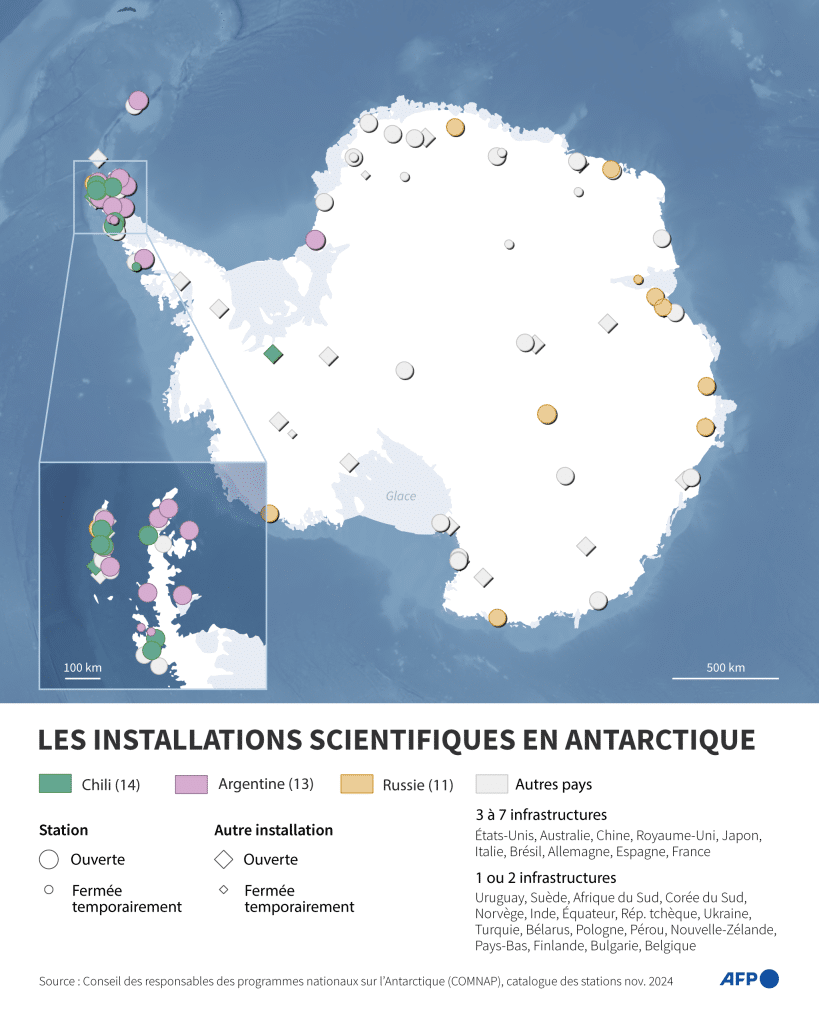
Chile (14 stations), Argentina (13) and Russia (11) dominate the ranking, while China inaugurated its fifth station in 2024 in a strategic area for access to resources.
-
The 1959 treaty, which dedicated the continent to peace and science, is under increasing pressure. Science is the legal pretext for presence. Geopolitics is, more and more, the real motivation.
A map, published by AFP using data from the Council of National Antarctic Program Managers (COMNAP), says the essentials about what the white continent has become: a space of scientific and strategic competition where more than thirty nations jostle.
There are several dozen stations and installations spread across the entire continental perimeter. Their location is not the result of chance. The vast majority is concentrated on the coastal fringe, where access from southern ports is the least difficult. The Antarctic Peninsula, this arm of land which stretches towards South America, constitutes the densest area: the map lists such a concentration of installations that AFP had to produce an enlarged insert to make them readable.
Read also: Antarctica, the continent of all challenges
Chile and Argentina in the lead
These are the two countries which have the greatest number of installations: 14 for Chile, 13 for Argentina. Their advantage is geographical as well as political: close to the white continent, they claim sectors of sovereignty which overlap with those of the United Kingdom on the peninsula. Their stations are in part instruments of this territorial claim, even if the Antarctic Treaty of 1959 froze all sovereign claims.
Russia, heir to the Soviet Union which had invested massively in polar exploration, comes in third position with 11 installations. Its stations are more dispersed across the continent, including inland areas, which says something about its strategic ambitions beyond just scientific research.
Read also: Russia’s polar ambitions
The middle powers club
Ten countries have 3 to 7 infrastructures: United States, Australia, China, United Kingdom, Japan, Italy, Brazil, Germany, Spain and France. This list deserves attention. There we find the great traditional scientific powers, but also nations whose presence in Antarctica reflects a growing geopolitical ambition. First of all, China, which has multiplied its stations over the last twenty years and inaugurated its fifth station, Qinling, in 2024, located in a strategic area for access to resources.
Antactic (c) Conflicts
France is included with its installations in Terre Adélie, including the Dumont d’Urville station, open permanently since 1956 and which serves as a base for research on the climate, terrestrial magnetism and polar fauna.
Read also: China settles in Antarctica
The long tail of nations
Perhaps what is most striking on this map is the list of countries that have only one or two infrastructures. There we find Uruguay and Sweden, but also India, South Korea, Turkey, Ukraine, Bulgaria, Belgium, the Netherlands, Finland, Ecuador and even Peru. Nations which, for the most part, have no polar tradition and whose presence in Antarctica is recent. It indicates that the continent is no longer just the business of the great powers: it has become an issue of belonging to the club of nations that count.
The 1959 treaty under pressure
The map also illustrates a tension that diplomats are struggling to resolve. The Antarctic Treaty, signed in 1959 by twelve nations and now ratified by fifty-six, dedicates the continent to peace and science, prohibits all military activity and freezes sovereign claims. It is presented as one of the great successes of multilateral diplomacy of the 20the century.
But the multiplication of stations, some of which have capacities which go far beyond strict scientific use, notably Chinese and Russian installations, raises the question of the sustainability of this framework. The region’s mining and fishing resources, the retreat of the ice which opens new maritime routes, the strategic value of polar observations for navigation and intelligence systems: so many factors which make Antarctica an increasingly coveted space.
Science is the legal pretext for presence. Geopolitics is, more and more, the real motivation.