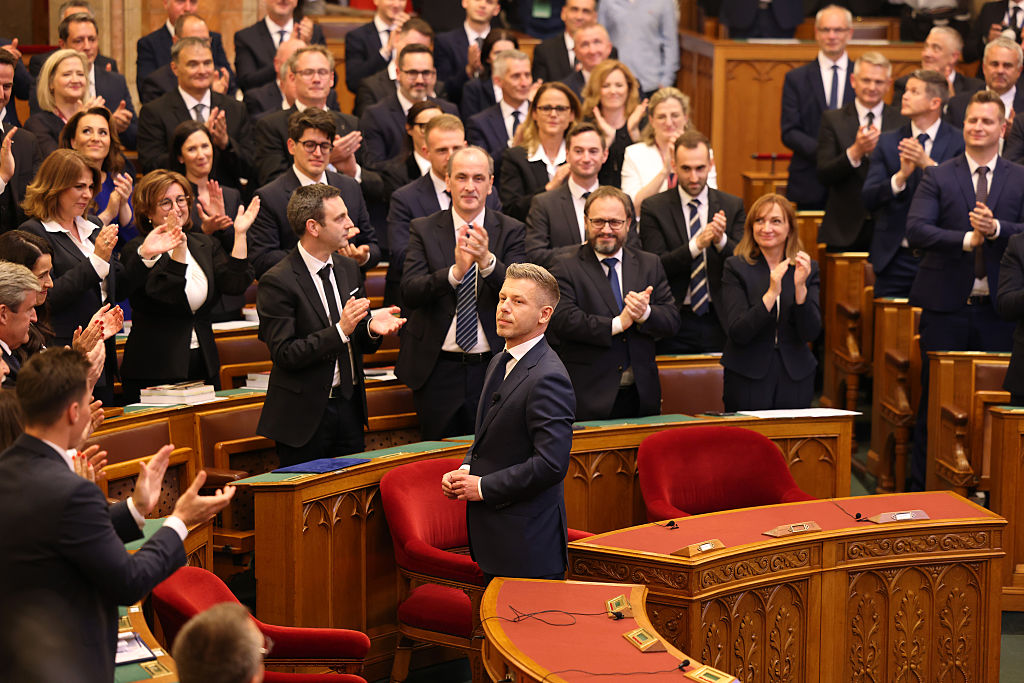
BUDAPEST – The future Hungarian government took advantage of this week’s parliamentary hearings to present a vast program of political reforms aimed at breaking with the legacy of Viktor Orbán, in power for sixteen years.
Péter Magyar’s proposed ministers pledged during mandatory parliamentary hearings to pursue a more pro-EU economic policy, implement institutional reforms and strengthen ties with Brussels. All 16 of his candidates were approved, an expected result given the qualified majority that Tisza has in Parliament and the corresponding control he exercises over votes in committee.
Pro-EU economic shift
András Kármán, the future finance minister, pledged to move away from what he described as the outgoing government’s model, based on low wages and foreign investment. He criticized the previous policy of keeping a weak forint, Hungary’s currency, arguing that it fueled inflation and weighed on wages.
Kármána said the government would aim for eurozone membership by 2030, introduce a 1% wealth tax on billionaires and move the annual budget process to the autumn to improve predictability.
István Kapitány, candidate for Minister of Economy and Energy, reinforced the pro-EU message, confirming that Budapest would immediately seek to release 10.4 billion euros of frozen EU funds, while maintaining a pragmatic approach towards Russian energy imports.
“We will use existing capacities,” Kapitány said, adding that Hungary would maintain subsidized energy prices for households while diversifying its sources of supply. He also ruled out any privatization of the MOL energy group.
Redefining foreign policy
Anita Orbán, future Minister of Foreign Affairs, assured that the new government would seek to restore trust with Brussels and repair relations with Poland, which had deteriorated significantly under Orbán.
At the same time, she said Budapest would maintain pragmatic relations with China and avoid what she called an ideological foreign policy.
Regarding Ukraine, Orbána reiterated his support for sovereignty and territorial integrity, but insisted on the rights of the Hungarian minority in Ukrainian Transcarpathia, suggesting that the government would not support an accelerated accession process for kyiv to the EU.
Furthermore, the future minister of the Prime Minister’s Office, Balint Ruffpromised the “biggest cleanup in history” of state institutions and announced plans to create a National Asset Recovery Office by June. He also pledged to open communist-era state security files that previous governments had kept sealed.
Education and health reforms
Judit Lannert, who will become education minister, has pledged to reverse several controversial policies implemented under Fidesz, including reinstating teachers fired for participating in demonstrations of civil disobedience.
However, she has come under criticism for her plans to “depoliticize” education, particularly on LGBT issues. Asked about future Secretary of State Szilvia Gyurkó, criticized by her opponents as an “LGBT propagandist,” Lannert said she had “never seen a transgender child in kindergarten before” and argued that sex education should not be confused with propaganda.
In health care, Zsolt Hegedűs – a former British NHS surgeon who became internationally known for his dancing skills – outlined plans to build a more transparent, values-based health system, with the aim of raising life expectancy to 80 years by 2035. He also announced that Nobel laureate Katalin Karikó would join his advisory committee.
(cs, bw)