lediplomate.media – printed on 05/07/2026
By Giuseppe Gagliano, President of the Centro Studi Strategici Carlo De Cristoforis (Côme, Italy)
When foreign policy becomes personal vengeance
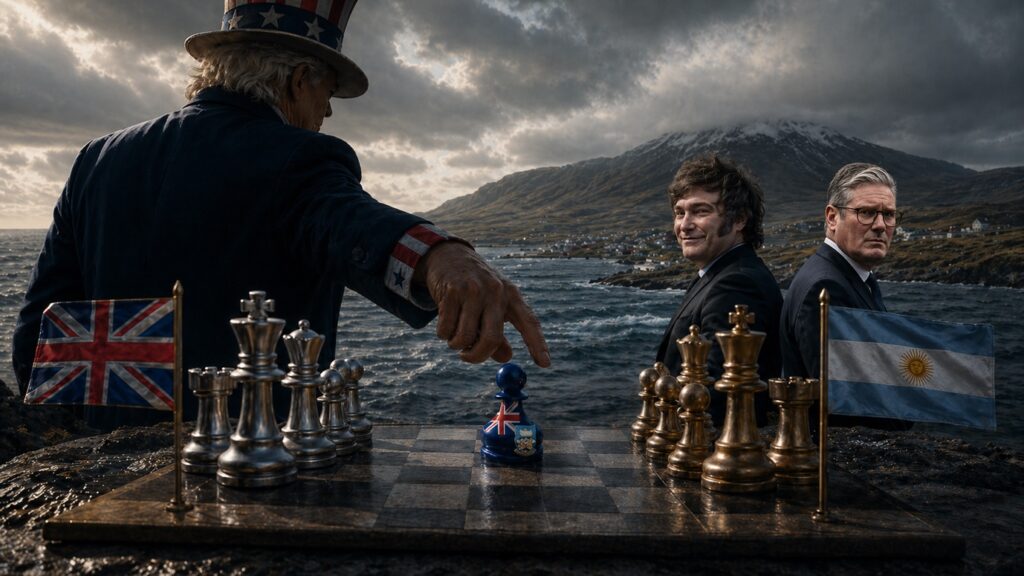
The possible revision of the American position on the Falkland Islands should not be read only as a diplomatic episode between the United States, the United Kingdom and Argentina. If confirmed, it would mean something deeper and more worrying: the shift to a foreign policy built not on a stable vision of national interests, but on the mood of the moment, personal resentment and the desire to punish the ally who does not align.
The question is not only whether Washington has really decided to abandon London in the dispute over the sovereignty of the archipelago. For the moment, no official changes have been announced. The real question is whether such a hypothesis could circulate in the American system as an instrument of political pressure. The Falklands thus become a lever. No longer a historical, legal and strategic file, but a diplomatic weapon to use against the United Kingdom, guilty of not having followed the United States in operations against Iran.
This is where the logic of Donald Trump’s foreign policy appears: not pure isolationism, not classical realism, not the linear defense of American interest, but a punitive, transactional diplomacy, based on the idea that each ally must immediately pay the price for his disobedience. If London does not participate in the war, then American support on a sensitive issue may be called into question. If a partner does not get behind Washington, he is exposed. If he does not obey, he is humiliated.
This way of proceeding creates permanent instability. Allies no longer know whether American commitments are the product of a strategy or an emotional reaction. And the adversaries, by observing, understand that the fractures within the Western camp can be widened with few means: we just have to wait for the next quarrel, the next revenge, the next file reopened by reprisals.
The Falklands as an imperial symbol and geopolitical lever
The Falklands, or Falklands for Argentina, are not just any archipelago. They are a symbol. For the United Kingdom, they represent one of the last expressions of its imperial presence overseas, a strategic position in the South Atlantic and an element of identity reinforced by the 1982 war. For Argentina, they are a national wound, a colonial heritage never accepted, a theme capable of uniting, at least in part, political forces often divided on everything else.
The British position is based on the principle of self-determination of the inhabitants of the archipelago, who have repeatedly expressed their desire to remain under British sovereignty. The Argentine position is, on the contrary, based on territorial continuity, decolonization and the idea that the British occupation took away part of its historical and geographical space from Argentina.
For decades, the United States maintained a carefully balanced line: recognizing the de facto British administration, without completely erasing the Argentine claim. An ambiguous but functional formula, because it allowed Washington not to break with London while not completely closing the door to Buenos Aires.
Now, according to reports, this ambiguity could be used aggressively. Not to open an orderly negotiation, not to promote an international solution, but to send a message to the British government. This is the most dangerous new development: a frozen dispute risks being thawed not because there is a real strategy to resolve it, but because it serves to settle scores between allies.
Milei between national sovereignty and American alignment
Javier Milei finds himself in a paradoxical position. He is one of the Latin American leaders closest, ideologically, to Trump’s United States, but he leads a country that maintains a historic claim against Washington’s closest European ally. For the Argentine president, the Falklands question offers a precious opportunity: to reaffirm national sovereignty without breaking with the United States, and even by presenting himself as a privileged interlocutor of the White House.
Milei reiterated that Argentina intends to do everything possible to recover the islands, but he also spoke of strategic lucidity and diplomatic pragmatism. The formula is significant. No one in Buenos Aires can seriously imagine a military solution. The 1982 war remains a painful memory and a warning. But American diplomatic pressure on London, even partial, would give Argentina a negotiating strength that it has not had for decades.
The Argentine president also knows that the Falklands issue is one of the few capable of overcoming internal fractures. In a country hit by economic crisis, political polarization and painful reforms, sovereignty over the islands remains a cement of identity. Milei can therefore use this issue to strengthen his patriotic image, by offsetting in the eyes of part of public opinion his almost total alignment with the United States.
But here too, the risk is obvious. If Buenos Aires imagines that Trump is really ready to sacrifice London to favor Argentina, it could mistake a tactical maneuver for a strategic turn. Trumpian foreign policy promises a lot, but it often uses partners as momentary instruments. Today, Argentina may seem useful against the United Kingdom. Tomorrow, it could be sacrificed on another file.
The military dimension: a small archipelago, an immense challenge
From a military point of view, the Falklands remain a sensitive node in the South Atlantic. The United Kingdom maintains a defensive presence on the archipelago intended to discourage any adventure. The distance from Argentina, British technological superiority and the memory of 1982 make an open military scenario unlikely. But war is not the only form of pressure.
A revision of the American position would have effects on strategic perception. London should ask itself whether, in the event of a new crisis, it could count on the full political and logistical support of the United States. Argentina, for its part, could feel encouraged to intensify diplomatic, legal and symbolic pressure. Other actors, from China to Russia, would carefully observe the possibility of a fracture in the Western camp.
The South Atlantic is no longer an insignificant periphery. It is a space where maritime routes, fishing resources, potential energy interests, access to Antarctica, naval projection and global competition intersect. Whoever controls or influences the Falklands has a strategic platform in a region that could gain increasing importance over the coming decades.
In this sense, the possible American maneuver would be doubly destabilizing. It would hit the United Kingdom on a political level, but it would also raise questions about the solidity of Western architecture in peripheral maritime spaces. However, in geopolitics, the peripheries are often the places where the announcement of crises in the center.
The economic scenario: privatizations, defense and resources
Milei’s position on the Falklands is also linked to the strengthening of the Argentine armed forces. The promise to devote part of the revenues from privatizations to the purchase of military equipment and strategic goods shows the desire to rebuild national capacities weakened by years of budgetary crisis, underfinancing and administrative disorder.
Economically, however, the project remains complex. Argentina must stabilize its accounts, attract investments, contain inflation and rebuild its financial credibility. Dedicating resources to defense can have strategic value, but it risks coming into tension with social emergencies and budgetary constraints. Milei tries to present defense as a long-term investment, not as an ideological expenditure. But any military modernization requires continuity, industry, training, maintenance and technological alliances.
This is why rapprochement with Washington becomes essential. Cyber cooperation, training, military technology and political support could offer Argentina a path to re-enter a tighter Western security network. But this network would have a price: increased dependence on the United States and reduced strategic autonomy.
The Falklands then also become a geoeconomic question. Around the archipelago are fishing, marine resources, possible energy interests, projection towards Antarctica and control of a vast ocean space. It’s not just a flag. It’s territory, sea, income, access and projection.
London faces the fragility of special relations
For the United Kingdom, this affair is particularly bitter. The “special relationship” with the United States has been one of the pillars of British foreign policy for decades. But in recent years, it has become less and less special and more and more conditioned by the immediate interests of Washington. The departure from the European Union should give London greater overall freedom. In reality, it has made the UK more exposed, more dependent on the United States and less protected by the European political framework.
The Starmer government, by refusing to participate in operations against Iran, probably sought to avoid a risky and unpopular military engagement. But Trump reads these choices not as the autonomy of an ally, but as a betrayal. It is a proprietary vision of alliances: the ally is not a partner, he is a debtor.
If Washington really used the Falklands as a sanction, the message sent to London would be brutal: no file is untouchable, not even those on which the United Kingdom bases its identity, its military memory and its residual sovereignty. The consequence would be a loss of confidence that would be difficult to reverse.
The world made unstable by the politics of blackmail
This affair reveals a general trait of our time. Great powers no longer simply compete with their adversaries. They are also starting to put pressure on their allies. The United States demands absolute loyalty, Europe fears being abandoned, regional partners seek protection while knowing that they may be abandoned. In this climate, each local crisis can become a global retaliation.
The problem with a foreign policy based on resentment is that it produces immediate results but lasting damage. It can force an ally to comply today, but it pushes him to be wary tomorrow. It can reward a tactical partner, but it makes him dependent on unstable favor. It can create pressure, but it destroys predictability. And without predictability, the international order becomes a market for revenge.
The Falklands are remote, small, sparsely populated. But that is precisely why they say a lot. If even a remote archipelago can become a bargaining chip in a feud between Washington and London, then there are no real guarantees. History, agreements, alliances, the memory of wars fought together count less and less. What matters is the usefulness of the moment.
This is why the possible American turning point would not only be good news for Buenos Aires or bad news for London. That would be a symptom. The symptom of an international system in which the dominant power no longer stabilizes, but agitates; no longer reassures, but threatens; no longer builds alliances, but uses them as instruments of discipline.
The Falklands are therefore not just a dispute between Argentina and the United Kingdom. They are a mirror. And in this mirror appears a West which no longer knows very well whether its enemies are outside or at the very heart of its own alliances.
#Falklands,#Malvinas,#Geopolitics,#Trump,#Diplomacy,#United Kingdom,#Argentina,#USA,#International Relations,#Strategy,#Foreign Policy,#AllianceO West,#International Crisis,#Milei,#South Atlantic,#Geopolitical Analysis,#World Power,#Sovereignty,#1982 War,#Defense,#Influence,#Realpoli tik,#Geoeconomics,#Global Tensions,#International Order,#British Empire,#American Policy,#Territorial Conflict,#Punitive Diplomacy,#Mili Strategy silence,#Allies,#Power,#Natural Resources,#Antarctica,#Naval Projection,#Geostrategy,#Instability,#West,#USAUK Relations,#PoliticalPressure