Islam, Herodotus and the Eastern Question. Overview of the books of the week.
The Islam of the Enlightenment: History of Muslim Humanism (7th-21st century)
Olivier Hanne, Tallandier, 368 pages, 23.90 euros
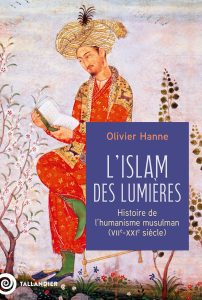
In a context where public debate on Islam often oscillates between orientalist fascination and categorical rejection, Olivier Hanne, a recognized Islamologist and researcher at Aix-Marseille University, offers with The Islam of the Enlightenment a perspective as necessary as it is audacious.
Far from the stereotypes that freeze Islam in a conflictual present or in a fantasized Middle Ages, the author unfolds a fresco of fourteen centuries to highlight the humanistic currents that have traversed Muslim civilization. The title itself constitutes a historiographical challenge: to speak of an “Islam of the Enlightenment” is to defy the dominant narratives that mechanically oppose Western reason to Islamic obscurantism. Hanne, however, does not veer into apotheosis. With the rigor of the historian known from his works on The Alcoran or Europe Facing Islam, he meticulously documents the moments when Muslim thought embraced humanistic values: the rational Mutazilism of the 9th-10th centuries, the philosophy of Averroes and Avicenna, the mystic Sufism of Ibn Arabi or Rumi, to the reform movements of the Nahda in the 19th century and contemporary intellectuals like Mohammed Arkoun or Abdennour Bidar.
The book reveals how, at different times, Muslim thinkers favored contextual exegesis over literalism, the primacy of reason over doctrinal rigidity, and universal openness over identity retreat. Olivier Hanne shows that these currents, far from being marginal, deeply marked the intellectual history of Islam, even if they have often been eclipsed by political powers or more conservative readings. The book deconstructs the idea of an essential incompatibility between Islam and humanism, between the Muslim faith and the tradition of the Enlightenment. Particularly stimulating is the way in which the author draws parallels between theological debates in the Islamic world and those that shaped medieval and modern Christianity. The question of the relationship between faith and reason, the tension between individual freedom and religious authority, the role of interpretation in the face of sacred texts: these are all questions that have animated both civilizations, often at the same times. This cross-historical approach, dear to Olivier Hanne, allows us to move away from the trap of exceptionalism as well as cultural relativism.
The pages dedicated to contemporary thinkers would have deserved more development, given the crucial current issues around the reform of Islam. However, The Islam of the Enlightenment emerges as a major contribution to the debate on Islam in France and Europe. As a rigorous historian, Olivier Hanne offers the intellectual tools to conceive of an Islam compatible with democratic and humanistic values, not through concession or syncretism, but through fidelity to its own intellectual traditions too often forgotten.
Tigrane Yégavian
Herodotus, 50 years of geopolitics: A tribute to the heritage of Yves Lacoste
Herodotus, Fifty years of geopolitics: Tribute to Yves Lacoste, Issue: 200-201 (double issue), 304 pages, 24 euros.
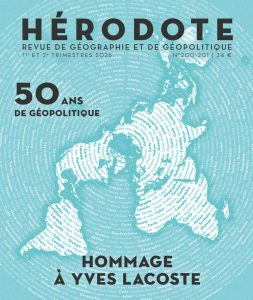
The Herodotus magazine celebrates its fiftieth anniversary with issue 200, which is more than just an editorial milestone.
It is an intellectual monument paying homage to Yves Lacoste and the ecosystem he created. Under the direction of Béatrice Giblin since 2006, Herodotus remains the major player among French-speaking geopolitics journals. What stands out in the history of Herodotus is Yves Lacoste’s ability to build a true ecosystem. The French Institute of Geopolitics, established in 2002 at Paris 8, trains analysts in this particular approach: an engaged, critical geography rooted in territories and their contradictory representations. No one doubts that this great geographer, so atypical in the world of geography, played a decisive role in the now undeniable return of geopolitics, both among academics – geographers, political scientists specializing in international relations, or historians specializing in contemporary history – and among journalists who were the first to seize upon it.
This issue begins with a retrospective look at the history of Herodotus, the methodology implemented throughout the issues, and the major themes that characterize the journal’s geopolitical approach. The second part is more prospective, addressing current geopolitical questions from unusual angles.
Béatrice Giblin, a founding member in 1976, embodies this intellectual continuity. She has preserved the DNA of the journal while adapting it to contemporary challenges: from the Arab world to Ukraine, from migrations to the Arctic. The journey of Herodotus has been marked by painful losses. Barbara Loyer, deceased on April 13, 2024, at the age of 62, was a central figure at the IFG. As the director of the Institute from 2010 to 2018 and a specialist in Spain, she refined the geopolitical methodology. Her articles on the Bonnets Rouges or the Balkans demonstrate remarkable intellectual rigor. Delphine Papin, a doctor from the IFG and responsible for infographics at Le Monde, has shown in her articles how mapping is an essential tool for geopolitical reasoning. Her work in 2012 on cartography perfectly illustrates how to represent the complexity of conflicts. Marc-Antoine Pérouse de Montclos, a political scientist at the IRD, exemplifies the intellectual position of Herodotus. His contributions on the Sahel, notably in issue 172 of 2019, deconstruct simplistic views on Boko Haram and French intervention. It is also recommended to read Marie Jego’s article on Russia.
Since Conflits, we warmly greet the Herodotus journal. In half a century, it has established a French school of geopolitics, rooted in geography and attentive to power rivalries over territories. Issue 200 is a culmination and a promise: that of demanding, democratic, and citizen-oriented geopolitics, faithful to the path initiated by Yves Lacoste.
Tigrane Yégavian
Stéphanie Prévost, The Battle of Opinion, The Eastern Questions in the United Kingdom, Late 19th-early 20th century,Presses Universitaires François-Rabelais, 2025, 397 pages, 26€.

In the north transept of Westminster Abbey, the coronation place of the kings of England and the United Kingdom since William the Conqueror in 1066 and a royal and national necropolis where lies, not far from Lord Palmerston, the most famous British defender of the Armenian cause, William Gladstone (1809-1898). The liberal politician, nicknamed by his supporters the “Grand Old Man,” is immortalized by a Victorian-style marble sculpture in which one must try to revive him by imagining him with all the force of his eloquence, declaring in a rich and vibrant singer’s voice that captivates the audience, playing on the most expressive and nuanced modulations with a hint of Liverpool accent: “To serve Armenia is to serve Civilization!” Reviving Gladstone’s statue through the panegyric given by the historian and liberal politician James Bryce (1838-1922) is an excellent exercise for approaching the reading of The Battle of Opinion, a book based on Stéphanie Prévost’s 2010 thesis, a young academic teaching British history and specializing in relations between Great Britain and the Ottoman Empire. Since 2021, the author has been a member of the Institut Universitaire de France and in this context, she is interested in the emergence of liberal internationalism and its practical dimensions leading up to the creation of the international refugee law in the early 1920s.
The book approaches the Eastern Question, or rather the Eastern Questions, from an unusual angle. Here, it is not about foreign policy or diplomacy – a single book would not suffice to address the role of Great Britain and its Empire in the ongoing “settlement,” currently unresolved, of various aspects – from the Balkans to Afghanistan, from Armenia to Jerusalem, from the Suez Canal to the Strait of Hormuz, of the Eastern Question!
The author intends to approach the Eastern Question as a “protean” phenomenon that occupied a central place in late 19th-century British political culture. The book’s first merit is to allow the reader to grasp the magnitude of this issue, not in terms of Britain’s relations with the rest of the world – one must bear in mind that preserving the British Empire often justified a realist approach to maintaining the integrity of the Ottoman Empire – but rather from the perspective of domestic policy. Thus, the book proposes to consider multiple aspects of the Eastern Question as an ideological matrix of the two-party system, a stumbling block between liberals and conservatives within the Parliament but also within a nebula of associations that influenced British public opinion at the end of the 19th century. For example, the Eastern Question Association, which, through Gladstone’s collaboration, managed to garner a certain level of working-class support and among the Radicals, not without creating new lines of division with the former Whigs and especially the Lords. Stéphanie Prévost demonstrates that the Eastern Questions are at the heart of a democracy characterized by vivid debates and played a determining role, for example, in the Liberal victory in the 1880 elections. Of course, the book also addresses the most resonating aspect of Gladstone’s commitment against “the Turkish atrocities in Armenia.” A fourteen-year-old Armenian girl, Gulizar, had been abducted by Moussa Bey, a Kurdish chief known for his numerous abuses against Armenians in the Bitlis vilayet. The kidnapping, rape, conversion, and forced marriage of Gulizar caused a stir and drew public attention through a widely circulated postcard-sized photograph of the young girl, along with an excerpt of a famous letter by Gladstone (August 27, 1889). Thus, Gulizar’s voice was heard all the way to London and Moussa Bey was brought to trial in Constantinople. This story within history is that of my great-grandmother told in Arménouhie Kévonian’s account, The Black Nuptials of Gulizar (Parentheses, 2005). Stéphanie Prévost shows with clarity and precision how, starting from the “Moussa Bey affair,” the Armenian question managed to assert itself in public discourse.
Taline Ter Minassian