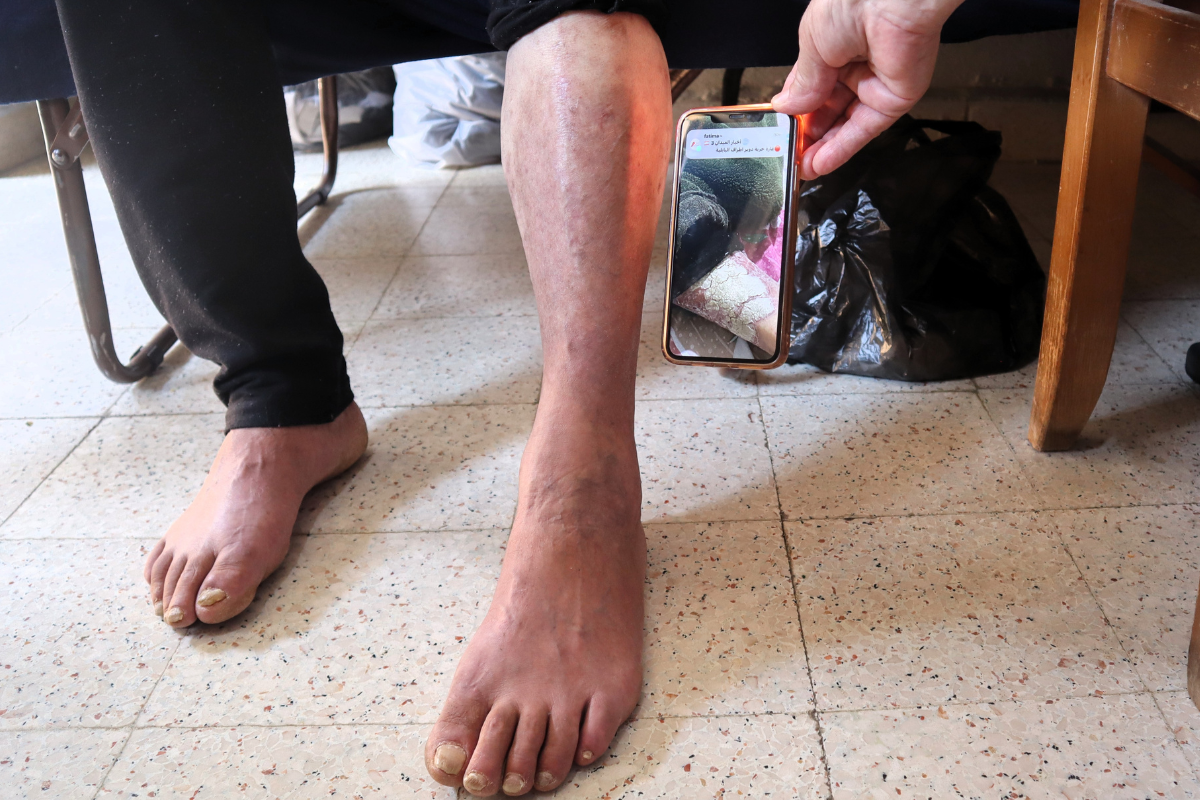
Youssef Atwi lifts his pants above his right knee. The skin, browned, shiny in places, remains irregular, as if torn off in patches. “That’s where the white phosphorus hit me. My skin was completely burned.”describes, in this month of June, this 60-year-old farmer from Khiam (south of Lebanon). This city destroyed by the Israeli army is today under its occupation.
On his wife’s phone, images taken a few days after the attack which injured him show a leg covered in thick white spots. Doctors consulted to whom we showed these photos believe that a link with white phosphorus is «très probable».
This article is freely accessible.
This is a strong commitment from our team, to allow everyone to learn for free about the ecological emergency and to make informed choices. If you can, make a donation to support our work over time and guarantee our independence.
I make a donation
According to Amnesty International, white phosphorus is an incendiary substance used to create a dense smoke screen or mark targets. When exposed to air, it burns at extremely high temperatures (up to 800 degrees Celsius) and often causes fires. Exposed people may suffer respiratory damage, organ failure, and other injuries with lasting consequences, including burns that are extremely difficult to treat.
Its use is governed by Protocol III of the Convention on Certain Conventional Weapons (CCW), to which Lebanon joined in 2017, unlike Israel. This protocol prohibits the use of incendiary weapons dropped from the air in areas where civilians are present, and strongly restricts the use of incendiary weapons fired from the ground.
“I had fire on me”
Youssef Atwi and his wife went through many ordeals as children of southern Lebanon: wars, occupations, deaths, displacements, destruction… But the couple never had to face the consequences of the burns caused by the incendiary weapon.
The episode dates back to June 2024, in the Khiam region. According to the whitephosphorous.info platform, created by researcher Ahmad Beydoun, who verified more than 248 incidents involving the use of white phosphorus, two distinct episodes affected the area on June 2 and 23, 2024.
Youssef Atwi does not remember the exact day but he remembers the circumstances perfectly. On his 10 hectare plot of land, he was harvesting watermelons when shapes, similar to large white balloons, appeared in the sky and released thick smoke. “I had fire on me, he describes today with grand gestures. I couldn’t breathe or see. I ran into the nearest lake to put out the fire.”
Two years later, the symptoms persist: itching, sores that reopen, impaired vision in the left eye. The couple and their two daughters, displaced several times since the start of the war in October 2023, with a brief return home in 2025, are now living in the north of Lebanon, they only took a few things with them, leaving behind the medical reports which we were therefore unable to access.
Israel has been at war with Lebanon since October 2023 and the opening of a front of support for Hamas from the south of the country by Hezbollah, a pro-Iranian Shiite political party with a powerful militia. During the latest escalation, underway since March 2, the Israeli army killed 3,826 people, injured 11,851 others and caused the forced displacement of more than a million residents. It continues its advances on Lebanese territory, after having demarcated a “buffer zone”, as during its occupation between 1982 and 2000, and has razed at least 65 towns and villages inside, including Khiam.
A wake-up call to states that supply weapons to Israel
“In 2026, but also in 2024 and 2023, white phosphorus has been used on several occasions by the Israeli army illegally over residential areas.”recalls researcher Ramzi Kaiss, of the NGO Human Rights Watch, who documented uses in several localities in southern Lebanon in 2023 and 2024. According to the organization, the Israeli army illegally used white phosphorus munitions during artillery fire above homes on March 3, in the town of Yohmor, in southern Lebanon. “Israel’s repeated illegal use of white phosphorus in Lebanon, along with other weapons, and attacks that have killed civilians at an alarming rate, should serve as a wake-up call to states that continue to supply weapons to Israel.”including France, continues Ramzi Kaiss.
The NGO Green Southerners, for its part, mentions around 181 occurrences since March, while specifying that this is a minimum. On June 7, she documented a white phosphorus attack above a residential area of Nabatieh, a town of 75,000 inhabitants which hosted many displaced people, and which was the subject of forced evacuation orders from the Israeli army on May 26, then on June 2. “We have not been able to identify any apparent military activity in this area.”explains its president, Hisham Younès. The use of white phosphorus “part of a broader pattern of intimidation, forced displacement and the transformation of civilian areas into increasingly difficult places to inhabit”he describes.
“There is nothing growing anymore”
Hussein Ezzedine fled Zawtar el-Gharbiyeh, in southern Lebanon, currently occupied by the Israeli army. Now moved north of Beirut, the capital, he tells us by telephone that he has lost everything: his three-story house, his citrus, avocado, wheat and legume plantations and his 35 sheep. “Of course they used white phosphorus! We feel it in the earth, because it has changed since the war: there is no longer anything that grows”he gets annoyed.
Since 2023, repeated strikes in southern Lebanon have caused «serious ecological disturbances»underlines Hassan Malkhlouf, professor at the Lebanese University and soil specialist: destruction of plant cover, sterilization of surface layers, disappearance of microbial life and organic matter, alteration of nutrient cycles and increased vulnerability to erosion. “In Mediterranean ecosystems, where soils are already fragile and subject to drought, the most worrying thing is not only the visible burning of forests and agricultural lands, but the progressive degradation of soil life. Once their biological balance is disrupted, their restoration is slow and requires rapid rehabilitation.explains the president of the Lebanon Eco Movement (LEM) association.
The Lebanese Ministry of Agriculture has detected high levels of phosphorus in some areas of the south, which it says pose no immediate danger to crops. According to official figures, almost 52,000 hectares of agricultural land have been damaged by all bombings since 2023 and almost 80% of farmers have been forcibly displaced.
Between the end of 2024 and the beginning of 2025, the American University of Beirut (AUB) analyzed more than 250 sites in Lebanon in order to assess contamination linked to white phosphorus. Initial results show total concentrations up to 400 times higher than natural levels in affected areas. Researcher Rami Zurayk (AUB) also took samples using samples provided by farmers. “Licareous soils fix phosphorus, making it poorly available. Contamination by heavy metals and contaminating entities associated with the massive destruction of homes [ainsi qu'aux frappes et aux bombardements, NDLR] will possibly cause more problems in the short and medium term than phosphorus.he observes.
For Roberto Reno, co-author of a study by Source international, Amel Italia and Amel association international published in May, the Israeli army uses the same techniques in Lebanon as in Syria and Palestine, particularly in Gaza, where white phosphorus was dropped. “The use of incendiary weapons, which include white phosphorus, creates scorched earth conditions rendering entire areas uninhabitable and collectively targeting civilian populations and their livelihoods.”says the president of Amel Italia.
“They want our land, our water, because it is a paradise for them”
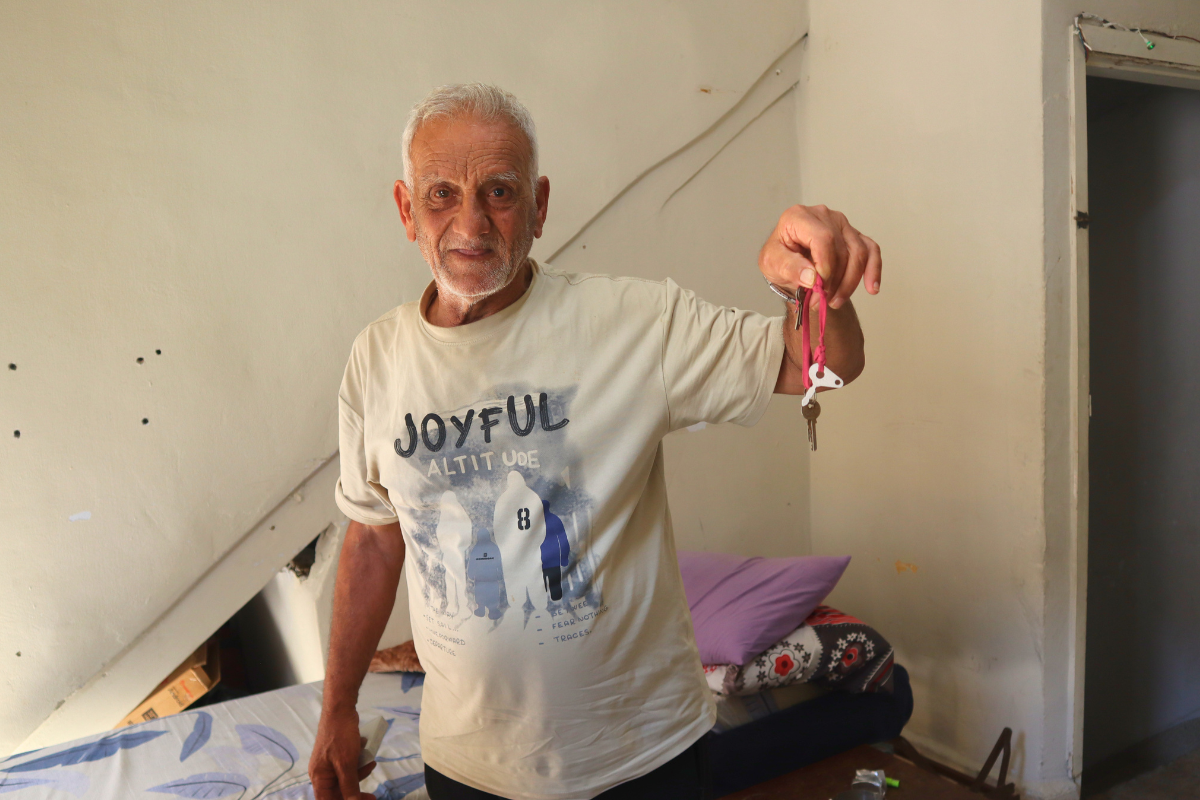
Far from his land in southern Lebanon, Youssef Atwi lights a new cigarette: “When we returned to our village after the ceasefire, the land was no longer yielding anything. Everything was dead because everything had been burned.” His 70 olive trees which allowed him to ensure a minimum of income were reduced to ashes or uprooted and, for some, taken to the other side of the border, according to him. For the couple’s eldest daughter, Israel is trying to destroy the population’s connection to the land. His mother (who did not want her name to appear) adds: “They want our land, our water, because it’s a paradise for them.”
The latter will soon travel to visit her children living in Canada. Youssef Atwi, despite their insistence, decided to stay in Lebanon, “unable to abandon his land”living with the scars of his burns, marked forever.
Contacted several times by e-mail, the Israeli army did not respond to us.