
The French government also banned this week from Eurosatory 2026 “offensive” weapons from Israel, and the stands of government organizations or those dependent on the Israeli government.
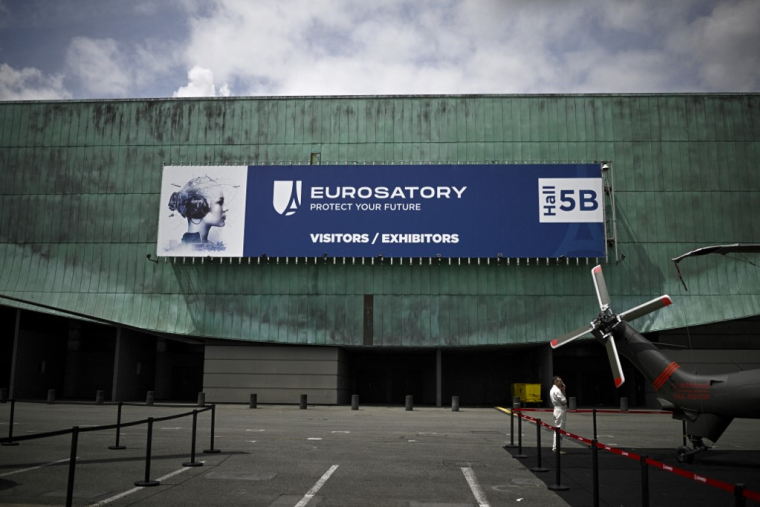
(AFP / JULIEN DE ROSA)
The Eurosatory arms fair will open in a week, while the Russian threat becomes more pronounced year after year, and the United States seems to be taking the path of unprecedented disengagement in Europe. The high mass of European defense will be marked by an exceptional presence of Ukrainian exhibitors and the limitation to “defensive” technologies of the Israeli Iron Dome, estimates the show commissioner.
The need to “prepare for war” in the face of this risk of an offensive by Russian President Vladimir Putin elsewhere in Europe is what sets the tone for this new edition of the biennial exhibition for defense and security professionals from June 15 to 19 in Villepinte, north of Paris, summarizes the General Charles Beaudouin, former senior official of the French Army.
This meeting is destined to become
“the receptacle” of geopolitical tensions and “uninhibited confrontations”
while state defense systems “are for the most part unsuitable” for modern conflict, including in France, he believes.
If Israeli exhibitors will be limited to defensive technologies, Ukraine will be able to present its missile with a range of 3,000 km or a large drone with a range of 1,600 km, from the Fire Point company, “which have done a lot of harm to Russia”.
“This is everything we don’t have in Europe,
and this will constitute a good challenge”, underlines the general.
“Europe is not putting itself in battle order today,” he laments. He evokes the “potentiality”, relayed by numerous observers and high-ranking French officers, of
a “window of opportunity” for Vladimir Putin to launch “an offensive” elsewhere in Europe
as the Ukrainian front stabilizes.
“It will be a completely different show than in 2024 when everyone was reassured, Biden was there and the Russians backed away from kyiv.” Donald Trump’s second term changed the situation. “There were 10 Ukrainian companies in 2024. There will be 80, an extraordinary presence,” announces Charles Beaudouin.
“The Ukrainians are so far in advance that we can only copy them,” he adds, recalling that it is “Ukrainian and not American specialists” who were invited to the Gulf countries, targets of Iranian drones.
On the other hand, “there is a feverishness of the States, which today will look for the material on the shelf” unlike previous shows focused on “futurist prospects”, he explains.
Another new feature revealing a change in perception:
“There will be a group of investors and banks” who have long been reluctant to finance defense.
“Today, they understand that the budgets are there” with in particular 36 billion additional euros provided for by the Military Programming Law in France and that the “era of happy modeling is over”, he concludes.
No offensive weapons for Israeli exhibitors
If the French government banned Israel’s “offensive” weapons this week from Eurosatory 2026, provoking the anger of Tel Aviv, private Israeli companies will however be able to exhibit “capabilities or bricks of capabilities relating to defense ground-to-air, anti-missile and anti-ballistic”, underlines the general.
During the previous edition, in 2024, France had initially decreed a “total” ban on Israeli participation, before the Paris commercial court judged this exclusion “discriminatory” and ordered, in the middle of the show, the reinstatement of the companies concerned.
With their very efficient “Iron Dome” anti-missile defense system which inspires even the United States, the Israelis will therefore be able to promote
capabilities “that we have never needed more”
in particular in front of the delegations from Saudi Arabia or the Emirates “which were hit by missiles”. “Governmental organizations or organizations dependent on the Israeli government are not allowed to have a stand,” specifies Charles Beaudouin.
Around thirty private exhibitors have been warned of the restrictions and will ultimately “necessarily” be fewer in number. “If, unfortunately, they don’t play the game (…) and the stands are ambiguous, they will never be at the show,” he warns, hinting at new twists and turns around Israeli participation.


