Negotiations to end the war in the Middle East appear increasingly compromised, with the Iranian news agency Tasnim affirming Monday that Tehran has broken off indirect dialogue with Washington, notably because of the Israeli offensive in Lebanon.
Tehran on Monday accused the United States of once again violating the fragile ceasefire concluded on April 8 after American strikes this weekend followed by Iranian military retaliations.
The decision to suspend negotiations was taken according to Tasnim because of the “crimes” that Israel “continues to commit” in Lebanon, and violations “on all fronts” of the ceasefire.
“The Iranian negotiating team is therefore suspending dialogue and text exchanges via mediators,” says the Iranian media.
According to diplomatic sources at AFP, an emergency meeting on Lebanon is planned for Monday at the United Nations Security Council, at the request of France, which estimated on Sunday that “nothing justified the major escalation underway in Lebanon”.
Israeli forces, who say they want to “eliminate” pro-Iranian Hezbollah, have advanced as never before in more than 25 years.
Iran had recalled earlier in the day through its Foreign Ministry that a ceasefire in Lebanon was “an essential condition for any agreement”.
– Drones “hostiles” –
Indirect negotiations have been slipping for weeks to end the war, triggered on February 28 by a joint Israeli-American attack against Iran.
Especially since Tehran reiterated on Monday that Iranian nuclear power was not part of the discussions “at this stage”, contrary to the expectations of Donald Trump, who affirmed on Sunday evening that a memorandum of understanding should stipulate “very clearly that Iran will not have a nuclear weapon”.
The American army announced that it had carried out a new wave of “defensive” strikes on southern Iran on Saturday and Sunday, the third in just over a week.
These bombings targeted radar and drone control systems in the city of Goruk and the island of Qeshm in the Strait of Hormuz, the US Middle East Command (Centcom) said on X.
The Revolutionary Guards, the ideological army of the Islamic Republic, claimed on Monday for their part to have attacked a base used by the American army for strikes against its territory, without naming the targeted country.
Kuwait says it intercepted “hostile” missiles and drones, attributing the attack to Iran.
Washington and Tehran had already accused each other on Thursday of violating the ceasefire in force since April 8, after American strikes on southern Iran followed by an attack on Kuwait.
The war has left thousands dead, especially in Iran and Lebanon, and is shaking the world economy by driving up oil prices.
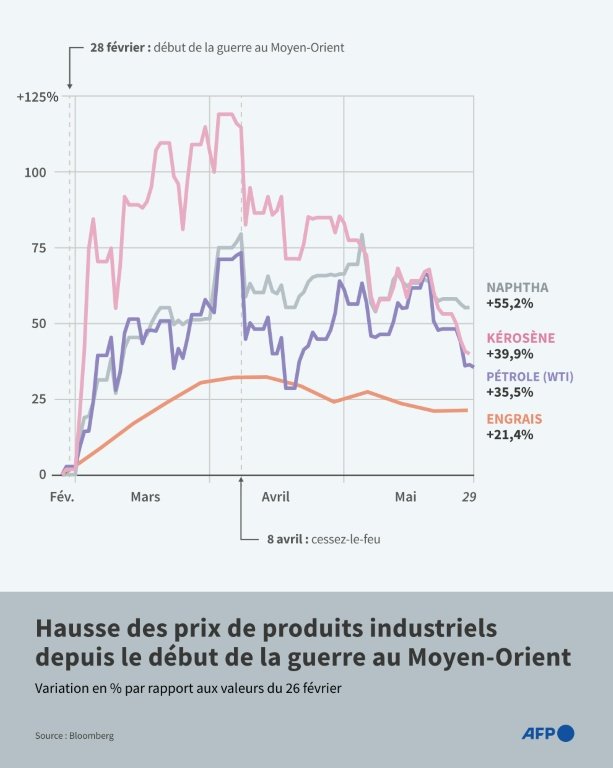 Since the end of February, Iran has been blocking the Strait of Hormuz, an essential sea route for the global transport of hydrocarbons, and the United States is imposing a blockade of Iranian ports.
The Iranian president promised Monday during a telephone call to the Japanese Prime Minister that his country would facilitate the passage of the Strait of Hormuz for Japanese ships.
While the two countries seemed to be moving towards an agreement in recent days, the New York Times reported on Saturday, without further details, that the American president had toughened his proposal and sent a new version of a memorandum of understanding to Tehran.
– Plus the fermeté –
According to the American site Axios, Mr. Trump, whose declared priority is to put an end to the Iranian nuclear program and to restore maritime traffic to Hormuz, wants more firmness from Washington negotiators.
CBS reported Sunday evening that the new American proposal provides for an extension of the ceasefire by 60 days with clauses for the reopening of Hormuz and a framework for a resumption of nuclear negotiations.
Iran, which claims its right to a civilian nuclear program, has always denied wanting to acquire atomic weapons, despite accusations to this effect from the United States and Israel.
He wishes to address this issue in a second step and demands the release of assets frozen abroad by American sanctions.
published on June 1 at 5:06 p.m., AFP