Report from Ukraine
In my four years working immersed in the front zones in Ukraine, no two years are the same. Each month brings changes and new dynamics, the conflict has truly transformed into a laboratory of innovations. The massive exploitation of drones, and particularly kamikaze FPVs, has radically redefined modern warfare. Precision has become surgical and the cost-effectiveness of these new weapons confirms that there will be no going back. These technologies now constitute the heart of the issues and strategies of the Russian-Ukrainian conflict.
As war reporters, we must relearn how to operate on a battlefield which has extended its perimeter of lethality to a death zone known as the “Kill Zone” which now exceeds twenty kilometers from the front lines. For several weeks, I was able to accompany a company of drone pilots, “Sapsan” (hawk), observing their daily life in this mortal space, their movements and the means they use to defend themselves against an omnipresent threat coming from the sky.
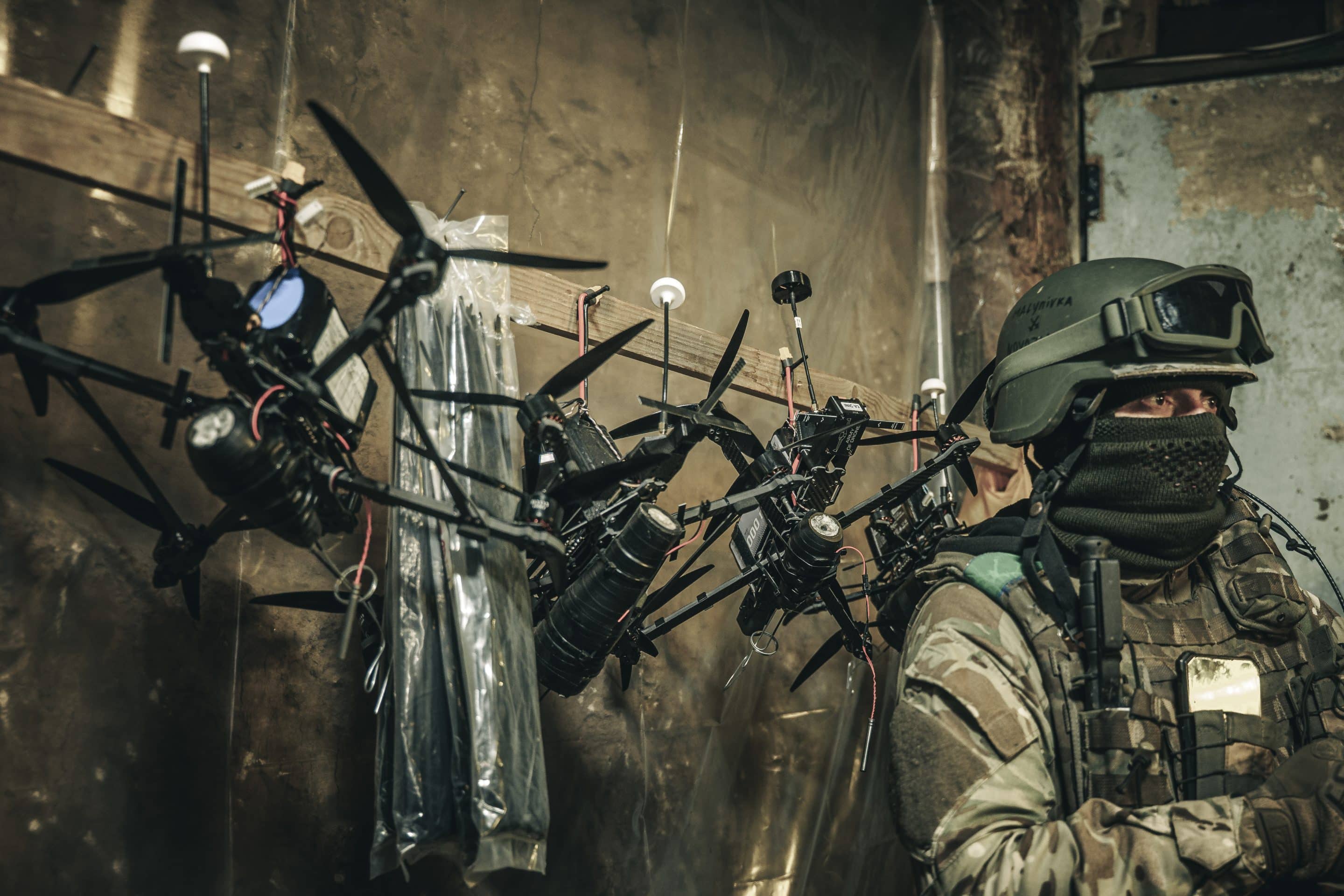 Photo of “Fish”, commander of the drone company “Sapsan”, in position in an “armour” four kilometers from the first lines. In the main room, four kamikaze FPV drones are fixed to the earthen wall, kept ready to be deployed at the slightest signal from the operator.
Drone pilots have become priority targets for the Russian army, and vice versa. The effectiveness of a drone pilot in decimating the adversary is unparalleled. The use of this type of weapon raises deep ethical questions, but the reality of this conflict makes it unavoidable. I spent Christmas Eve with drone pilots. One of them, aged 23, named “Papa Bear”, confided to me: “You know, we pilots are the most effective and deadly weapon on the front. I’ve been a pilot for two years and I think I’ve killed or injured approximately 500 Russian soldiers. You can imagine that we are priority targets. HAS”
Drone pilots face the same front zone dynamics as artillery units
Everyone must go to the heart of the “Kill Zone” to operate in position. Those of the drone operators are located between three and eight kilometers from the contact lines, whether they are the pilots of bomber drones (of the Vampire type, nicknamed “Baba Yaga”) or kamikaze drones. Access and crossing this front perimeter are considered more dangerous than remaining in forward shelters.
About every four days, Ukrainian soldiers rotate, bringing in a rested team with resupplies and bringing out pilots and operators who have worked non-stop for four days and nights. This rotation is expected by the Russian army, and it is precisely this moment which concentrates the greatest danger. The most delicate part remains the exit. One of the strategies consists of letting the pick-ups enter the “Kill Zone”, observing the drop-off point and anticipating the return journey to target the vehicle. This allows two things: to identify the position, if it corresponds to that of drone pilots, and to identify the exit path used for rotation to cover access with FPVs.
I completed more than six rotations with the “Sapsan” company, including four with Commander “Fish”, a close friend. Since the constant presence of drones in the death zone, nothing really prepares us for the anxiety we feel when crossing.
There is always this moment when the driver informs you: “Stay focused, we’re getting back to the zone”, and yet, nothing changes drastically seen from the inside
This distinction from the environment is made through the experience of the soldiers, who know the most targeted roads, edges and crossings.
Fear mounts, we feel hunted, our gaze instinctively searches for a movement outside, a flying object, and the deeper we penetrate this perimeter, the more lethality increases. In an emergency, the commander had to go to position, I accompanied him in his “War Raptor” buggy, without drone detector or jammers. While driving at more than 80 km/h on the paths, he said to me: “If you have the chance to see or hear an FPV, jump. HAS”
Addiction to mobile jammers
Both armies had to improvise new protections. From 2023, pick-ups and 4x4s are favored for transporting soldiers in position. Faster, more maneuverable and less targeted than armored carriers, these light vehicles have become the norm. Faced with the increase in Russian FPVs, Ukraine has gradually equipped its vehicles with jammers, these systems emitting waves on several frequencies, capable of jamming the signal between the pilot and his drone. The first covered three to four frequencies.
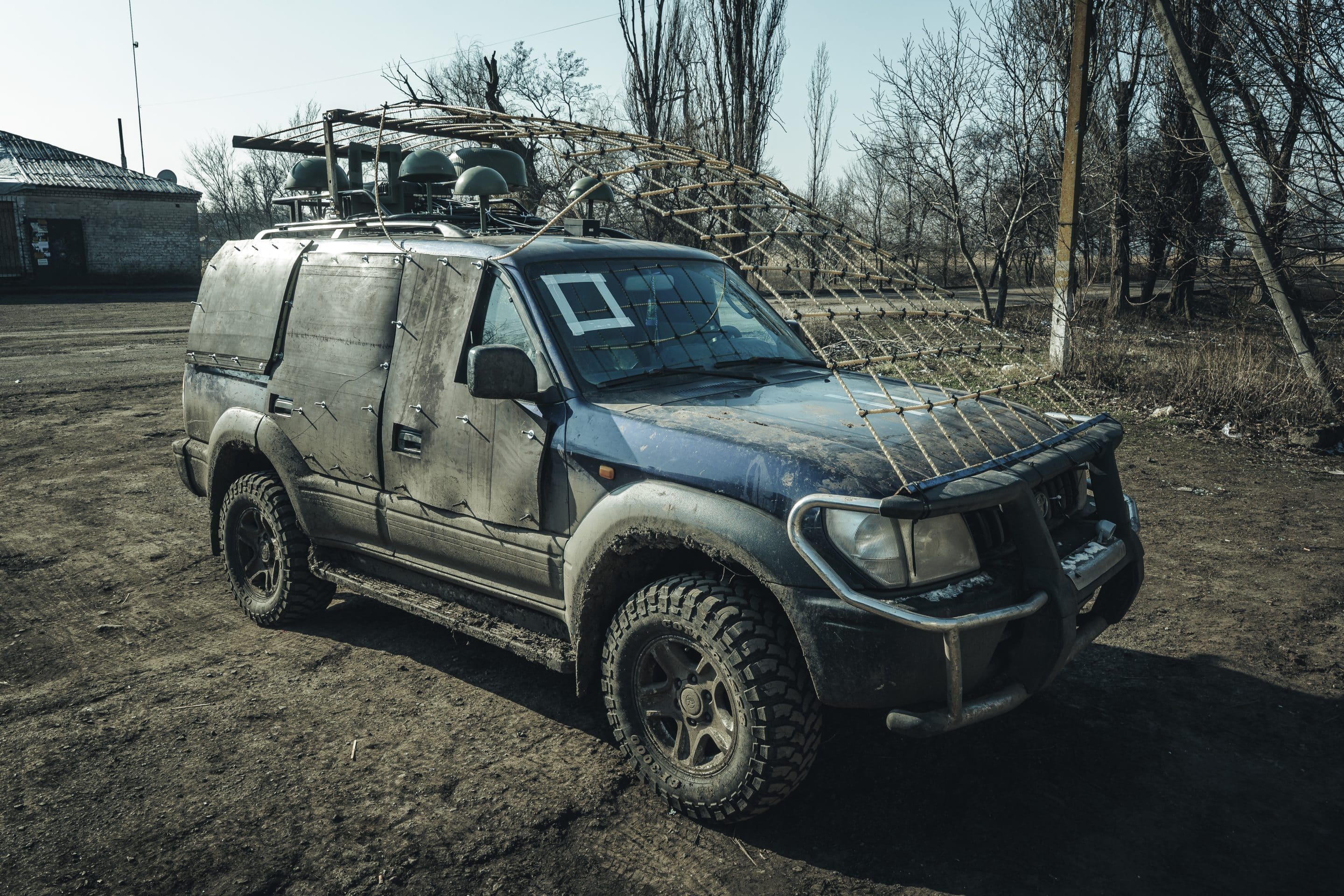 Photo taken around Pokrovske, showing protective equipment commonly used on light vehicles at the front. This Toyota Land Cruiser is heavily modified to survive the “Kill Zone”: a REB (jammer) system on the roof, thick rubber panels on the windows and a full anti-drone mesh intended to neutralize or deflect the charges of kamikaze drones.
From the beginning of 2025, the electromagnetic warfare battalions recommended covering more than twelve to guarantee minimum protection. However, a new technology has come to disrupt this balance: FPV equipped with optical fiber. Connected to the transmitter by wire, the jammers no longer have any impact. These slower drones allow pilots to fly at low altitude, land between five and ten kilometers behind the front, and wait for a vehicle to pass. Taken by surprise, the latter can hardly avoid the attack.
This technology does not replace radio frequency drones; on the contrary, it adds a new danger to the “Kill Zone”.
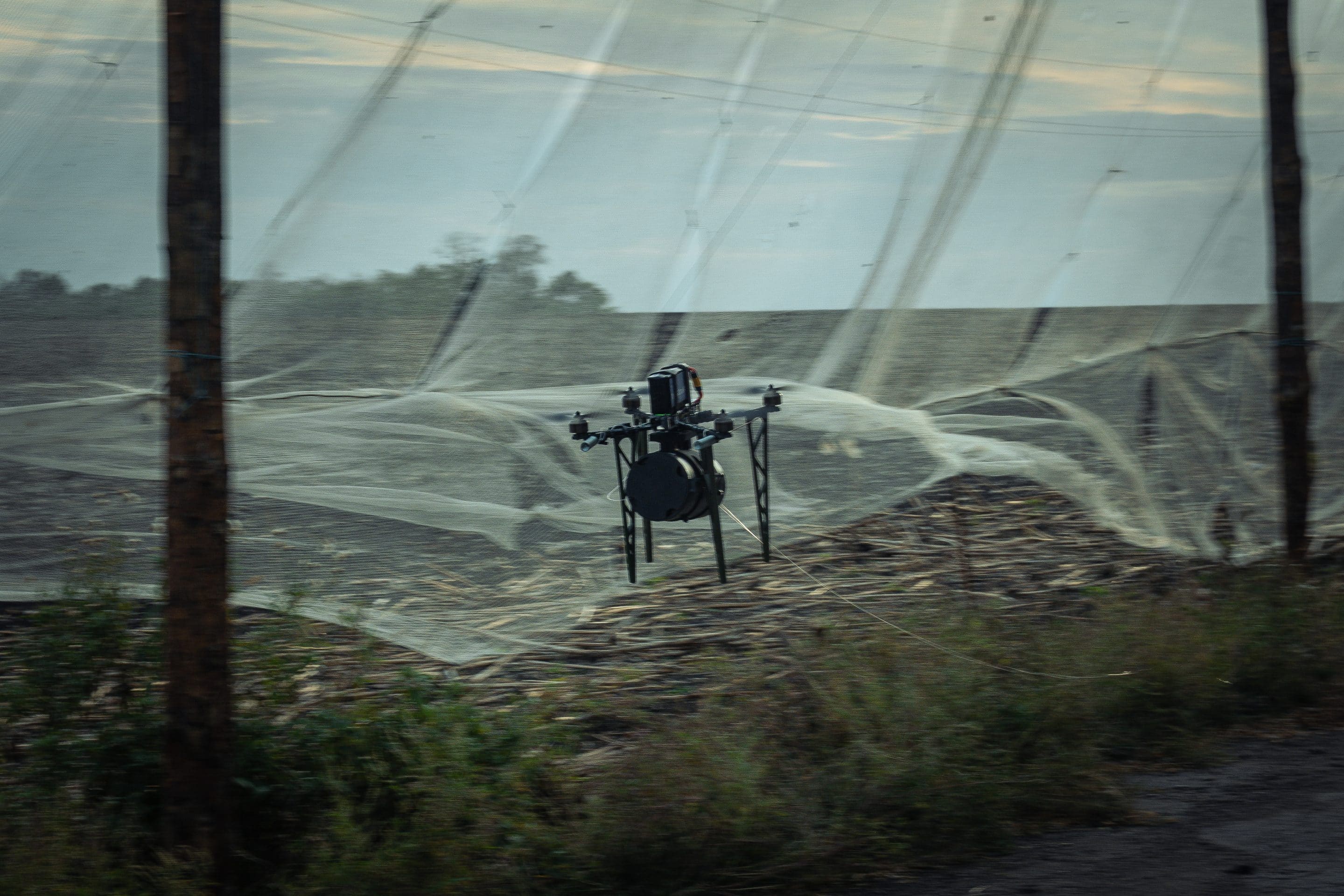 Photo of a fiber optic FPV drone in the testing phase, equipped with a new deployment coil. If this wired system makes it possible to circumvent electronic jamming (REB), the weight and deployment of the optical fiber significantly modify its flight characteristics compared to current radio-controlled models.
Cages, pellet guns and fishing nets
In addition to the jammers, there are now cages mounted around the bodywork, nets, fences and metal plates. These homemade shields considerably increase the occupants’ chances of survival. We will also mention the famous hedgehog tanks, these machines weighing more than fifty tonnes covered with metal stakes. Soldiers also use pellet guns as a last resort, usually when operating on foot or in the back of a pick-up truck.
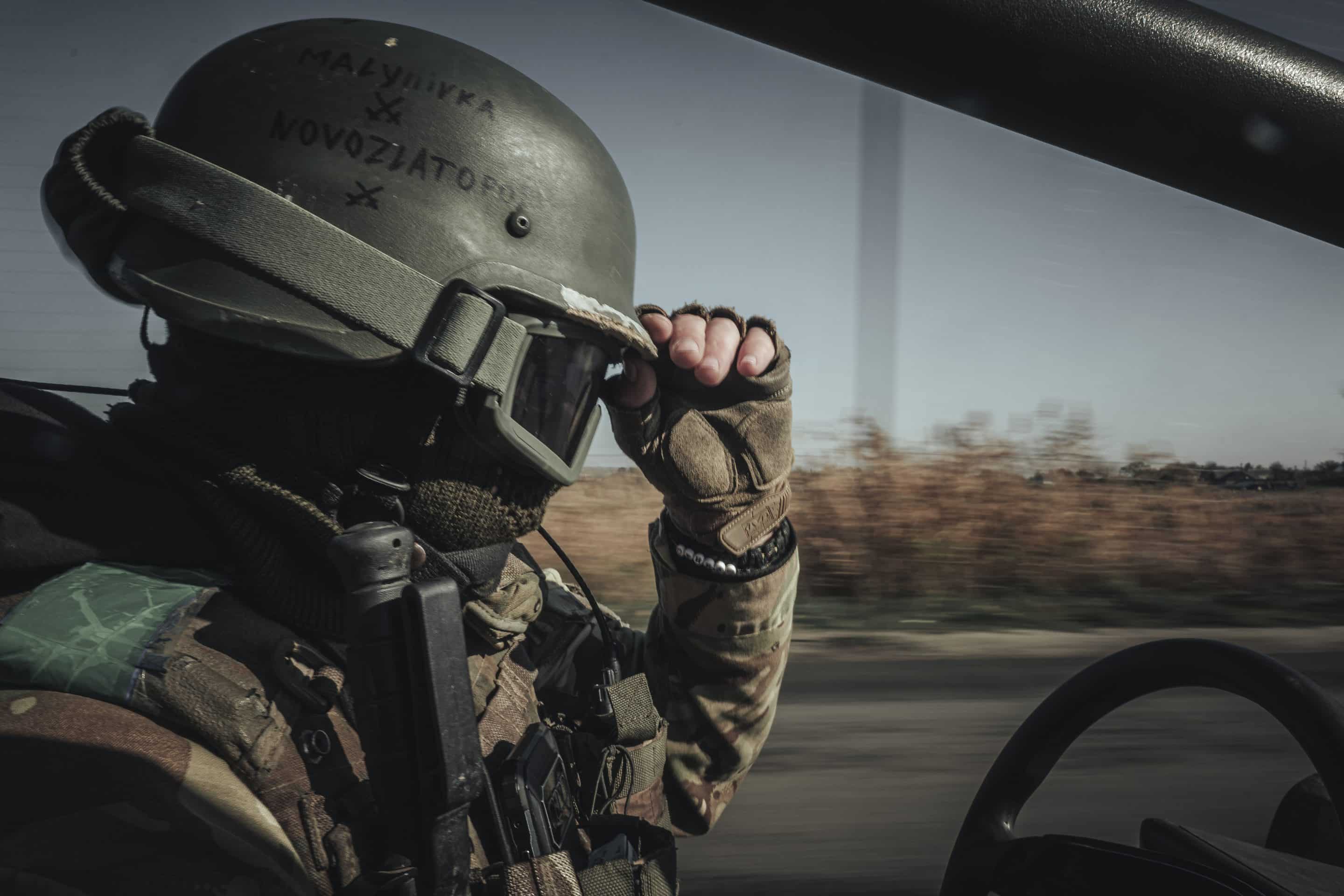 Photo of “Fish”, commander of the “Sapsan” drone company, leaving the safety of the anti-drone nets and telling me that we are entering the deepest part of the “Kill Zone”.
In anticipation, the Ukrainians are installing anti-drone nets above strategic axes, deploying tunnels of fishing nets covering hundreds of kilometers of major roads
In this war, drones assembled with Chinese parts and 3D printed components costing less than 800 euros can destroy vehicles worth several million euros, but are stopped by Finnish fishing nets and lead intended for partridge hunting…
Artificial Intelligence comes into play
In recent months, Ukraine has invested massively in anti-drone defense technologies. Two Ukrainian companies working in cooperation opened their doors to me about a project in the finalization phase which could radically alter the dynamics of the conflict.
One manufactures small machine gun turrets equipped with rapid motors allowing them to rotate in the blink of an eye. The second produces optical identification systems based on AI, integrated into a 3D printed case, rustic and inexpensive. This software detects a drone, identifies it and anticipates its trajectory, simulations and tests have demonstrated a success rate exceeding 90%: less than two seconds to identify and destroy two FPVs flying more than 70 meters, one shot for each. any type of vehicle, in addition to jammers.
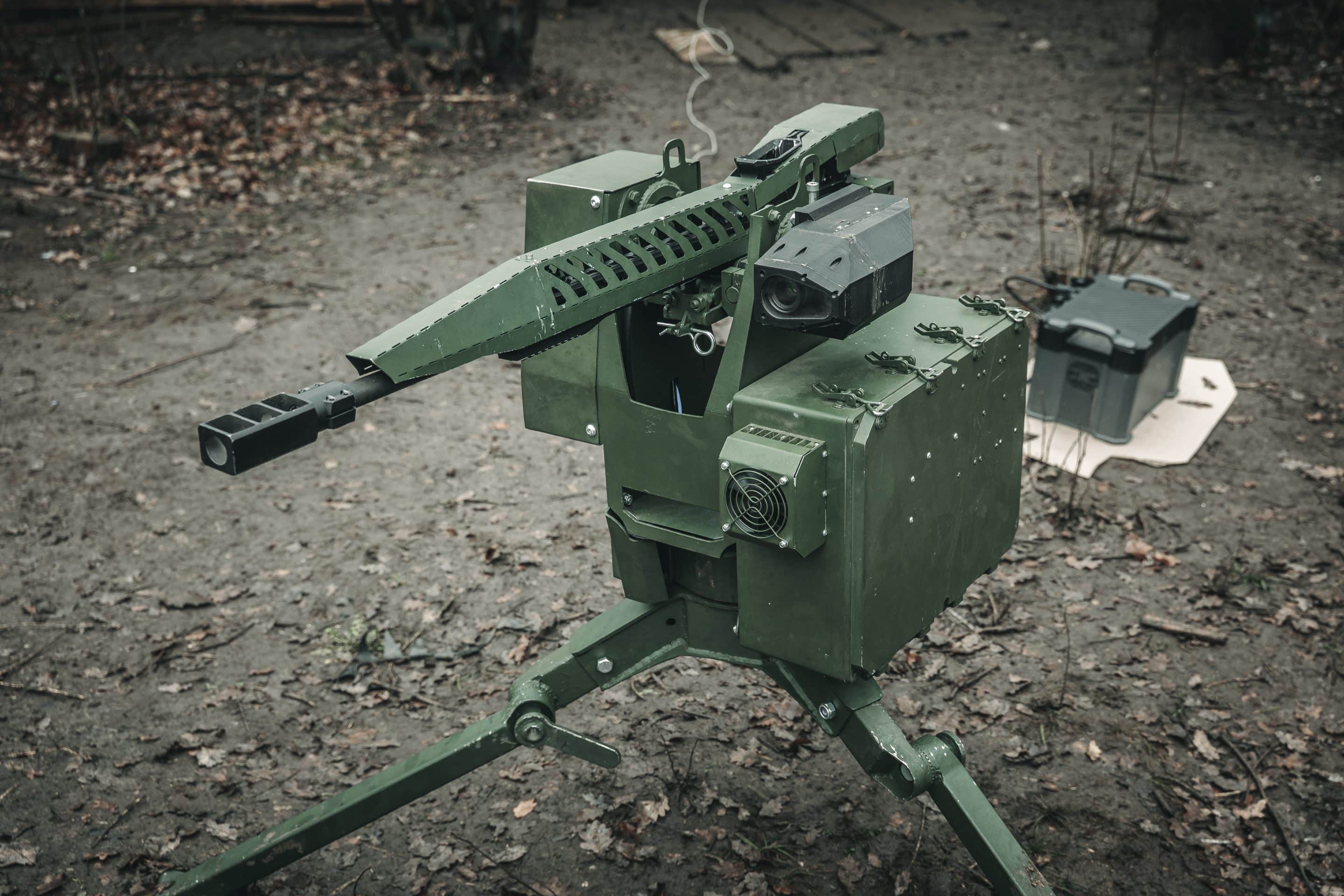 Photo of an anti-drone machine gun turret in the testing phase, equipped with automatic identification optics by AI. This type of emerging technology aims to automate the defense of positions and vehicles in the face of airspace saturation by drones.
It is this type of equipment that is lacking in the “Kill Zone”, which would protect soldiers in position and on the move. Commander “Fish” came home one evening and said to me: “Tough day my friend, we were attacked seven times by FPVs. » Two weeks later, a young soldier from “Sapsan” was killed in position.