The Pentagon has unveiled its 2027 budget, marked by a significant increase in defense spending to 1.504 trillion dollars. Drones take center stage, with nearly 75 billion dollars allocated to these systems and their countermeasures.
Last week, the Pentagon detailed the budget it is seeking from Congress for fiscal year 2027, starting on October 1, 2026. A clear standout in the various budget lines is the growing importance placed on drones and “associated technologies.”
Overall, this budget proposal includes a 42% increase in defense spending, totaling 1.504 trillion dollars. A significant portion of this budget would be dedicated to unmanned systems, with nearly 75 billion dollars set aside for drones, as well as technologies aimed at neutralizing them, indicating a heightened militarization of this sector.
Additionally, 54.6 billion dollars would be allocated to the Defense Autonomous Warfare Group (DAWG), a Pentagon entity established during the Trump administration, which last year integrated the Replicator initiative launched under Biden in 2023 to deploy a fleet of flying objects with associated technologies to rival China.
This investment alone would place this program among the top ten largest military budgets globally, surpassing countries like Ukraine, South Korea, or Israel, as noted by Ars Technica.
Bloomberg explains in detail that these funds will be used to increase drone production, train operators, develop deployment logistics networks, and enhance anti-drone capabilities. Jules Hurst III, Acting Under Secretary of Defense and Pentagon Comptroller, stated, “Drone warfare is rapidly reshaping the modern battlefield. This budget represents the largest investment ever made in the United States in drone warfare and anti-drone technologies.”
Context:
The Pentagon’s proposed budget for 2027 emphasizes a significant increase in spending on drone technology and associated defense measures.
Fact Check:
- The Defense Autonomous Warfare Group (DAWG) was established under the Trump administration and integrated the Replicator initiative launched in 2023 during the Biden administration.
- The budget proposal aims to allocate funds for drone production, operator training, logistical networks, and anti-drone capabilities.
A new military reality
The growing emphasis on drones reflects a profound evolution in modern military tactics, influenced notably by the conflict in Ukraine. Small drones, long-range attack models, and disposable devices have proven their effectiveness on the battlefield, prompting rapid adaptation by armed forces. Iranian Shahed drones, widely used against infrastructure in Middle East conflicts, exemplify this new trend.
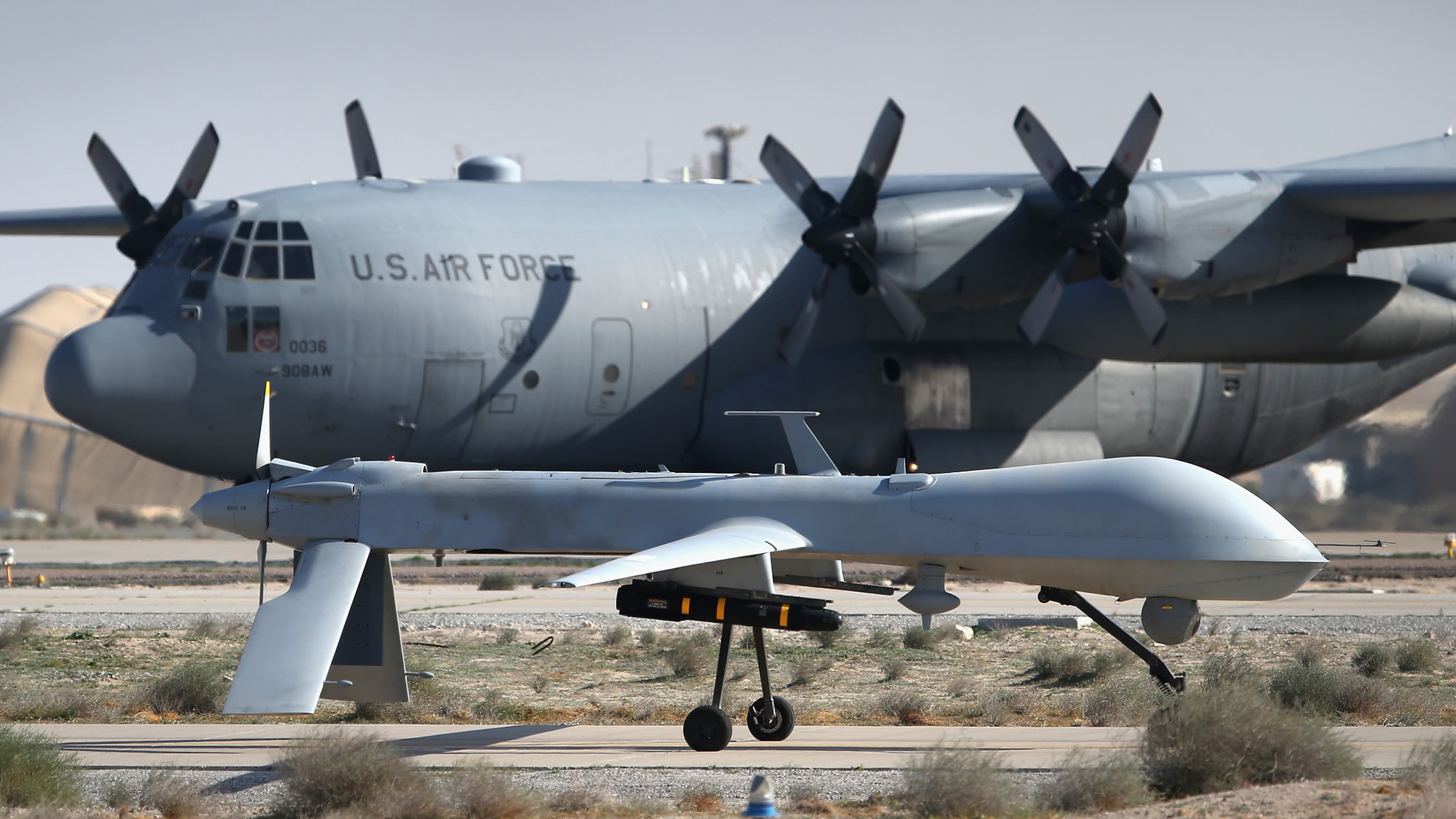
Caption: A MQ-1B Predator drone from the US Air Force, carrying a Hellfire air-to-ground missile, flies past a C-130 Hercules cargo plane at an airbase in the Persian Gulf region on January 7, 2016 (photo illustration). Photo by JOHN MOORE / GETTY IMAGES EUROPE / GETTY IMAGES VIA AFP
The United States has been utilizing drones for a long time. The American military relies on models like the MQ-1B Predator and MQ-9 Reaper in counter-terrorism operations, but is now aiming to integrate lighter and less costly systems at the core of its military strategy.
Current American drones, excluding programs like LUCAS, remain particularly expensive. According to CBS, eight MQ-9 Reaper drones have been lost in the Middle East since April 1, bringing the total number of drones destroyed in the Iranian conflict to 24. The estimated cost is around 720 million dollars, with each drone valued at 30 million dollars or more, depending on the version.
Furthermore, the Pentagon plans to deliver “tens of thousands” of drones to the military this year, followed by “hundreds of thousands” by 2027, totaling around 340,000 units in two years. This is a significant effort but falls short of the production rates observed in Russia and especially Ukraine, where Kiev aims to produce 7 million drones this year, compared to 800,000 in 2023.



:fill(black)/2026/06/10/6a294e3fc793d039607152.jpg "Coupe du monde : un couvre-feu pour les moins de 16 ans à Clermont-Ferrand")