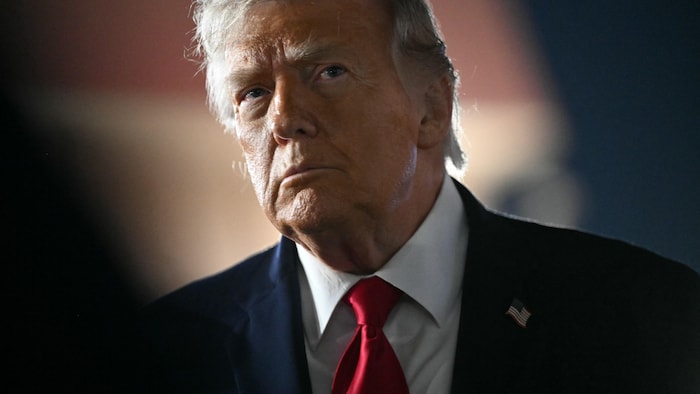
After a brief reopening, Iran has once again closed the Strait of Hormuz on Saturday, declaring that this strategic maritime route would not be reopened as long as the United States continues its blockade of Iranian ports, a form of “blackmail,” according to Donald Trump. This hardening comes amidst diplomatic efforts to end the war in the Middle East, beyond the two-week ceasefire that began on April 8 between Iran and the United States and is nearing expiration. Faced with the maintenance of the blockade by the United States, Iran made a U-turn on Saturday, asserting its intention to control traffic through the Strait of Hormuz until the end of the war, following its decision the previous day to allow the passage of a “limited number” of tankers and commercial ships.
“They are playing the clever ones,” reacted Donald Trump, believing that there could be no “blackmail.” However, the American president stated that there were “very good conversations” towards a lasting cessation of hostilities. The president of the Iranian parliament, Mohammad Bagher Ghalibaf, mentioned “progress,” but specified that the two countries were still “far away” from a final agreement. Earlier, the Iranian Supreme National Security Council had said to be reviewing new proposals from Washington and promised to make “no compromises.”
Context: The article discusses the recent escalation in tensions between Iran and the United States, particularly relating to the closure of the Strait of Hormuz.
Fact Check: The content mentions the United States continuing its blockade of Iranian ports as a reason for Iran closing the Strait of Hormuz. This reflects the ongoing geopolitical challenges in the region.
Tensions and threats:
After over a month of a war that has resulted in thousands of deaths, primarily in Iran and Lebanon, and shaken the global economy, the announcement on Friday by Tehran of the reopening of the strait had boosted financial markets and caused a significant drop in oil prices, as a fifth of the world’s crude oil and liquefied natural gas normally transits through Ormuz. While some ships were able to pass through the strait during its temporary reopening on Saturday, others faced shots and threats from the Iranian army.
Any ship approaching the strait will now be “targeted,” warned the Revolutionary Guards, Iran’s ideological army. Negotiations continued behind the scenes, with the Egyptian Foreign Minister Badr Abdelatty stating that he was “working tirelessly” alongside Pakistan towards a “final agreement.” Direct talks between Iran and the United States, the first in person at such a level since the 1979 Islamic Revolution, were held on April 11 and 12 in Islamabad but failed.
Context: The escalation in tensions surrounding the Strait of Hormuz has implications for international trade and security in the region.
Fact Check: The involvement of various countries and organizations in trying to address the situation indicates the complex dynamics at play in resolving the conflict.
“Losing our place“:
In Lebanon, another front, a French soldier was killed on Saturday, and three others, including two seriously, were wounded in the south in an ambush against peacekeepers. The attack was attributed to the pro-Iranian Hezbollah, which, however, denied any involvement. UN Secretary-General Antonio Guterres “strongly condemned” the attack and urged all parties to respect the 10-day ceasefire that came into effect the previous day in the country.
Context: The content touches on the spillover effects of the conflict into Lebanon and the challenges faced by peacekeepers in maintaining stability in the region.
Fact Check: The mention of UN condemnation of the attack underscores the international community’s concern over the escalating situation.


/2026/06/10/6a28930de28d1465956743.jpg "Guerre au Moyen-Orient : les Etats-Unis annoncent des frappes \"proportionnées\" contre l'Iran après l'attaque d'un hélicoptère américain")