The first days of September 1939 dawned warm over the Lehigh Valley. Normally this would be late beach weather and there were crowds at New York's World's Fair. But there was nothing normal about this late summer as radios were blaring the news that World War II had begun with the German invasion of Poland and a declaration of war by England and France.
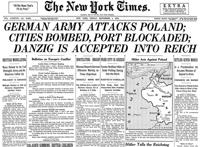
New York Times front page, September 1, 1939Â
“Those who had not kept their radios on all night,†noted the New York Times, “awoke with fingers itching to flip the switch. And those who either had no set or preferred to listen outdoors crowded around loudspeakers in taxis, bars, restaurants and neighborhood shops. Wherever word was being received by air eager knots of listeners mulled over, argued, disagreed, mocked or approved.â€
Crowds gathered in front of the Times building at Times Square. A photo that appeared in the newspaper shows the backs of many heads looking up at the electronic sign that carried the news. “Around the Times Building,†noted the newspaper, “in glowing letters five feet high rippled the same story… out-of-towners who had never seen it before leaned against buildings and stared…newsboys were shouting “’War Extras.’â€
Outside the cities the news was spreading as well. In an interview several years ago, the late George Hurd, a Bethlehem Steel executive, recalled standing in front of the clubhouse of the Saucon Valley Country Club with his usual foursome that included Steel president Eugene Grace. When they heard the news, Grace turned to the others. “Gentlemen,†he said, “we are about to make some money.†Then they played golf.
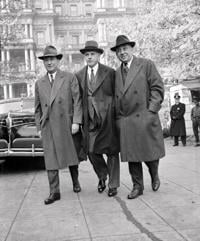
Eugene Grace, center, arriving at a labor summit in Washington D.C., November 13, 1941, weeks before the U.S. entered World War II.
Word was circulating that on the afternoon of September 3 Fritz Kuhn, leader of the American Nazi party, otherwise known as the Germen American Bund, was going to be addressing a rally in the town of Sellersville. In other circumstances it might not have drawn the attention of the national press. But the outbreak of the war made it news. The Times thought it significant enough to send a reporter or perhaps had a “stringer†already there.
The local press was also preset, represented by Allentown Morning Call reporter Gordon Fister and photographer William “Bud†Tamblyn. Both were known in the Valley. They were something of a politically odd couple. Fister, an ardent Republican, and Tamblyn, a strong Roosevelt Democrat. Fister had a knowledge of German but no love of Nazis. Both men recalled it many years later and how they knew they were in a hostile crowd.
The 30s was a tumultuous time and demigods and dictators offered a variety of panaceas and political snake oils to appeal to those seeking relief. America had Huey “Every Man A “King†Long, Gerald L.K. Smith and his Knights of the Silver Shirts and Father Coughlin the “Radio Priest†broadcasting from his Shrine of the Little Flower were among the better known of the day.
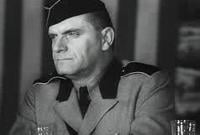
Fritz Kuhn in 1938
Fritz Kuhn was among those with a foreign link. He was a German chemist who immigrated here in the 1920s who had fought in the German Army in World War I. He became a supporter of Hitler and created the German American Bund, a Nazi allied organization. Some sources claim Hitler was rather cold to his movement at first, perhaps because he felt there was only room for one Supreme Leader.
In any event, thousands of like-minded folks were attracted to his banner. In 1939 he held a huge rally in New York's Madison Square Garden with large banners of George Washington. Uniformed storm trooper marched through the aisles, shocking some of those present.
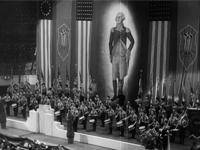
1939 rally in Madison Square GardenÂ
Kuhn had a private life that belied his proclaimed virtue, frequenting nightclubs. Sherman Billingsly's Stork Club was a favorite and not just with Kuhn. Others at the popular see-and be-seen venue included FBI Director J. Edgar Hoover and New York District Attorney Thomas Dewey. “Say, where is your friend?†Kuhn asked Dewey's detectives who were tailing him. “I bet he's at the Stork Club-that's where I am always running into him.â€
For whatever reason or for no known reason he selected Sellersville to give his speech about the outbreak of the war. It had a strong German American community around it, a local ethnic social club, the Deutschhorst Club (the German Eagles Nest Club) which was created on 40 acres by the Bund in August 1938. Germany had gone through some hard economic times in the post war years. Hitler made Jews the scapegoat for the genocidal horror he was about to unleash on them and the world.
Over the years Tamblyn and occasionally Fister would recount tales of their Sellersville adventure that day. When they arrived, a crowd estimated at over 2,000 was present. Most were not members of the small community itself but were from the surrounding region of eastern Pennsylvania. A platform draped with large American and swastika flags greeted them.
Tamblyn had gotten his job at the Morning Call through his friendship with the newspaper publisher, Donald P. Miller, who, according to Tamblyn, he had gotten to know working on the Allentown High School's newspaper. Tamblyn had lost his job at a local furniture company at the start of the Depression and had been working driving a horse-down milk wagon, something he was not happy with.
Fister and Tamblyn drove down that Sunday early and were there before Kuhn arrived. Like most newspapers, Morning Call hired residents of outlying areas to keep track of events and potential stories. In this case it was Sellersville native Robert “Bert†Baum, son of local artist Walter Emerson Baum, the founder of Allentown's Baum School of Art. Bert Baum even kept up a membership in the Deutschhorst Club. Asked why many years later, he said, perhaps sarcastically, “well they had great German beer.â€
A crowd had already gathered and as Tamblyn remembered it, they were not at all friendly. When Tamblyn raised his camera, uniformed men began to chase him. “He's a spy! Throw him in the river!†they shouted. Tamblyn began to run, trying to both protect his camera and himself from being doused in a nearby stream. “I felt like I was in Nazi Berlin, let me tell you!†Tamblyn recalled. Fortunately, he and Fister were able to retreat to their car and apparently remained there until Kuhn arrived.
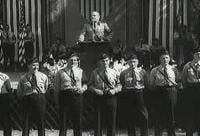
Kuhn speaking at a German American Bund rallyÂ
Kuhn, dressed in a business suit, mounted the platform and after an arm's length Nazi salute began his remarks. They appear roughly the same in both the Morning Call and the New York Times. No name is given for a Times reporter, which was not uncommon with the paper at that time. Fister later recalled that he kept a pencil deep in his pocket and wrote what he did that way.
Kuhn, who laced his remarks with references to FDR as “President Rosenfeld†and his “government by the Jews†began with a justification for Hitler's invasion. “What is wrong with Hitler looking for raw materials in other lands? Hitler had to act. His only choice was to get to Russia. That was why he had to go through Poland.†Kuhn added that he had no doubt that “Hitler could lick England, France or the whole world if he wanted.''
Kuhn knew that Hitler's major concern at that point was to keep America neutral. There would be time for war with them later. That day in Sellersville it was Kuhn's chief message. “The Bund stands for absolute neutrality,†he told the crowd. “Not a single shell or a single pound of food is to be sent to the belligerents. You can best serve the fatherland and show your heart is with Germany by being absolutely neutral. We will see how far the Jewish warmongers go; how far our youth will be driven into war.†G.W. Kunze, the Bund's public relations man added, “I would not want to be in England's shoes for nothing.â€
With that Kuhn, with a better understanding of the role of publicity than his followers, had several photographers up to the reviewing stand to take pictures. Among them was Tamblyn whose pictures were run in the next day's Morning Call. Baum's photo of Kuhn addressing the crowd, taken with a 49-cent box camera he purchased that morning, was later in newspapers across the country.
The New York Times did not have any photos of the Sellersville event. There unnamed byline ran simply “Special to the New York Times.†It has been suggested that perhaps Baum was also “stringing†for the Times as well as the Call.
The next morning’s papers with the Sellersville story had headlines that blared about the German U-boat sinking of the British liner Athena on its way to Canada, filled with refugees, almost 300 of them Americans. Most appeared to have been rescued but many Americans must have recalled that unrestricted submarine warfare was a major cause that led the country into World War I.
The Sellersville rally was in many ways a high point for Kuhn. Eventually the FBI's G-Men and New York District Attorney Thomas Dewey's detectives were on his trail. He served time in prison later. He was returned to Germany when the war ended and died there at the age of 55 in 1951, long after his fuehrer was dead by his own hand.