ORCHARD PARK, N.Y. — Environmental experts say that with climate change, the warning for a worse tick season compared to the previous one is going to be common. This year is no different.
What You Need To Know
- Peak season for nymphs will be in early May instead of mid-May or June
- Second peak, when ticks are adults, will be in August
- It’s projected 80% of nymphs have Lyme disease this year in some areas
These numbers from the Centers for Disease Control and Prevention show emergency department visits for tick bites in the Northeast from the week ending on April 26. The data dates back to 2017, and it shows that this year, there have been a lot more cases.
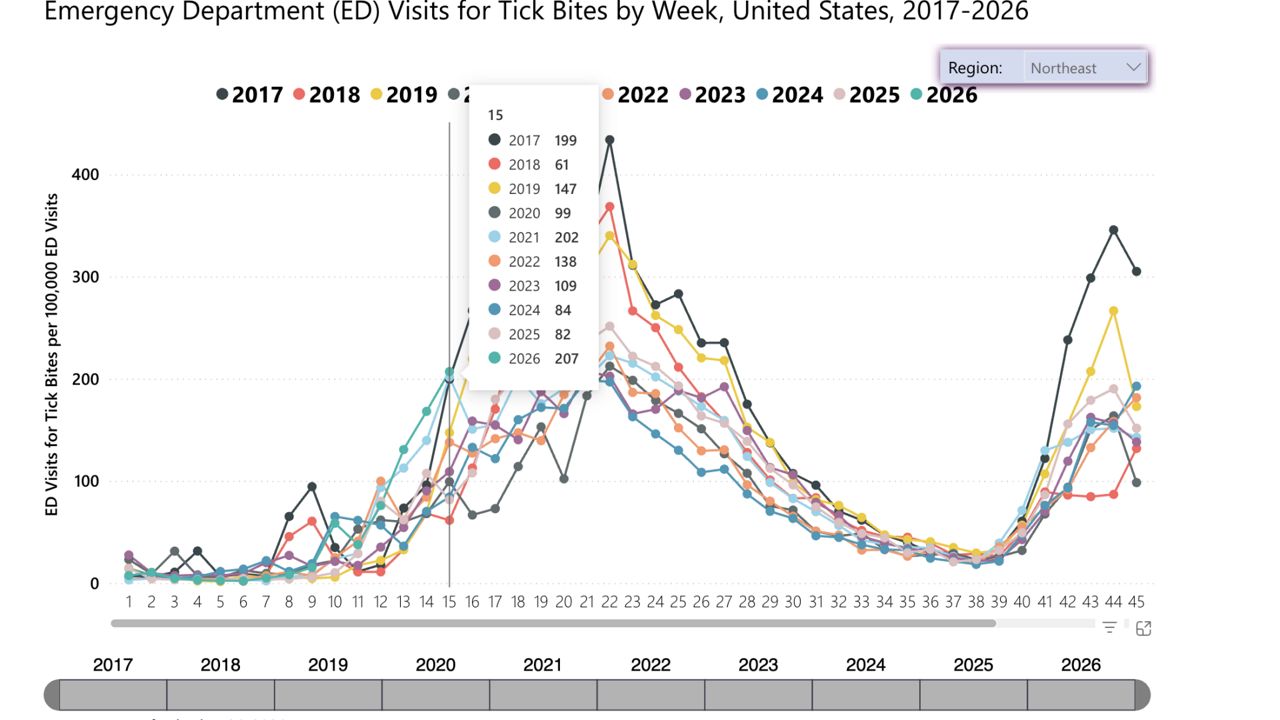
The data makes the case for safety reminders and an explanation of why this year, besides climate change, the tick season is projected to be one of the worst. First, it only takes the temperature to be just above freezing for ticks to be active. They’re hiding in leaves and on tree branches and bushes.
Right now, we are in the nymph stage of the black-legged (deer) tick. This is a tick’s third stage of life, so they are small, the size of a poppy seed. Supervising Park Ranger Chuck Bartlett for the Erie County Parks Department says the nymphs are what typically give people Lyme disease. Not adults.
So why are we expected to see more ticks and disease? Bartlett says a lot of it has to do with a large amount of acorns mast a couple of years ago.
“So what that does is it increases the food source for, primarily, small mammals, like mice,” Bartlett said. “We had a large mouse population, so they’re more likely to feed on a mouse. Once a mouse is infected with Lyme disease, for every tick that feeds off of the mouse after that, they’ll have Lyme. All the larvae last summer that got infected with Lyme; they hunkered down, and those are the ones that are starting to come out now.”
Bartlett is warning that the number of nymphs infected with Lyme disease has doubled, projected at 80%. It takes 24 to 48 hours for a tick to transmit the disease to you. Peak will be in a matter of days, earlier than normal.
Here are preventative measures via Bartlett and the CDC:
- Wear light-colored clothing
- Tuck your pants into your socks
- Insect repellent (containing DEET, picaridin, IR3535, Oil of Lemon Eucalyptus (OLE), para-menthane-diol (PMD), or 2-undecanone)
- Natural repellents are essential oils like lemongrass, cedarwood, peppermint and geranium
- Walk in the center of a trail
When you return from your adventure, Bartlett says check the following places on your body:
- Under the arms
- In and around the ears
- Back of the knees
- In and around hair
- Groin
Bartlett says as soon as you get home, brush yourself off, take your clothes off. If you’re not washing your clothes immediately, you can throw them in the dryer for, like, 20 minutes. That way, the ticks don’t move about your house.
If you get bitten by a tick, it is suggested you monitor your health for 30 days.
Keep an eye out for fever, chills, rash, fatigue or aches in your muscles and joints. Be sure to send the tick off for testing, too.