_______________________________
In the name of the Father, of the Son
and the Holy Spirit.
Peace be with you!
Chers frères et sœurs, bienvenue! Welcome!
I am told that the Germans are very punctual! Ich bin ein Ausländer.
Dear friends,
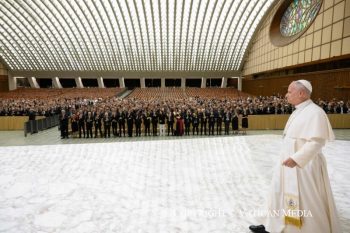
I am happy to greet all of you, members of the German Catholic student associations, who are gathering for a common congress, the Cartel meetingfor the first time outside Germany. Your decision to come here to Rome, to the See of Peteris motivated by the Catholic faith that defines you, by the communion that binds us as disciples of Jesus and by the cultural activities that you carry out. I would like to focus briefly on these three aspects in order to strengthen the fraternal bond that unites you and your common commitment to the Church.
 Regarding your Catholic identity, your strong commitment to the faith is reflected in the four principles that guide your association: religion, science, friendship and country. Faced with despotism and the ideologies of the past, the Catholic faith has never been a simple facade or a label, but rather a way of life to be shared in academic and professional circles. Like the leaven of the Gospel, your brotherhood continues to grow both in the scientific and political fields and within various academic, professional and social circles. This common dimension of your activities benefits not only your country, but also the whole of Europe, at the center of which Germany is located.
To this geographical centrality, you rightly add the cultural centrality of the human person, creature of God and architect of his own life. Faced with the challenges of the technological revolution, you must pay particular attention to the study and promotion of our common humanity. In his irreducible expression as a man or woman, the human person is in fact always relational and limited, and this is why he is called to become a commitment for himself and a gift for the other. Just like the exercise of reason, the light of faith illuminates the promises and illusions of the present time, inviting each person to do their best to help build a just and peaceful society.
Regarding the spirit of communion which animates this initiative, I am happy to recall your motto: Unity in necessity, freedom in doubt, charity in all things. These words testify to the true foundations, critical dialogue and constant dedication that characterize your association. The relationship between the members of many associations is not limited to sharing knowledge, but is transformed into mutual esteem. It is not limited to ideas, but becomes a collaborative practice. As you all follow Christ, the one Lord and Master of life, you embody Catholic values in society not as partisan standard-bearers, but as representatives of the common good of humanity. In Germany, in Italy and throughout the world, the Catholic faith itself strengthens our cooperation without giving in to the fashions of the moment, without putting individualistic preferences before the common Tradition of the Church. In the joy of fraternity, I therefore encourage you to promote the evangelization of culture: your university organizations constantly attract new young people because they testify to passion, competence and authentic Christian friendship.
Regarding the various cultural activities that you carry out in the different fields of study and work, you have realized that it is not simply a question of devoting yourself to a profession (Profession), but to follow a vocation (vocation). Indeed, the search for truth is a good that deserves to be desired and transmitted. When we pursue it methodically, we realize that no area of study can be reduced to mere speculation. Precisely because it involves the exercise of both the intellect and the will, study is rather a commitment that requires self-discipline and a conversion: a transformation of the mind, which we cultivate as fertile ground by perfecting our working tools. By doing our best, we become responsible stewards within society without being seduced by careers centered on money. On the contrary, we recognize that culture is a good of humanity: the truth makes us free, while lies distort names and things. Faced with what dehumanizes people – especially the smallest among us, the poor and the sick – I ask you to be witnesses to Christian humanism. In this regard, I invite you to think deeply about what he said Pope Benedict XVIan illustrious former member of your association: develop a coherent “ecology of man”. Man also has a nature that he must respect” (Vvisit to Parliament at the Reichstag in Berlin, September 22, 2011). Integral ecology, so dear to Pope Francis (cf. Encyclical Letter Praised yesn° 10-11, 62), highlights the fact that the world is full of meaning and is not an inert entity to be shaped as one pleases or out of a thirst for power. Indeed, we are not a random set of particles, but bodies open to transcendence: by directing our thirst for life and justice, wisdom and love, we discover together the truth in knowledge, action and faith.
After all, human beings are always searching for God, and He has revealed Himself to us as our Savior. It is therefore not in spite of our activities, but precisely through what we do that we establish a relationship with God, which becomes a path to holiness. Yes, the cultural mission of Christians is to orient society and history toward this summit of a God-centered life. Through the intercession of Saint Boniface, evangelist of Germany, may you be witnesses to this wisdom of the Gospel in German and European society. With all my esteem for your associations, I willingly grant my apostolic blessing to all of you and your loved ones. Thank you very much !
Let us pray together: Our Father…
________________________________________
L’Osservatore RomanoDaily edition, Year CLXVI n° 126, Friday June 5, 2026, p. 6.
Â
Translation by ZENIT