– Advertisement –
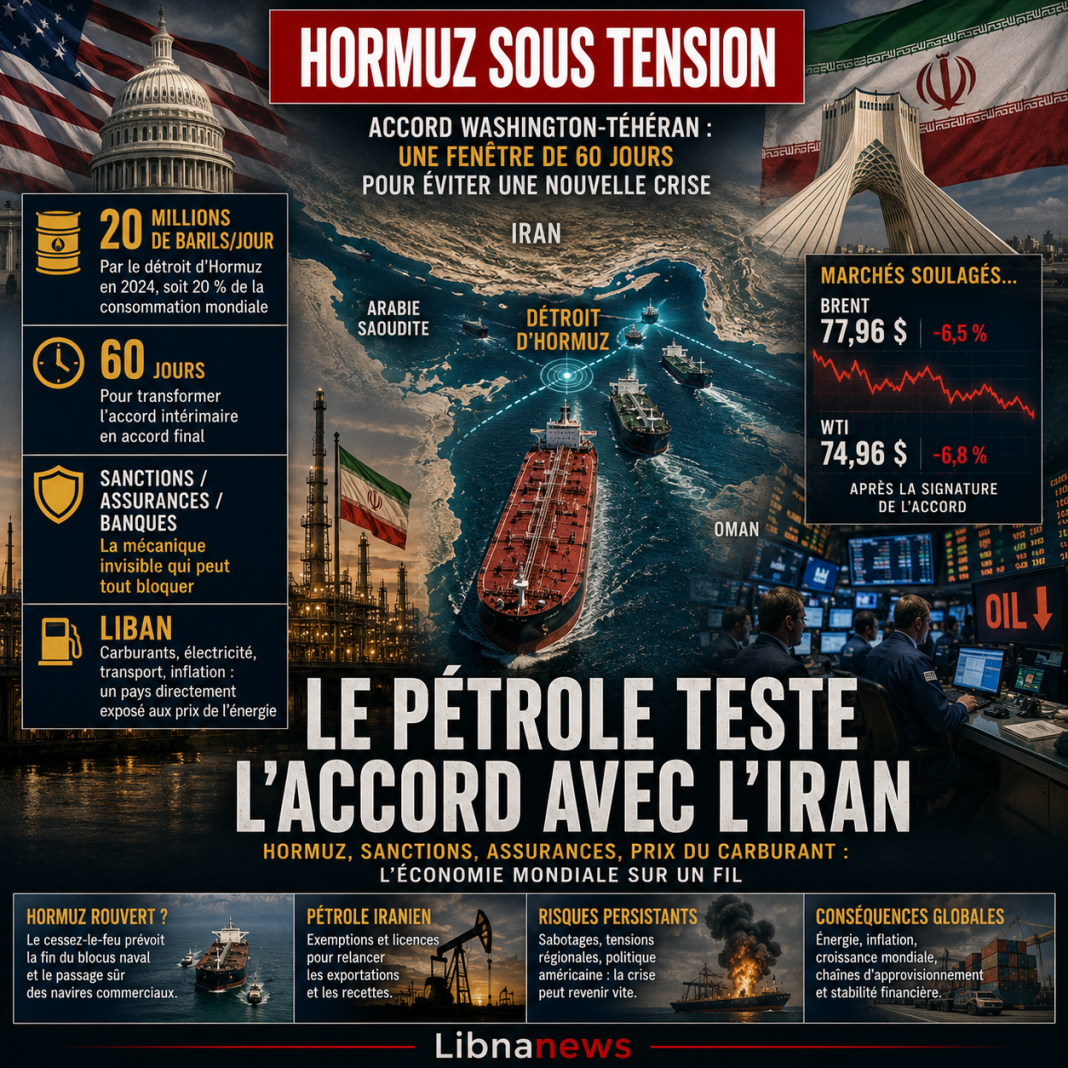
The energy aspect of the agreement with Iran goes far beyond the nuclear issue. It touches on the Strait of Hormuz, Iranian oil exports, maritime insurance, American sanctions, fuel prices and the balance of vulnerable countries like Lebanon. After the signing of the interim memorandum between Washington and Tehran, the markets immediately reacted to the prospect of a gradual reopening of the most sensitive maritime route in the Gulf. The barrel has fallen, a sign that operators anticipate a partial return of Iranian supply and a relaxation on oil transport. But this reduction does not constitute a regulation. The agreement opens a sixty-day window. It guarantees neither the complete lifting of sanctions, nor the lasting normalization of the Strait, nor the disappearance of the risks of regional sabotage.
Hormuz, the corridor that shakes the markets
The Strait of Hormuz is not just a geographic map. It is one of the most strategic crossing points in the world economy. According to the US Energy Information Administration, oil flows through this strait will reach around 20 million barrels per day in 2024, or almost 20% of global consumption of petroleum liquids. The EIA ranks it among the world’s most important energy bottlenecks, along with the Strait of Malacca.
This concentration explains the nervousness of the markets. An incident in the Strait of Hormuz does not only affect Iran or the Gulf monarchies. It can disrupt Asian refineries, London insurers, Greek shipowners, European banks, transporters of refined products and fuel consumers in Beirut, Paris or Manila. Geography imposes dependence. Alternative routes exist, but they remain limited, expensive or insufficient to absorb a major crisis.
The American-Iranian memorandum therefore has a direct energetic impact. Reuters reports that the text provides for the restoration of safe passage for commercial ships through Iran, the gradual end of the American naval blockade and a return to maritime traffic in the Gulf. The same document opens a sixty-day negotiation period to transform this note of understanding into a final agreement.
The market reaction was rapid. Brent fell to around $77.96 a barrel and WTI to around $74.96 after the deal was signed, according to Reuters. This drop reflects less certainty than relief. Traders are not yet celebrating peace. They are reassessing a risk premium that had swelled with the war, the partial closure of the strait and the threat of a broader confrontation.
The possible return of Iranian oil
The second major aspect concerns Iranian oil. The memorandum provides for exemptions or licenses allowing Tehran to resume sales of crude oil and petroleum products. Reuters had already reported, before the signing, that a US official indicated that Iran could sell oil immediately after the agreement. The interim text also mentions the gradual lifting of sanctions and access to certain financial circuits.
For Iran, the stakes are vital. Hydrocarbons remain a central source of foreign currency. American sanctions have long forced Tehran to sell under constraint, with discounts, opaque circuits, intermediaries and increased dependence on certain Asian buyers. The return of more normal channels would increase revenues, reduce transaction costs and restore part of Iranian commercial credibility.
For the markets, the question is not just whether Iran can sell. It is to know how much, at what speed, with what insurance, what flags, what banks and what American guarantees. A legally authorized barrel does not circulate automatically. We need contracts, letters of credit, available tankers, reassured insurers and buyers convinced that Washington will not suddenly reverse its exemptions.
This uncertainty explains the caution of analysts. Reuters says some market participants anticipate a gradual normalization, not an immediate supply shock. Goldman Sachs, cited by the agency, estimates that exports could normalize by the end of July and production by October, if the political process holds. Â
The calendar is therefore decisive. A rapid drop in prices can occur on expectations. A lasting decline requires real volumes. Refineries must receive crude. The tankers must cross. Insurers must cover. The banks must pay. The agreement creates the possibility of this chain. It does not yet guarantee its complete operation.
Sanctions, insurance and banks: the invisible mechanism
The general public mainly looks at the price of the barrel. Professionals also look at sanctions, insurance and payments. For years, the American architecture against Iran has not only targeted oil sales. It targets ships, banks, front companies, brokers, foreign refineries, ports, insurers and logisticians. The US Treasury Department maintains a page dedicated to Iranian sanctions, with recent warnings about risks related to Iranian requests for passage through Hormuz and oil trade with certain refineries.
This architecture has a powerful effect: it transforms any transaction with Iran into a compliance risk. Even when the rules relax, companies expect written guarantees. A European bank can refuse a payment if it fears a secondary sanction. An insurer can refuse to cover a tanker. A shipowner can demand a high premium. A buyer can wait for clear licenses to be published before signing.
This is why the lifting of sanctions cannot be reduced to a political phrase. It requires implementing texts, licenses, Treasury instructions, coordination with European and Asian partners, then communication to the markets. American sanctions have become a global administrative system. Loosening them sometimes takes as much time as imposing them.
The memorandum promises a dynamic of lifting. It does not instantly remove all constraints. Opposition in the American Congress, Israeli objections, reservations from Iranian conservatives and the risk of a military incident can slow down or cancel this mechanism. The sixty-day period will therefore be as much legal as diplomatic. Economic actors will look at the texts, not just the declarations.
A relaxation of prices, but not acquired security
The drop in oil prices after the agreement should not be confused with complete stabilization. Energy prices depend on several factors: available supply, inventories, global demand, OPEC+ decisions, refinery capacity, exchange rates, monetary policy and risk perception. The Iran deal affects one major factor, but it does not control all the others.
US stocks show pent-up stress. Reuters reported that total U.S. crude inventories, including commercial and strategic reserves, fell to 758.5 million barrels, their lowest level since March 1985, after ten straight weeks of declines. This situation reflects the disruptions linked to the Iranian war and the increase in demand for American supplies.
This data limits euphoria. If stocks are low, the market remains vulnerable. A reopening of Hormuz could lower the risk premium. But an incident can cause it to rise immediately. The difference between a lasting relaxation and a simple rebound will depend on the continuity of flows, the reconstitution of stocks and the capacity of producers to supply without creating new tensions.
The International Energy Agency had already highlighted, in its May 2026 report, that disruptions to maritime trade by Hormuz had weighed on land stocks and refining throughput. It forecast a significant drop in refining throughput in the second quarter of 2026 due to damage, export restrictions and reduced availability of raw materials.
The return to normal will therefore not be instantaneous. Infrastructure must work. Ports must resume. Refineries must adjust their supplies. Refined product flows must be replenished. The oil market reacts quickly to announcements, but it slowly stabilizes in terms of volumes.
American political risk
The agreement with Iran will also be tested in Washington. Donald Trump can present the memorandum as a success: drop in oil, reopening of Hormuz, end of the war, maintained pressure on Iranian nuclear power. But Republican and pro-Israeli critics can denounce a text that is too favorable to Tehran. They can point to oil exemptions, Iranian funds, the prospects of lifting sanctions and the lack of immediate dismantling of the nuclear program.
This opposition can have an immediate economic effect. If companies believe that the agreement will be contested, blocked or reversible, they will remain cautious. The memory of the American withdrawal from the 2015 nuclear agreement remains present in all legal directions. Large groups know that a change of line in Washington can transform a legal contract into a major risk.
Trump is also maintaining military pressure. According to information reported after the signing, the American president insisted that the bombings could resume if Iran did not respect its commitments. This double logic, agreement and threat, reassures part of its electorate, but it also maintains uncertainty.
Markets can live with a threat. They live less well with unpredictability. If the exemptions are clear and lasting, flows will resume. If they seem conditional on each declaration or each incident, prices will remain volatile. Iranian oil could then return in fits and starts, without producing the expected relaxation.
Iran between economic victory and nuclear constraints
For Tehran, the energy aspect is a political victory. The return of oil to the markets allows the Iranian government to assert that it has resisted military pressure and obtained recognition of its economic rights. Access to frozen funds, the resumption of sales and the partial end of maritime blockages offer the government some breathing space.
But this breathing comes at a price. Iran must restore maritime security, commit not to develop nuclear weapons and accept supervision over the fate of enriched materials. The memorandum mentions on-site dilution under IAEA supervision as a minimum basis for stored materials.
The compromise is fragile. The toughest Iranian officials can denounce an excessive concession on nuclear power. Opponents of the agreement in the United States can denounce excessive concession on sanctions. Israel may seek to demonstrate that Iran retains a dangerous capability. Each camp therefore has reasons to contest the text.
Energy here becomes an instrument of stabilization. By quickly giving Iran economic benefits, Washington seeks to create a material interest in respecting the agreement. By allowing a drop in oil, Trump is also seeking an American domestic benefit. Diplomacy is coupled with market calculation. The more prices fall, the more politically defensible the agreement becomes.
The effects for vulnerable countries, including Lebanon
Lebanon is not a major global consumer. But it is very exposed to energy prices. It imports most of its fuels. Its electricity network remains fragile. Private generators, road transport, industry, agriculture, hospitals and households are directly affected by variations in oil and diesel. A lasting fall in prices can therefore offer real relief.
This relief remains indirect. Lebanon does not automatically benefit from a global decline if its currency, its public finances, its import mechanisms and its distribution circuits remain fragile. The final price also depends on taxes, margins, transport costs, currency availability and the operation of importers. A relaxation on the barrel can reduce the pressure. It does not repair the Lebanese electricity sector.
For Lebanese companies, the energy reduction can improve production costs. Factories that depend on diesel to compensate for cuts can find a little margin. Carriers can absorb fewer loads. Households can pay less for certain trips or services. But these effects will only be significant if the decline lasts and is really transmitted to local prices.
The risk is therefore to overestimate the agreement. Hormuz can reopen. Iranian oil can return. Prices may fall. But Lebanon will remain vulnerable until it reforms its electricity, restores banking confidence, secures its imports and stabilizes its institutions. The agreement may reduce the bill. It cannot replace a national energy policy.
A global economy still hanging on Gulf security
The energy file shows the power of interdependencies. A decision taken in Washington and Tehran changes the price of fuel in Beirut. Naval incident in Gulf may affect Asian imports. A US Treasury license can determine whether a bank agrees to finance an Iranian shipment. A strike in Lebanon could threaten the credibility of an agreement on Hormuz.
This interdependence gives the memorandum an importance that goes beyond its political content. It’s not just about calming down a war. It is about restoring a global economic chain: navigation, insurance, financing, refining, distribution. If this chain starts again, the agreement will produce visible effects. If it remains blocked by mistrust, relaxation will remain partial.
The next few weeks will therefore be decisive. We will have to check if the ships are really passing, if the insurance premiums are falling, if the buyers are taking back Iranian crude, if the American licenses are clear enough, if the sanctions are being eased and if the prices remain on a downward trend. It will also be necessary to monitor the actors who can sabotage the process: opponents of the agreement in Washington, Israeli officials hostile to any concession to Iran, suspicious Iranian factions and regional groups likely to restart an escalation.
Hormuz remains the barometer. If the Strait works, the deal will have immediate economic value. If the transition remains uncertain, the market will maintain a risk premium. For fragile countries, the stakes are concrete: fuel, electricity, transport, inflation, purchasing power. The agreement with Iran will therefore not only be measured in diplomatic communiqués, but in ports, refineries, gas stations and energy bills.
– Advertisement –