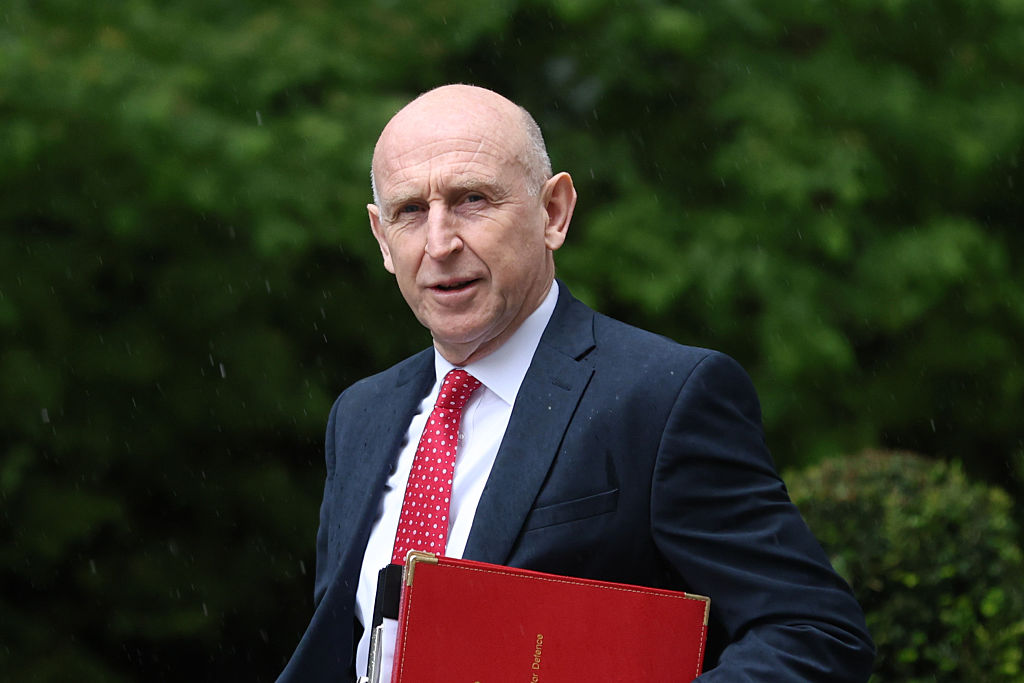
New blow for Keir Starmer: British Defense Minister John Healey announced his resignation on Thursday, expressing his disagreement with the head of the Labor government on the level of investments required in the military field.
“You have not been able, and the Treasury (Ministry of Finance, Editor’s note) has not wanted to mobilize the resources that the nation needs to defend the country in this period of increasing threats,” wrote the minister in his resignation letter addressed to Keir Starmer and published on X.
The publication of a ten-year investment plan in defense, initially planned for the end of 2025, has been postponed several times, against a backdrop of difficult budgetary decisions.
In his two-page missive, Mr. Healey explains that he received the draft agreement on Monday. This is “far below what is required,” he believes.
“Having explained to you that I could not accept an agreement that would not give our forces the necessary resources, I now have no other choice but to submit my resignation,” he announced.
This surprise resignation is a new blow for the Labor Prime Minister, politically weakened for months and threatened by internal protest, one week before a crucial partial legislative election.
Mr. Healey, whose name is sometimes mentioned as a possible competitor to Keir Starmer within the Labor Party, did not specify whether he would participate in a possible race to replace him at the head of Labor and in Downing Street.
Political “earthquake”
Keir Starmer’s government has pledged to increase military spending and is due to unveil its defense investment plan before the NATO summit on July 7-8.
This summit, which will bring together the 32 member countries of the Atlantic Alliance in Ankara, will be held in the presence of American President Donald Trump.
The tenant of the White House has repeatedly expressed his criticism of NATO, reproaching the allies in particular for their refusal to commit to his side in the war he launched with Israel against Iran.
The UK government has committed to increasing defense spending to 2.5% of gross domestic product by 2027, then to 3% after 2029, and to 3.5% of GDP by 2035, in line with the target set by NATO.
The war in Iran has recently revealed to the general public the limitations of the Royal Navy, which result from years of lack of investment and industrial delays.
For Ed Arnold, of the British think tank specializing in defense, the resignation of John Healey “is a political earthquake”, “for the government and the Ministry of Defense”.
This resignation will have the consequence “that this government – and the following ones – will have more difficulty showing complacency in matters of defense spending, and will give this subject the increased public attention that it deserves”, he believes.
The increase in defense spending to achieve the objectives set by NATO constitutes a political and economic issue in many member states. It involves delicate budgetary trade-offs, in a context where governments must also finance other priorities.
Questioned at a press conference in Brussels, NATO Secretary General Mark Rutte, who was not aware of this resignation, acknowledged that increasing military spending was not an easy thing.
“Of course, it’s not easy, because in the end there is always a compromise to be found with other spending, which is also important, but the primary mission of any government is, ultimately, to ensure the security of the country and ensure that the economy is strong,” he said. declared.
AFP