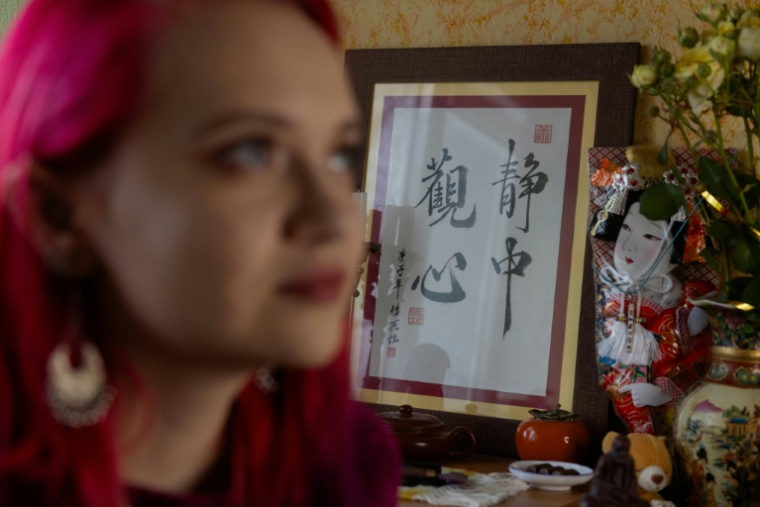
Vladislava Simonova, dans son appartement de Poltava, en Ukraine, le 19 avril 2026 ( AFP / Tetiana DZHAFAROVA )
In Poltava, Ukraine, in a building located near the trolleybus depot, a capricious elevator leads to the apartment of the poet Vladislava Simonova, 27 years old, renowned in Japan but almost unknown in her country.
She has pink hair, a fuchsia sweater and pink socks. The room is covered with a soft carpet. Vladislava Simonova sits down to tell the story of her parallel life, 7,800 km away, in an archipelago where she has never set foot.
In the sky over Poltava (center), the buzzing of a drone worries him. The device explodes, in the distance, just as she says the word “explosion”. She mentioned the Russian bombings which are terrorizing Ukraine.
Near her, a shelf has fifteen books with colorful edges (a collection of contemporary Ukrainian poets), two Japanese teapots, three religious icons and a figurine of Phoebe Buffay from the series Friends.

Vladislava Simonova dans son appartement de Poltava, le 19 avril 2026 ( AFP / Tetiana DZHAFAROVA )
“I never imagined that I would one day write about the war (…) Then I realized (…) that tiny details can, perhaps, convey the tragedy of this great war much better.”
A whole generation of Ukrainian artists, soldiers or civilians, known or confidential, bear witness to this extremely violent military aggression, which also targets their culture.
In 2013, Vladislava Simonova, still a teenager, discovered haikus, these poems of three lines and 17 syllables (5/7/5) generally including a fall and codified in Japan in the 17th century to illuminate, with simplicity, the beauties of nature and everyday life. and the ephemeral.
For years, she studied the Japanese masters – Basho, Buson, Issa – and wrote more than 600 haikus which, she says, became less and less “clumsy”.
With insolence
In front of apricot skins
A big cat comes forward.
24.04.2015
No matter the rain
I tremble and carry home
A small tree stand.
16.10.2014
– “Communion” –
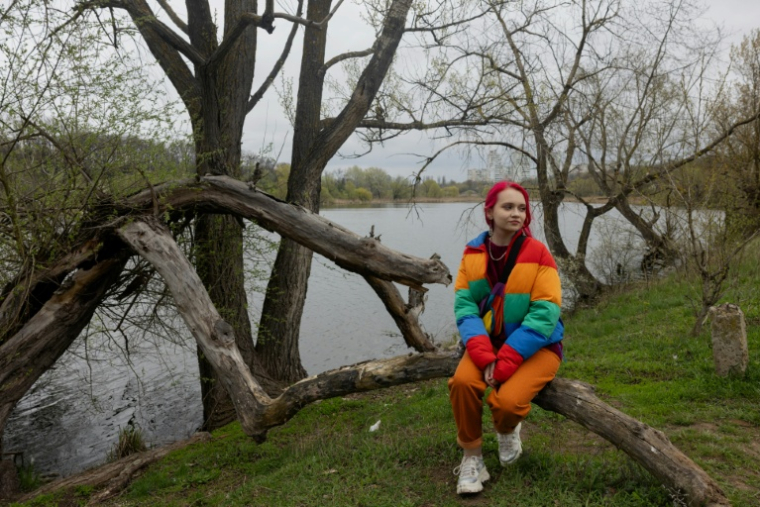
Vladislava Simonova in a park in Poltava, Ukraine, 19 April 2026 (AFP / Tetiana DZHAFAROVA)
In 2018, she won a competition organized by a Japanese foundation.
When the massive invasion began in February 2022, she was living in Kharkiv. The Russian army is trying to conquer this northeastern city and is constantly bombarding it. For three months, the poet survived in an underground shelter.
Instead of the storm
The explosions resonate.
Spring is here.
14.05.2022
Deaf bees
To the sirens in the sky.
The flowers of the lime trees.
19.06.2022
In March 2022, from her shelter, she gave a written interview to the Japanese newspaper Asahi Shimbun. A renowned poet, Mayuzumi Madoka, contacted her a few weeks later.
“She has a deep understanding of the essence of haikus,” Mayuzumi Madoka told AFP. According to her, her colleague’s work reflects a “communion with nature” and a “sense of optimism, despite themes close to obscurity”.
Through the roof
Of a house in ruins
The stars are shining.
14.05.2022
With around ten people, Mayuzumi Madoka is helping Vladislava Simonova translate and publish her first collection in Japan, in 2023. The book has received “great praise”, says Mayuzumi Madoka.
She recalls that many Japanese people composed haikus during dark times, notably after the nuclear bombings of 1945 and the tsunami of 2011.
– “Cherry trees” –
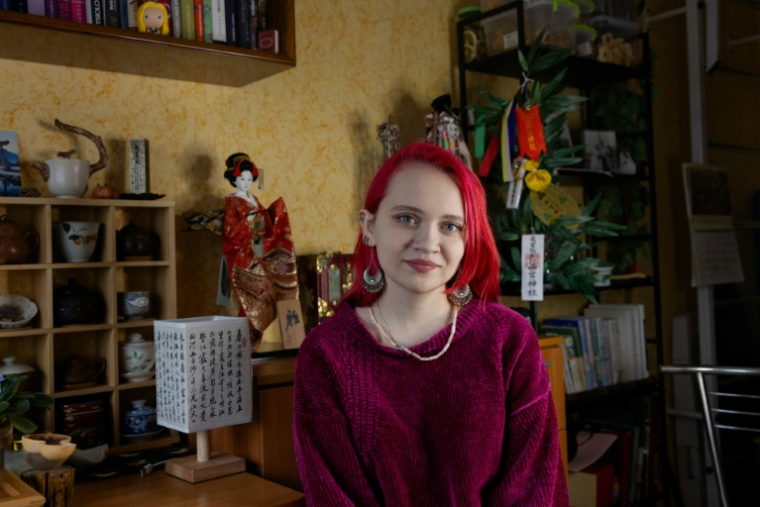
Vladislava Simonova pose dans son appartement de Poltava, le 19 avril 2026 ( AFP / Tetiana DZHAFAROVA )
In August 2022, the underground shelter where Vladislava Simonova had lived, in Kharkiv, was destroyed by a Russian missile. She goes to live in Poltava.
In 2024, she published a second collection in Japan, then another, at the beginning of 2026, in Denmark. She dreams of publishing one in Ukraine.
Before the war, she wrote in Russian, then switched to Ukrainian. The translation of his compositions caused him “complex problems”: the two languages, which are close, contain many different words.
Simonova does not read prose, “only poetry”. And the Bible. She belongs to the tiny Catholic community of Poltava.
She suggests going to the park, greets her husband who is staying at home, and runs down the stairs of her Soviet building. His elevator stopped working.
It’s a cold spring Sunday, the park is almost empty. The poet wears a multi-colored down jacket. She sits on the branch of a tree, near a pond with steely reflections.
Since childhood, she has suffered from a serious heart disease which exhausted her. She discovered haikus in the hospital, in an anthology where there were also “Persian poems”.
The wind is blowing. She gets up and reads aloud. This is the first time she’s done it in public. She says each poem twice.
The first is for his missing friends.
They go to the wind,
Free cherry blossoms,
Those who are close to me.
The second is a souvenir from Kharkiv.
I took and squeezed
The debris of a rocket.
Wave of pain.
She looks through her collection with the pink cover. Then choose one last one.
What a sky today!
It is from him that comes to us
The flight of missiles.
/2026/06/12/6a2bd18d8af1c253720555.jpg "\"Is he a genius in the art of the deal or is he talking nonsense?\"Donald Trump’s strategy against Iran raises questions, according to a geopolitical scientist")
/2026/06/12/6a2bf4e1c1df0409196392.png "Ukraine strikes Tatarstan, in central Russia, 1,600 km from its border")