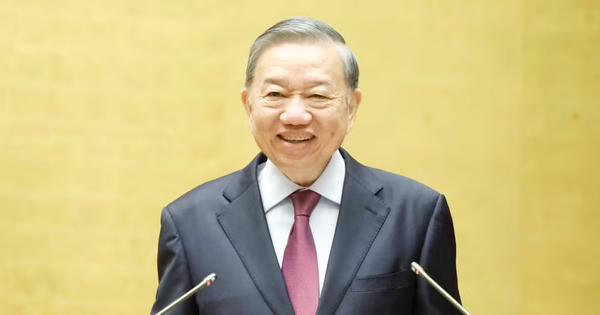
Pham Thi Thinh, deputy director and deputy editor-in-chief of the National Political Publishing House, affirmed that the speech of General Secretary and President To Lam concretized the position of the Vietnamese Communist Party during the 14th National Congress on foreign policy: to actively contribute and proactively to peace, friendship, cooperation and sustainable development, in a spirit of friendship, reliability and responsibility within the international community; actively and responsibly participate in solving common regional and international problems. This speech not only focuses on regional security, but also reflects the evolution of Vietnam’s thinking and position on foreign policy in the new era, moving from mere “participation” to true “active construction”.
Secretary General and President To Lam not only analyzed the global challenges, reflected in three fundamental crises: the crisis of the international order, the crisis of the development model and the crisis of strategic confidence, but he also formulated proposals concrete measures on confidence building, preventive diplomacy, the role of ASEAN, the governance of new technologies and the strengthening of international law.
This shows that Vietnam wants to move from a position of “participant” to that of “actor”; not only react to international changes, but also help shape the way in which these problems are resolved. It is the manifestation of a nation displaying increased strategic confidence after 40 years of reform and integration.
Secretary General and President To Lam stressed: dialogue should not be limited to the statement of positions. It must make it possible to quickly identify risks, share information, maintain communication channels in the event of tensions and prevent differences from degenerating into crises.
History has fully and clearly demonstrated this message. Vietnam not only talks about peace, it also helps maintain it in conflict zones around the world. From 2014 to date, Vietnam has deployed nearly 1,100 soldiers, officers and personnel to participate in United Nations peacekeeping missions in South Sudan (UNMISS), the Abyei region (UNISFA), the Central African Republic (MINUSCA) and the United Nations headquarters. Recently, Vietnam deployed seven Level 2 field hospitals and seconded 181 officers to the United Nations.
In particular, Vietnamese field hospitals in South Sudan have been highly praised by the United Nations for their ability to treat wounded soldiers and provide humanitarian aid in a context of war, epidemics and humanitarian crises. This demonstrates that Vietnam has moved from a position of “beneficiary of peace” to a position of “contributor to world peace”. For many years, Vietnam has been recognized by the international community as one of the countries that has successfully pursued a balanced foreign policy, maintaining good relations with the main world powers.
One of Vietnam’s defining characteristics over the years has been its refusal to participate in military alliances and its lack of involvement in international military confrontations. Instead, Vietnam has often worked to promote dialogue, build trust, reconcile interests and, above all, respect international law.
The international community greatly appreciated Vietnam’s secure environment, neutrality and diplomatic prestige when it was chosen to host the US-North Korea summit in 2019. Many international experts then considered Vietnam as a model of transition from war to development and to international integration.
When Secretary-General and President To Lam said at the Shangri-La Dialogue that peace must be based on dialogue, cooperation, respect for international law and strategic trust, this was not simply a modern political choice. It was also the continuation of a long historical tradition of the Vietnamese nation: resolving conflicts peacefully whenever possible; placing the peace and stability of the people above the interests of war.
The Vietnamese people will always remember that the Third War of Resistance against the Mongol invaders was one of the greatest military victories in the nation’s history. After the victory on the Bạch Ä áº±ng River in 1288, the Ä áº¡i Việt had all the cards in hand to maintain pressure on the Yuan dynasty. However, King Trần Nhân Tông and his court chose the path of peace and reconciliation, actively reestablishing diplomatic relations with the Yuan dynasty and continuing to send emissaries in order to avoid the prolongation of the military confrontation. This is a great lesson of Vietnamese history: victory is necessary to preserve independence, but peace and reconciliation are essential to guarantee lasting peace.
Vietnamese history has often commemorated with pride the victory of Ngoc Hoi-Dond Da, who annihilated 290,000 Qing soldiers. Following this victory, King Quang Trung chose not to continue the war and, instead, sent diplomatic letters to the Qing dynasty, thus establishing peaceful relations between the two countries. This tradition has allowed Vietnam to survive and develop throughout the millennia of its history, while laying the cultural and political foundations for its peaceful, independent and autonomous foreign policy today.
According to Major General, Associate Professor and Doctor Nguyen Van Sau, Deputy Director of the Vietnam Institute of National Defense Strategy and History, Secretary General and President To Lam’s speech not only reflects Vietnam’s strategic vision in the face of the profound evolution of the regional and global security context, but also constitutes a strong message of its foreign policy in this new phase of development. Vietnam actively participates in regional and global processes as a responsible member and contributes to shaping common issues, while reaffirming its commitment to an inseparable relationship between peace, stability and development, strategic trust and the rule of international law.
In his speech, Secretary General and President To Lam affirmed that peace must be built through dialogue, cooperation, respect for international law and the strengthening of strategic trust. This is not a simple political message, because reality shows that Vietnam has deployed thousands of troops in international conflict zones; participated directly in United Nations peacekeeping operations; contributed to ASEAN security mechanisms; promoted dialogue between opposing parties; resolved disputes consistently through international law; and maintained a stable environment conducive to development in a region marked by strong strategic competition.
The speech notably highlighted the role of strategic trust in international relations. In a context of growing mistrust, confrontation and competition, building trust is an essential condition for preventing conflicts, minimizing misunderstandings and laying the foundations for lasting cooperation. Vietnam is convinced that strategic trust cannot be based on mere words, but must be manifested through concrete actions, sincerity, transparency, mutual respect and scrupulous compliance with international commitments.
In an uncertain world, where strategic competition threatens to eclipse cooperation, Shangri-La’s message goes beyond the framework of a security forum. He affirms that peace is not a state of passive waiting, but that it must be built on trust, cooperation and shared responsibility.
Through this forum, Vietnam also sent a clear message to the world: Vietnam is not only a country that enjoys peace, stability and development, but it is also gradually becoming one of the active forces contributing to the creation of these values for the region and the world…
Source : https://baotintuc.vn/thoi-su/doi-thoai-shangrila-hoa-binh-phai-duoc-kien-tao-bang-trach-nhiem-va-long-tin-20260602121309662.htm
/2024/11/16/luc-chagnon-1701076824682-67387885eacb8428340233.png "DIRECT. 2026 World Cup: the 48-team World Cup begins with Mexico-South Africa in the opening match at 9 p.m.")