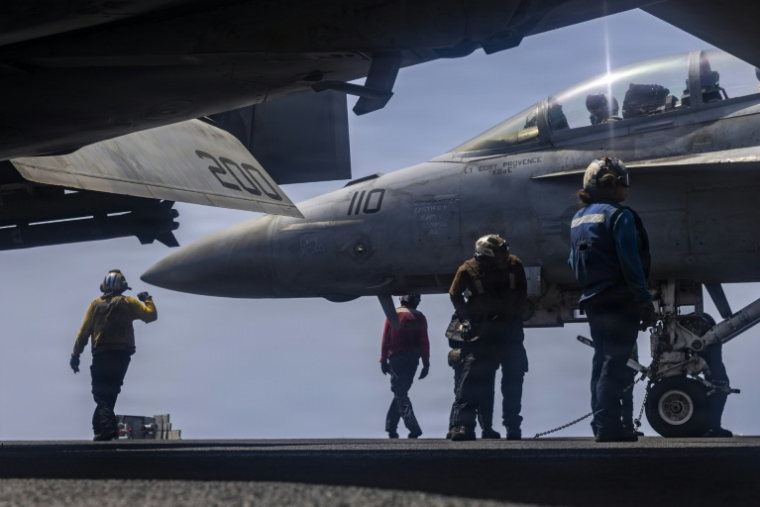
Photo released by the US Navy and US Central Command Public Affairs, May 28, 2026, an F/A-18F Super Hornet, on the flight deck of the aircraft carrier USS Abraham Lincoln, May 25, 2026 (US NAVY / -)
Donald Trump assured Monday that negotiations with Tehran to end the war in the Middle East were continuing “at a rapid pace” and that detente was looming in Lebanon, as demanded by the Iranian side.
A little earlier, the Iranian news agency Tasnim had affirmed that the country’s negotiators had “suspended” indirect dialogue with Washington because of the “crimes” that Israel “continues to commit”, without this information being confirmed by an official Iranian source.
“The United States is directly responsible for a violation of the ceasefire against Iran, and for a violation of the ceasefire by the Israeli regime against Lebanon,” said the Iranian Ministry of Foreign Affairs in a statement.
The Revolutionary Guards, the ideological army of the Islamic Republic, estimated that “the red lines crossed” in Gaza and Lebanon amounted to “a direct war”, in reference to Israel’s almost daily strikes in the Palestinian territory and its offensive in the neighboring country.
“In response”, Iran “is determined to carry out defensive operations” and to “open new fronts”, warned the Guardians.
But Donald Trump announced that he had obtained from the Israeli Prime Minister, Benjamin Netanyahu, a commitment not to send troops to Beirut, and from the pro-Iranian Hezbollah a commitment to “totally cease fire”.
“Israel will not attack them and they will not attack Israel,” he wrote.
Shortly after, the Lebanese embassy in the United States confirmed that Hezbollah had accepted an American proposal for a “mutual cessation of attacks” with Israel.
– Le pétrole fébrile –
Indirect negotiations between the United States and Iran, to end the war triggered on February 28 by a joint Israeli-American attack, have been stalling for weeks.
Especially since Tehran reiterated on Monday that Iranian nuclear power was not part of the discussions “at this stage”, contrary to the expectations of Donald Trump, who affirmed on Sunday evening that a memorandum of understanding should stipulate “very clearly that Iran will not have a nuclear weapon”.
Another key issue in the discussions, maritime navigation. According to Tasnim, Iran intends to continue to block the Strait of Hormuz, and plans to disrupt traffic in that of Bab el-Mandeb, on the other side of the Arabian Peninsula – which would block access to the Suez Canal via the Red Sea and force ships to make huge detours.
A ship was hit by a projectile in the Gulf which triggered a strong explosion, the British maritime safety agency UKMTO said without further details.
In this context, the price of Brent from the North Sea, the world benchmark for crude oil, suddenly rose again (up to around +7%) before slowing down somewhat and ending the session up 4.24% at $94.98.
– Washington defends “defensive” strikes –
Iran had earlier in the day accused the United States of once again violating the fragile ceasefire concluded on April 8, after American strikes this weekend followed by Iranian military retaliations.
The American army announced that it had carried out a new wave of “defensive” strikes on southern Iran on Saturday and Sunday, the third in just over a week.
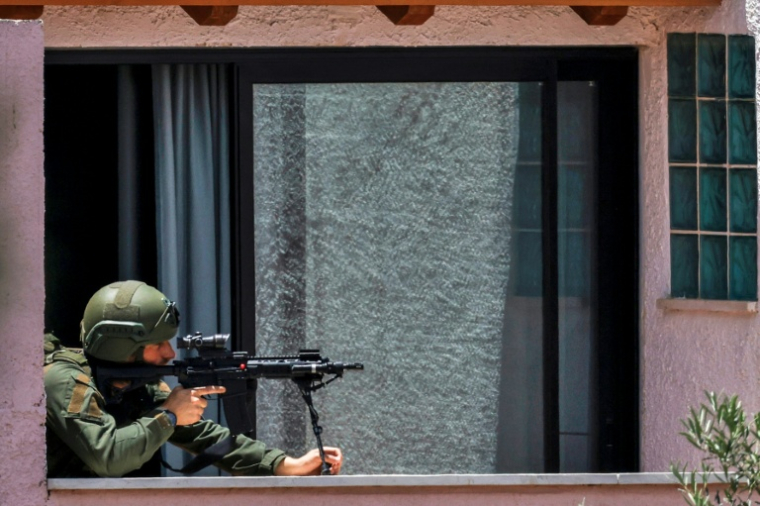
An Israeli soldier in position on the balcony of a building in northern Israel, on the border with southern Lebanon, May 31, 2026 (AFP / Jalaa MAREY)
These bombings targeted radar and drone control systems in the city of Goruk and the island of Qeshm in the Strait of Hormuz, said the US Middle East Command (Centcom).
The Iranian Guards said they had responded by attacking a base used by the US army for strikes against its territory, without naming the targeted country – but Kuwait intercepted “hostile” missiles and drones and attributed them to Iran.
The war has left thousands dead, especially in Iran and Lebanon, and is shaking the world economy.

/2026/06/11/6a2adcc83a0a9970169772.jpg "Strikes in the Middle East: the CGT of merchant navy officers denounces facts \"extremely serious\" and does not exclude an evacuation of French sailors")

/2026/06/11/6a2a9d8bc94f2058438041.jpg "Coupe du monde 2026 : pour la FIFA, lidée cest jouer plus pour générer plus de recettes, selon un spécialiste du sport business")