-
The Lobito Corridor links the Copper Belt of Katanga and Zambia by rail to the Angolan port of Lobito on the Atlantic. An alternative route to infrastructure controlled by China.
-
Since 2023, the United States and the European Union have been investing massively in this project to secure their supply of critical minerals – copper and cobalt.
-
Behind the railway line, a geopolitical battle: Beijing controls a considerable part of the mines that the corridor is supposed to open up, and is not a passive spectator of this rebalancing.
A railway line crosses southern Africa from east to west, from the heart of Katanga to the Atlantic. It connects the copper and cobalt mines of the Copper Belt – the area that straddles the south of the Democratic Republic of Congo and the north of Zambia – to the Angolan port of Lobito. This is the Lobito Corridor. And Since 2023, it has been one of the most strategically contested infrastructure projects in the world.
Read also: Critical minerals: Africa at the heart of the war for resources
A century-old line, a challenge for the 21st century
The railway line which constitutes the backbone of the corridor is not new. The Benguela railway, which connects Lobito to the Congolese border crossing Angola for nearly 1,300 kilometers, was built by the Portuguese between 1902 and 1929. It was then used to export the colony’s minerals to European markets. After Angolan independence in 1975 and the long civil war which ravaged the country until 2002, the line gradually deteriorated, partially destroyed, abandoned on certain sections.
It was China that rehabilitated it. Between 2006 and 2014, a Chinese state company, China Railway 20th Bureau Group, reconstructed most of the line for $1.83 billion, financed by loans guaranteed on Angolan oil. The line reopens, but remains underused due to a lack of sufficient extensions towards the Congolese and Zambian mines. This is where the current project comes in, with a radically different ambition.
The geography of an issue
The map is strikingly readable. To the east, the Copper Belt concentrates most of the world’s copper reserves and a considerable part of the world’s cobalt. Kolwezi, Lubumbashi, Ndola: these names are those of the large mines which power the batteries of electric vehicles, electricity transmission cables, defense equipment. Without Congolese copper and Katangese cobalt, there will be no energy transition as the West has planned.
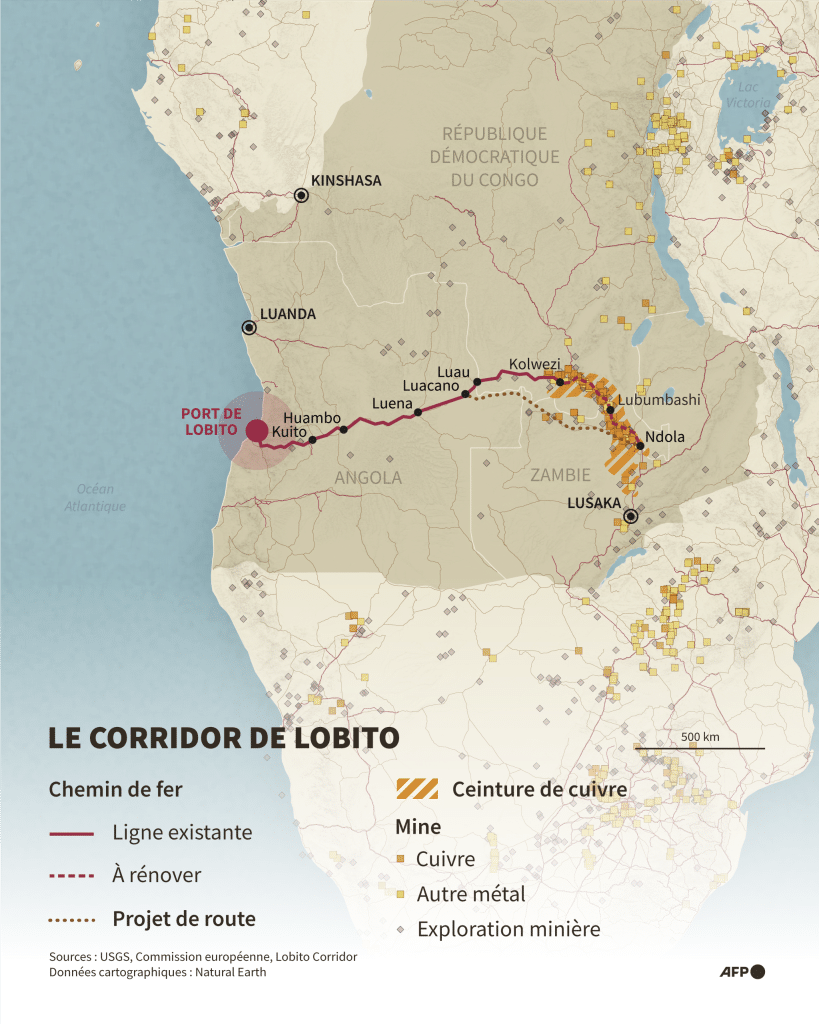
Congo (c) AFP
The problem is evacuation. Today, most of the minerals extracted from the Copper Belt travel east to Tanzania and the port of Dar es Salaam, or south through Zambia and Zimbabwe to the South African ports of Durban and Beira. These roads are long, saturated, dependent on aging infrastructure. Above all, they pass through countries where China is strongly established: the TAZARA line linking Zambia to Dar es Salaam was built by Beijing in the 1970s, and China remains by far the leading investor in the ports and railways of the entire region.
The Lobito corridor offers an alternative: a route west, towards the Atlantic, towards European and American markets without passing through Chinese infrastructure.
Read also: China in Africa: the New Silk Roads put to the test
The geopolitical battle
It is this logic which explains Western interest in this project. In September 2023, during the G20 summit in New Delhi, the United States, the European Union and their partners announced a joint investment of several hundred million dollars to finalize the corridor. The EU is mobilizing its Global Gateway mechanism – the European response to the Chinese New Silk Roads – to finance the rehabilitation of the Congolese section and the Zambian extensions.
The challenge is important: creating a supply chain for critical minerals that does not pass through China, does not depend on its transport companies, and is not subject to its commercial conditions. The Sino-American economic war, which is being played out over semiconductors and green technologies, is also being played out on African soil.
The map shows it precisely. The existing line, in solid red, goes from Lobito to the Congolese border. The dotted section, to be renovated, covers the Congolese territory up to the mines of Kolwezi and Lubumbashi. The road project, in dashes, extends the network towards Zambia and Lusaka. It is these last two segments – Congolese and Zambian – which concentrate most of the announced investments and diplomatic issues.
The actors and their calculations
Angola plays a central and paradoxical role. An oil country in decline in production, it seeks to diversify its economy and emancipate itself from the Chinese tutelage which had governed the post-civil war reconstruction. President João Lourenço, in power since 2017, has initiated a policy of rebalancing towards the West. The Lobito Corridor is the instrument of this pivot: it makes Lobito a regional hub, generates transit revenues, and attracts non-Chinese foreign investment.
The DRC is in a more complex position. It is the geographically essential player in the corridor – it is its subsoil which contains the resources to be evacuated – but it is also the country where Chinese companies are most deeply established in the mining sector. Companies like CMOC, which operates the Tenke Fungurume mine, control a considerable share of production. The Tshisekedi government is playing on all fronts, accepting Western funding for infrastructure while maintaining mining contracts with Beijing.
The DRC and Zambia have an interest in this new road
Zambia, for its part, is emerging from a severe debt crisis which led it to restructure its loans – notably from Chinese creditors – between 2020 and 2023. It has every interest in diversifying its export outlets and not no longer depend exclusively on roads controlled by Beijing.
Read also: DRC: cobalt, curse or luck?
What the map doesn’t show
The map shows the lines and mines. She doesn’t show the obstacles. The Congolese section crosses active conflict zones: northern Katanga and the neighboring regions remain unstable, with armed groups extorting convoys and infrastructure regularly sabotaged. Congolese governance of the mining sector is notoriously failing. And China is not a passive spectator: its companies control a share of the mines that the corridor is supposed to open up, which gives it considerable leverage over the actual flow of minerals.
There is also the question of deadlines. African infrastructure projects have an unfortunate tendency to accumulate delays. The Lobito corridor is announced to be operational over its entire route for 2028. This is optimistic.
But the stakes are high enough for Westerners to maintain their commitment. Without secure Congolese cobalt, no batteries for European and American electric vehicles. Without Zambian and Katangan copper, there will be no electrical infrastructure for the energy transition. The Lobito corridor is not an African railway project. It is part of the 21st century war for resources.
Cartographic source: AFP / USGS, European Commission, Lobito Corridor, Natural Earth, May 15, 2026.