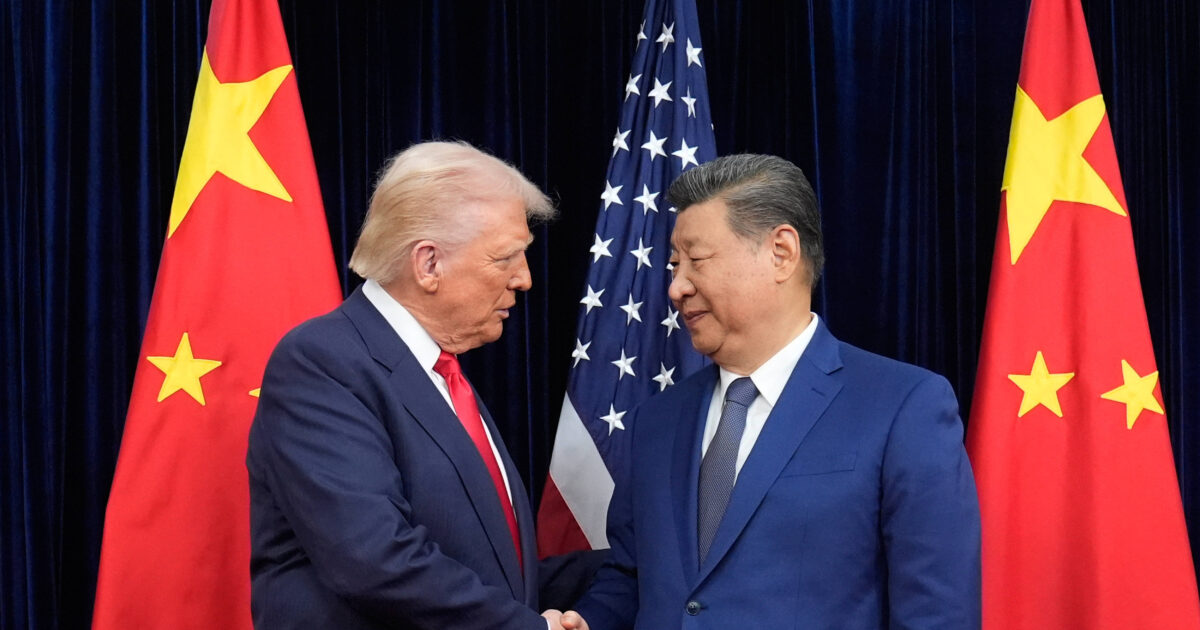
After rounds of tariff battles and negotiating a fragile truce, Washington and Beijing are considering a new mechanism to regulate their trade exchanges.
For some observers, this could distort free competition. Others see it as a way to pave the way for a more peaceful coexistence between the two top global economic powers.
Here’s a brief explanation of the ongoing work before a hypothetical meeting between Presidents Donald Trump and Xi Jinping.
– What is it about? –
Following a meeting on March 15 and 16 between senior American and Chinese economic officials in Paris, White House Trade Representative Jamieson Greer mentioned the creation of a “Trade Committee” between the US and China.
According to him, it would be a hybrid mechanism to formalize and determine “what types of products” the US should export to China and vice versa.
According to Wendy Cutler, Vice President of the Asia Society Policy Institute, this committee could assess the possibility of increasing trade in non-sensitive products or discuss mutual reduction of tariffs in non-strategic sectors.
She notes in an analytical note that officials seem close to unlocking purchasing commitments from China (agricultural products, energy, aircraft) at the moment.
– Is this new? –
Chad Bown, from the Peterson Institute for International Economics, sees it as a form of “regulated trade.” He cites the example of Japan in the 1980s, when it deliberately slowed down car exports to the US.
More recently, during Donald Trump’s first term, Washington and Beijing signed an agreement where China committed to importing more American products worth $200 billion over two years. This commitment did not materialize.
– Why does it raise concerns? –
“If instead of removing regulations, reducing tariffs, and letting companies decide more easily what they sell and at what price, the system becomes more bureaucratic,” warns Joerg Wuttke, associated with the consulting firm DGA-Albright Stonebridge Group.
“It’s not a good sign,” he adds. “Where are the laws of the market?”
He believes this approach could reduce competitiveness and annoy other countries.
An anonymous American business leader wonders: if the government controls trade, how will it choose priority companies and favored sectors?
– Will the relationship improve? –
According to Chad Bown, the new mechanism could be more successful than previous attempts to smooth out their trade disputes.
“It is clear that the old system was not working. Could we try something else?” he suggests, emphasizing that a “more sustainable relationship” is better than “constantly reigniting conflicts.”
But for this to work, the agreement must be acceptable and realistic for each of the signatories.
“Both parties would have to commit sincerely,” he warns. “And even then, it will be really, really difficult.”
Published on March 22 at 2:37 PM, AFP.