-
Paradoxically isolated from its regional environment despite an exceptional geostrategic positioning, Guyana struggles to integrate into South American and Caribbean dynamics.
-
The port of Dégrad des Cannes, undersized and expensive to dredge, symbolizes this delay: while its neighbors are investing, Guyana watches the maritime flows pass.
-
A multi-use offshore platform and a deep-water port could transform this territory into a regional hub – provided that the French state finally decides to invest.
In a previous paper, we highlighted the need for France to redesign an ambitious strategy with regard to Latin America. For the sake of political legitimacy and geographic coherence, we advocated placing the DROM-COM at the heart of this renewal. Geostrategic assets (EEZ, fishery resources, positioned at the center of maritime trade, advanced security bases), these territories paradoxically remain isolated from their regional environment, with France remaining their primary partner. Making them the pillars of a renewed strategy requires developing them and integrating them into regional dynamics.
Guyana illustrates this paradox well: located at the crossroads of South America, the Atlantic and the Caribbean, it is locked in a situation of insularity, outside of trade. Building on this ideal positioning, we are proposing a new role for Guyana through an overhaul of its port activities.
The Guyanese port of Dégrad des Cannes, “the most expensive in the world”?
The Guyanese coastline is undergoing the “migration of Amazonian mud banks”, a flow of sediments from the Amazon River. Upon meeting the ocean currents of the Atlantic, this mud flows along the coast of the Guiana plateau, causing alternating erosion and accretion of the coastline. To limit these effects, the port was built at the mouth of the Mahury river, at the Dégrad des Cannes. Despite this precaution, the port requires weekly dredging of its funds, earning it the reputation of being “the most expensive in the world”[1] (8 M€/an).
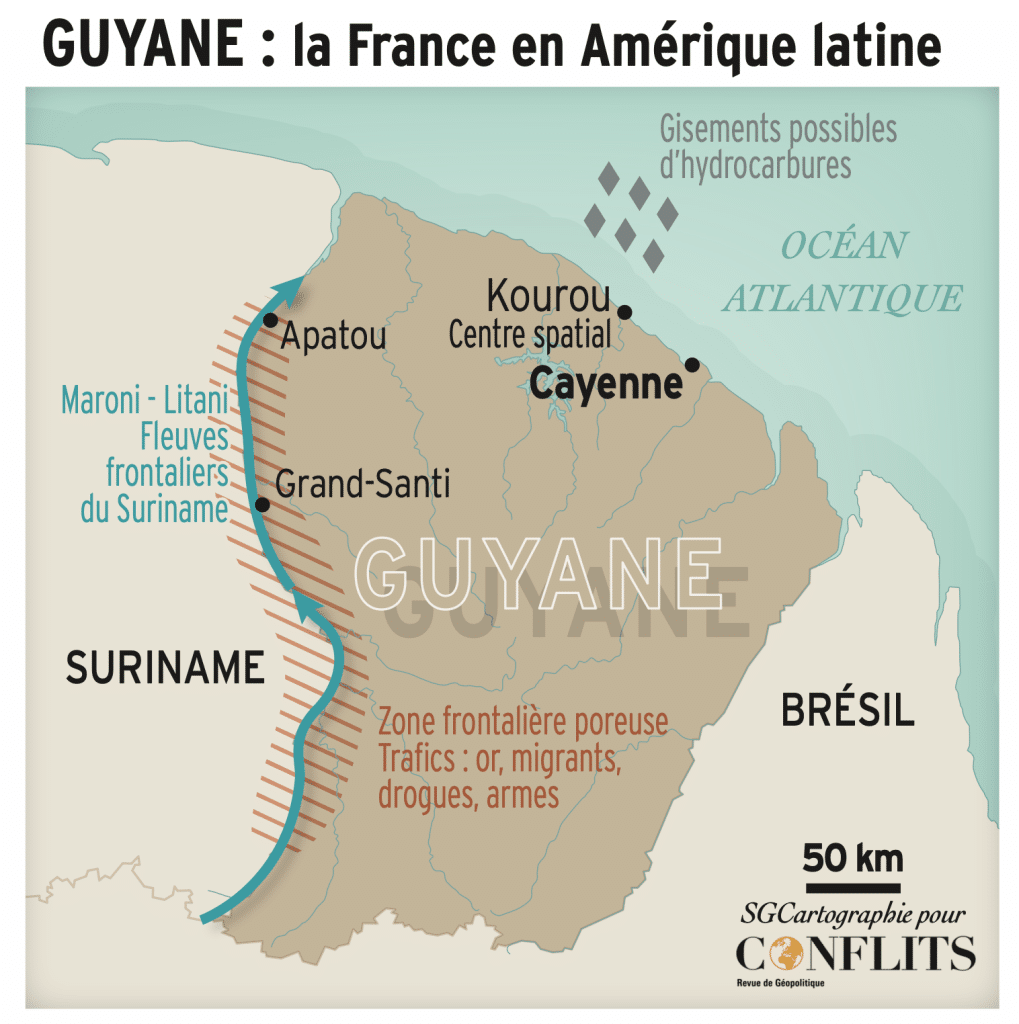
Guyana (c) Conflicts
With a restricted layout of five quays (containers, oil tankers, minerals), a draft of 6.5 meters and limited quay infrastructure, the port of Dégrad des Cannes can only accommodate intra-regional container ships and processes 1 million tonnes of merchandise and 75,000 TEU containers per year.[2]
Lessons from its Guadeloupean and Martinican neighbors
The ports of Guadeloupe and Martinique handle respectively 3.5 and 2.25 million tonnes of merchandise, 210,000 TEUs and 187,000 TEUs, as well as several hundred thousand stopover and cruise passengers. They are equipped respectively with 9 and 8 quays, modern and specialized quay infrastructure, and have a draft of 16 and 14 meters, for a maintenance cost approximately similar to the Guyanese port.
In fact, the two West Indian ports are at the heart of the “Hub Antilles” strategic vision, which aims to double container traffic through investments. Despite some renovation and normative upgrade expenses, the Guyanese port is not experiencing the same dynamic. This is an observation singled out by local elected officials, port authorities and Guyanese entrepreneurs who demand an ambitious vision to develop the port.
Read also: Martinique and Guadeloupe: two prosperous islands in the Antilles archipelago
The example of Guyana: the port of Berbice at the heart of maritime trade
The debate concerns the sedimentary constraint which would make possible developments too costly and technically difficult. If this technical constraint is a reality, it is not insurmountable. Some of the most important ports in the world operate on the Amazon River in the heart of Brazil, where sedimentary movements are part of daily life. In full economic growth, Guyana, a small English-speaking country, aims to build a deep-water port to boost its trade.[3] Constrained in the same way as French territory by a changing coastline, Guyana intends to build this port at the mouth of the Berbice River open to the Caribbean Sea. The mouth of this river offers a profitable draft of more than 15 m, well beyond the mouth of the Mahury.[4]
What is important to emphasize in the Guyanese approach is the taking into account of regional dynamics in the definition of the project. Thus, Guyana wishes to place itself at the heart of Brazilian export flows towards Asia and the Caribbean. The development project in Berbice includes road and rail axes which will connect the city in the far south of the country to the Brazilian city of Boa Vista, located in the north of the state of Roraima This city of 436,000 inhabitants could be integrated into cross-border infrastructures saving time for Brazilian exports.
“Guyana, constrained by the same shifting coastline as French Guiana, intends to build a deep-water port at the mouth of the Berbice – with 15 meters of draft, compared to 6.5 at Dégrad des Cannes.”
Expand the port of Dégrad des Cannes?
The Grand Maritime Port of Guyana (GPM) is carrying out developments despite the constraint of limited public investment and national disinterest (modernization of quays and cranes, expansion of the container terminal and surfaces, etc.).[5] However, with more resources and ambition, it would be possible to imagine a significant expansion of the main Guyanese port by promoting the acquisition of land and using land reclamation techniques, creating dikes, installing floating terminals and reinforcing the banks.
However, this work would not solve the problem of the weak draft of the Mahury River, despite a gain of a few meters, insufficient for large container ships. Moreover, they would make it possible to stabilize funds, expand the quays and thus strengthen the role of the port in intra-regional trade. Such a project requires investments and global thinking on the strategic place of the port and Guyana in its regional environment.
Read also: For a geopolitics of French overseas territories
The “Kourou of the seas”: a deep-water port for Guyana
Faced with constraints, the Grand Maritime Port of Guyana is exploring innovative solutions. In order to overcome the double problem of sediments and low draft, the GPM proposes to develop a deep water port, in the open sea, i.e. a multi-use offshore platform (POMU).[6] Located off the coast of Guyana, within its EEZ, this port platform would offer 15 meters of draft, while being located away from cyclonic trends.
This 20 ha fixed platform would integrate multi-use port terminals, energy terminals, a ship repair yard and aquaculture production units.[7] With the aim of establishing itself as a regional hub, the POMU will be capable of processing 300,000 TEU per year (transshipment and regional service), to serve as an export base for dry bulk goods (Brazilian and Surinamese ores), to serve as a logistical support base for the Guyanese fishing industry and the exploitation offshore oil from neighboring countries (Guyana, Suriname and Brazil), and finally, to produce energy independently and fisheries resources. Its potential turnover is estimated at €150 million/year, compared to €22.6 million in 2024 for Dégrad des Cannes.[8]
“The Guyanese POMU would serve as a logistics hub between Europe and the Atlantic on one side, and the Caribbean and the Americas on the other— with a potential turnover estimated at €150 million/year, compared to €22.6 million today for Dégrad des Cannes. »
Place Guyana at the heart of regional dynamics
Despite the Guyana project, the creation of a port in Guyana would remain relevant. The latter would be integrated into the maritime routes linking Brazil to the Caribbean, particularly from Fortaleza (fourth Brazilian port in terms of flows). From a broader geographical perspective, the Guyanese POMU would serve as a logistics hub between Europe and the Atlantic on one side, and the Caribbean and the Americas on the other, by ensuring transhipment and redistribution operations. Taking advantage of the oil boom in the Guiana plateau and northern Brazil,[9] Guyana could establish itself as an oil hub by leveraging the experience of French groups in this area (refining, petrochemicals, security and risk management, logistical support, etc.).
At the same time, the port of Dégrad des Cannes would focus on regional cabotage, between Brazil and the Guiana plateau, confirming this new role in maritime trade for French territory. To ensure the success of these projects, the State must support these initiatives by financing part of the development work, by freeing up land around the port, by setting up free port zones and by strengthening regional cooperation.
Read also: The French West Indies: the geostrategic asset that France refuses to assume
Integrate the entire Guyanese territory through the port
The state of underdevelopment of Guyana must lead the political authorities to consider the territory as a whole. Until 2025, Guyanese grain imports from Brazil transited through Le Havre due to a lack of customs infrastructure. New port infrastructures alone will not be able to remove the latter from its « insularityé » ; great paradox of this territory sharing 1,240 km of borders with its neighbors.
This port development must involve that of its roads which total 1,412 km, including 850 km asphalted. The dry port project in Saint-Georges-de-l’Oyapock, supported by the GPM, would constitute a lever to develop Franco-Brazilian flows which are currently limited despite the inauguration in 2017 of the Oyapock bridge. CMA-CGM shows an interest in Guyana through investments in specialized and adapted container ships,[10] and investing in the fishing sector. It is up to the French State to support these initiatives. By imagining a special status for Guyana within the EU, or even its exit, the territory could equip itself with more advanced free zones than the nebulous New Generation Free Zones of Activities (ZFANG). Finally, the development of air services, today limited and expensive, also constitutes a challenge for strengthening the economic and territorial integration of Guyana.
New port infrastructures with dual civil-military use
In 2014, a senatorial report highlighted, regarding the French Navy, “a significant risk of capacity disruption” which could hinder State Action at Sea (AEM) in overseas territories.[11] This is particularly significant in Guyana, where the state mobilizes the army and the gendarmerie to fight against illegal fishing (POLPECHE mission) with mixed results (between 7,500 and 15,000 tonnes of fish are caught illegally versus 5,000 legally). Despite major operational efforts, the maritime forces (army, gendarmerie, customs, etc.) deal with significant capacity gaps to also fight against gold (HARPIE) and drug (NARCOPS) trafficking, and to secure rocket launches (TITAN).
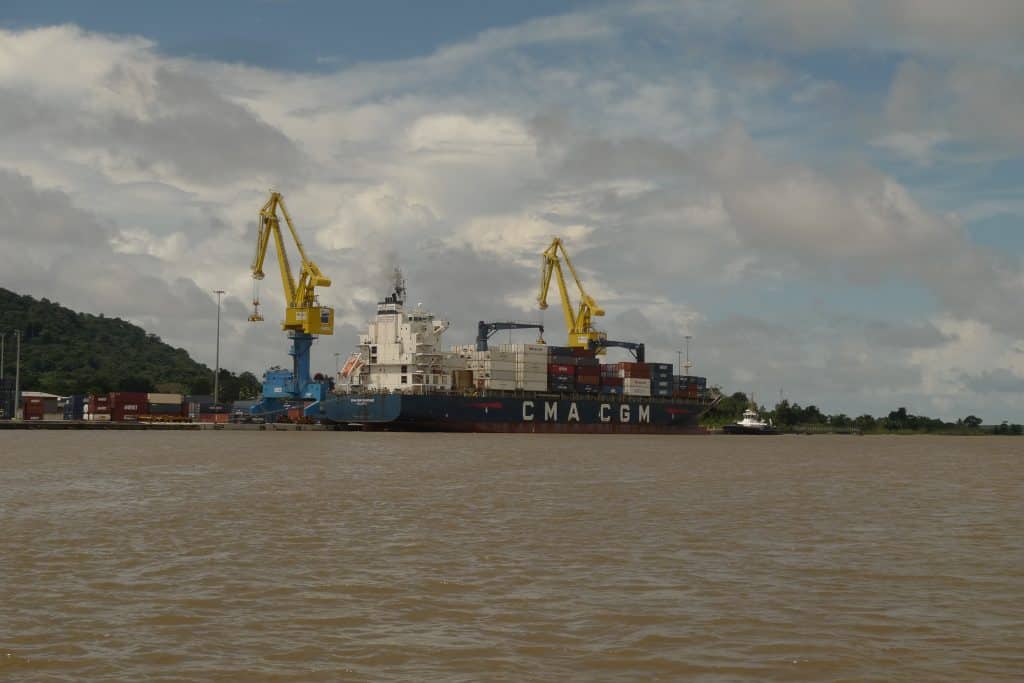
Guyana (c) Hugues-Marie Foissey
In addition to the constraints imposed by the operational limits of the resources deployed at sea (2 P700 patrol boats and two launches) and by the “operational contract” of ships (annual deployment limit at sea), maritime forces must operate with limited dockside support infrastructure. Poorly distributed along the coast (in the East), the lack of this infrastructure does not allow the forces to act effectively and equally across the entire EEZ. Thus, the POMU could serve as a logistical support base for the P700s in order to partially compensate for their operational limitations (range of action, autonomy at sea), and host a destruction site for seized boats, because the only one in service is at Dégrad des Cannes. The reception capacity of the POMU would make it possible to provide Guyana with additional resources or to receive stopovers from ships of interest in order to carry out “strategic reporting”.
Read also: China’s influence overseas
Guyana facing the risks linked to maritime issues
With these new port infrastructures and this new regional role, Guyana would see maritime flows increase along its coasts, with its share of risks (piracy, navigation, pollution, shipwrecks, trafficking, etc.). In fact, the missions entrusted to maritime forces, and in particular to the French Navy, will increase in complexity and operational requirements. In particular, the mission to protect the Space Center (TITAN), which is the absolute priority of the FAG (P0) and which will move into another dimension with this intensification of maritime flows. For example, the Navigation Prohibition Zone (ZIN), temporarily decreed by the prefect of Guyana during rocket launches, could be made permanent. The problem of trafficking will also have to be taken into account, while Guyana is already caught in a spiral of ever-increasing illicit flows.
“Of the 21 million euros necessary for a “not extraordinary†modernization of the port of Dégrad des Cannes, it is the EU which finances 55% — and not the French state. Which says a lot about Paris’ priorities with regard to Guyana.
What future for Guyana?
In view of the table, we can question the real ambition of the French state for Guyana. Recently, out of the 21 million euros needed to “normal modernization” et “Nothing extraordinary” of the port of Dégrad des Cannes, it was the EU which financed 55% (FEDER) and the GPM the rest.[12] The government’s recent communication stunt concerning a « prison de haute sécurité » of €400 million in Saint-Laurent-du-Maroni caused a stir in Guyana. Even if we can doubt its effective achievement, the fact remains that this amount mobilized to lock up “the most dangerous profiles of drug trafficking” and “Islamists” is enough to frustrate the department which is most affected by crime in France. Clearly, state priorities lie elsewhere. For a long time to come, Guyana should retain the appearance of an old colony…
Read also: Strengths and weaknesses of overseas France