-
Pink and cyan flat colors, beveled typography, a little “crime and coconut” vibe: the Ile-de-France fast-food chain Tasty Crousty has built all its visual communication on the aesthetics of Grand Theft Auto: Vice City.
-
Behind the graphic borrowing lies a promise: that of belonging, of an outlaw identity sold for nine euros per chicken/rice tray.
-
Each restaurant opening is organized like a video game mission, where hundreds of young people occupy a territory – revealing that images carry more than what they are asked to convey.
There is something immediately recognizable in the graphic design of Tasty Crousty restaurants: pink and cyan flat colors, downward beveled typography, a little “crime and coconut” vibe. Everything speaks to us, and we are faced not with a graphic charter but with a confession. A fast-food chain from Ile-de-France has chosen a video game forbidden to those under eighteen as its aesthetic emblem: Grand Theft Auto: Vice City. The city of Miami (eternally frozen in 1986) is then pixelated. The sign, like the fantasy Miami, will hit hard. And hit hard for sure! Bourgeois steeped in your certainties, you’d better leave quickly! Because, clearly, you are not ready for what is coming.
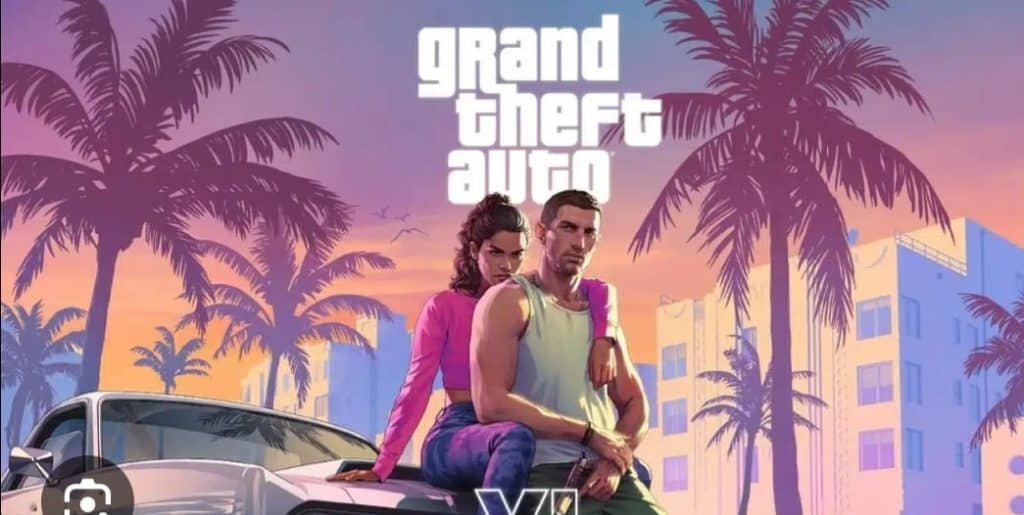
(c) Miami Vice screenshot
Vice City, or the fantasy of Miami
To understand Tasty Crousty, we must first look at what Vice City is. Released in 2002 and published by Rockstar Games, the game immerses the player in a cardboard and neon Miami. The streets are saturated with cocaine, and the 1980s “made in” soundtrack smells of sunburn and coagulated blood near parking lots. The immediately recognizable aesthetics offer palm tree silhouettes on a background of pink gradients and characters drawn in a semi-realistic style reminiscent of B-movie (or even Z-movie) crime novel covers. The main font of the game – Pricedown, designed by Typodermic Fonts – has become, in twenty years, one of the most identifiable scripts in popular culture. Rockstar understood (before everyone else) that typography was a decorative element as much as architecture and served to impose on our minds a new mental geography. Because Vice City is not Miami – it is the fantasy of Miami for a generation raised on Miami Vice episodes and Brian De Palma’s cocaine-filled movies. An America made of stucco and chrome, where social ascent would only happen through crime, and moral rules only apply to those who cannot afford to break them. The game was intended as a satire, but alas, its aesthetics were too alluring to remain sarcastic for long. The Tasty Crousty teams understood this well and decided to embrace this mafia-themed world with gusto.
It’s amazing to see how the fast-food chain founded in Épinay-sur-Seine has built its entire visual communication by adopting the codes of the fictional Vice City. The almost literal transplantation is staggering.
It’s amazing to see how the fast-food chain founded in Épinay-sur-Seine has built its entire visual communication by adopting the codes of the fictional Vice City. The logo, flyers, decor, everything, absolutely everything, evokes a tropical mafia. The establishment shamelessly appropriates a cultural memory and, beyond selling a chicken/rice tray for 9 euros, offers its “audience” a sense of belonging.
Neon against the grayness of the 9-3
To understand fully how the strategy works, we need to look at what happens during restaurant openings. Here too, the video game grammar of Vice City is not far off. Each new opening is organized as a mission: the territory is clearly defined, and multiple objectives are set (being the first to reach the sacred tray or snagging one of the countless rewards given out: electric scooters, motocross bikes, consoles…) for a spectacular outcome. Hundreds, sometimes thousands, of young people flock to a point on the map. It’s no longer just a restaurant opening: it’s a territorial occupation.
Ultimately, by offering criminal anarchy while selling a rice tray for nine euros, it’s a cynical yet profitable move.
Ultimately, by offering criminal anarchy while selling a rice tray for nine euros, it’s a cynical yet profitable move.
Tommy Vercetti and the promise of social ascent through crime
Let’s remember, Vice City is a game where crime is seen as the only way to climb socially. Tommy Vercetti, the game’s protagonist, is a hitman fresh out of prison who rises through the ranks of a mafia organization by committing murders, trafficking, and other delights. The imagery conveys more than it’s asked to, indicating that a portion of the new generation is built around the belief that the rules of the game are not meant for them.
Restaurant openings as territorial occupation
To fully grasp how well the strategy works, we need to examine what happens during restaurant openings. Here too, the video game grammar of Vice City is evident. Each new inauguration is organized as a mission: the territory is clearly delineated, and multiple objectives are defined (being the first to reach the sacred tray or grabbing one of the many rewards distributed: electric scooters, motocross bikes, consoles…) for a spectacular result. Hundreds, sometimes thousands, of youths flock to a point on the map. It’s no longer just a restaurant opening; it’s a territorial occupation.
Ultimately, offering criminal anarchy while selling a tray of rice for nine euros is as cynical as it is profitable.
Ultimately, offering criminal anarchy while selling a tray of rice for nine euros is as cynical as it is profitable.