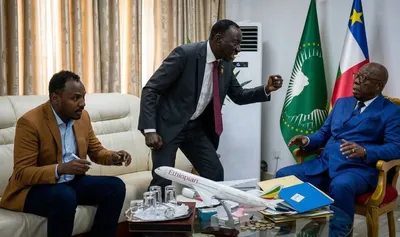
(SenePlus) – The controversial decision to award the 2025 Africa Cup of Nations (CAN) to Morocco on a green carpet continues to cause a stir beyond the soccer pitches. Decoded in an article published in Liberation by journalists Pierre Boitel and Antoine Galindo, this controversial decision by the Confederation of African Football (CAF) is fueling continental passions. It highlights two major geopolitical dynamics: the growing fear of Moroccan dominance and Algeria’s ambush strategy ready to capitalize on any opportunity.
In the kingdom, the acquisition of the trophy did not trigger popular euphoria, with the Royal Moroccan Football Federation justifying its action as simply “applying the rules”. However, for many observers, this victory is part of a much larger plan. Historian Yvan Gastaut points out in Liberation that Rabat’s objective is clearly to “strengthen its international influence, not just in football”.
This frantic quest for leadership, which is expected to culminate in co-hosting the 2030 World Cup, inevitably generates tensions. It feeds what Jean-Baptiste Guégan, a specialist in sports geopolitics, describes as a “narrative of Moroccan over-power”. According to him, social media feeds a “very conspiratorial and conspiratorial fantasy” depicting Morocco as an actor capable of dictating its rules to the governing bodies of CAF.
However, the expert nuances this statement: if the country has undoubtedly become a sports power capable of defending its interests, its actual power “does not go beyond influence”. The proof is that the demotion of the initial winner was obtained on appeal, not in the first instance, dispelling the idea of absolute control by the Moroccan federation over the organization’s machinery.
Faced with this controversy, which threatens to tarnish Morocco’s image in sub-Saharan Africa, Algeria is watching carefully. The major Maghreb rival of Rabat could well be the main collateral beneficiary of this institutional earthquake.
As Jean-Baptiste Guégan points out in the columns of the French newspaper, Algeria is currently making a structured comeback in continental sports diplomacy. With four stadiums recently renovated or built and meeting FIFA standards, the country now has all the cards in hand to host a CAN successfully. Diplomacy being primarily “the art of being opportunistic”, the expert warns that it would be quite logical to see Algiers capitalize on this scandal. Seizing the current diplomatic crisis would be a golden opportunity for Algeria to “go support where it hurts, just to destabilize its Moroccan adversary”.