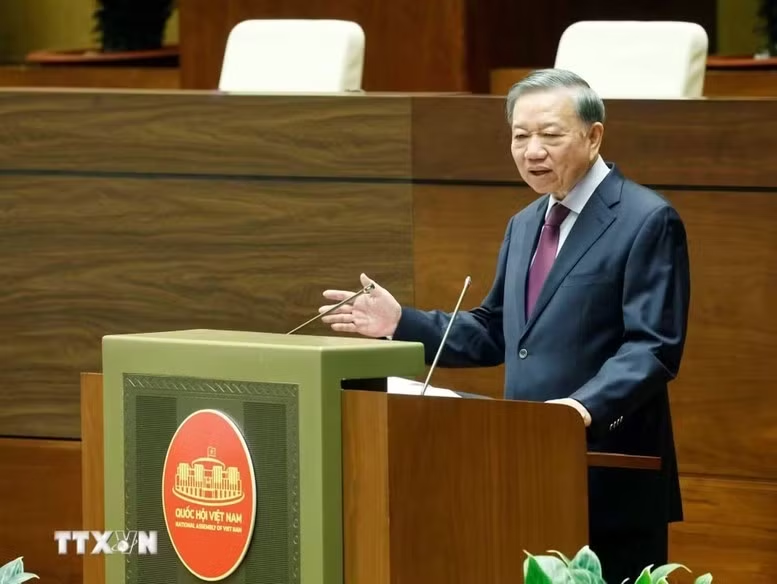
Resolution No. 06-NQ/TW of the Politburo relating to the implementation of the foreign policy guidelines of the XIV Party Congress constitutes a significant step forward in the Party’s strategic thinking. It describes foreign affairs as a “crucial” task. and permanent”, playing a pioneering role in creating a peaceful and stable environment and in broadening the country’s development prospects. The directives of Secretary General and President To Lam, during the national conference, aimed at disseminating this resolution, further clarify the direction of the resolution. Vietnamese foreign policy for the new era.

Diplomatic successes to meet the demands of the times
In view of nearly 40 years of national reforms, it is clear that Vietnamese foreign policy has made considerable progress of major historical importance. From a country once subject to a blockade and an embargo, Vietnam has established diplomatic relations with almost all countries in the world, weaved an ever-expanding network of partnerships, actively participated in multilateral institutions and become a committed and responsible member of the international community.
Foreign relations have played a crucial role in maintaining a peaceful and stable environment, protecting national interests, exploiting external resources for national development and constantly strengthening Vietnam’s international influence and prestige.
These achievements are the fruit of a foreign policy pursued consistently, independently, autonomously, peacefully, friendly, cooperative and focused on development; a constant policy of multilateralism and diversification of international relations; and proactive and comprehensive integration within the international community.
However, the world is entering a period of profound transformation. Strategic competition between the great powers is intensifying; traditional and non-traditional security challenges are increasingly intertwined; and economic, scientific and technological transformations, digital transformation and ecological transitions are changing the global landscape, creating both new opportunities and new challenges for nations.
In this context, foreign policy must not be limited to maintaining a peaceful climate or managing international relations, but must also proactively broaden the scope of development, contribute to the creation of new engines of growth and strengthen the country’s influence. The demands of reality require constant innovation in thinking about foreign policy and greater importance given to its role in national construction and defense.
The development of foreign relations in this new era must be commensurate with the historical, cultural and national prestige of the country.
On May 19, 2026, the Politburo adopted resolution No. 06-NQ/TW relating to the implementation of the foreign policy guidelines of the XIV Party Congress. This resolution marks a new stage in the Party’s strategic thinking in this area. of foreign policy, in a context where the country is entering a new era of development, with ever higher demands for the protection and development of the nation.
One of the main contributions of Resolution No. 06-NQ/TW lies in the significant evolution of the understanding of the place, role and mission of foreign policy in the new era. Above all, the resolution defines the objectives of the development of Vietnamese foreign policy in line with the historical, cultural and national status of the country. This is not only a necessity for developing international relations, but also an essential condition for improving the quality, efficiency and influence of Vietnam’s foreign policy.
In particular, Resolution No. 06-NQ/TW affirms that foreign policy and international integration are the concern of the entire Party, the entire people and the entire armed forces; she calls foreign policy a “crucial and ongoing” task. This is an important development in the Party’s theoretical thinking. Foreign policy is no longer the sole responsibility of the diplomatic sector, but a responsibility shared by the entire political system, at all levels, in all sectors, all localities, all businesses and by all people.
Another important strategic point is the emphasis placed on strategic autonomy and self-sufficiency, guarantors of national interests. In today’s unstable world, maintaining independence, self-sufficiency and defending national interests constitute the foundation for Vietnam’s sustainable development and its proactive adaptation to changing international situations. Strategic autonomy is not limited to the resolute pursuit of an independent foreign policy; it also encompasses the capacity to master the destiny of the nation and to proactively choose a development path adapted to its situation. Combined with national self-sufficiency, this autonomy maximizes internal assets and lays the foundation for strong international integration and cooperation.
You may like

Resolution No. 06-NQ/TW also sets out several major directions for the future, including promoting the pioneering role of foreign affairs in preventing risks and contributing to the early and long-term protection of the Homeland; the expansion of new development spaces for the country; strengthening Vietnam’s responsibility and contribution to solving common problems of the international community; elevating the position of the nation through leveraging its cultural influence and Vietnamese resources abroad; and the construction of a global, modern and professional diplomacy up to the strategic tasks of the new era.
Five main directions for Vietnam’s foreign policy in the new era.

At the National Conference on the Study, Understanding and Implementation of Resolution No. 06-NQ/TW (dated June 11, 2026), Secretary General and President To Lam clarified the essential content of the resolution.
Stressing that Vietnam’s development cannot be separated from the development of the region and the world, Secretary General and President To Lam said that the close and effective alliance of national forces and the forces of the time, internal forces and external forces, is a prerequisite for the rapid and sustainable development of the country.
The Secretary General and President notably emphasized that the recognition, for the first time, of foreign affairs as a “crucial and permanent” task in the same way as national defense and security constitutes a major advance in the leading thought of the Party. From then on, foreign affairs is no longer just a tool to create a favorable environment for development, but also an essential method to build, protect and develop the country, thus helping to identify, prevent and mitigate risks at the earliest, remotely and at the source.
On this basis, the Secretary General and the President defined five main directions for foreign policy in the coming period.
The first orientation consists of promoting a pioneering role in maintaining a peaceful and stable environment, and creating an international context favorable to the country. Faced with the increasing complexity of global developments, the defense of national territory, both in advance and at a distance, is of growing importance. Foreign policy must proactively identify risks, effectively address challenges, contribute to conflict prevention and establish an international environment conducive to national development.
The second orientation consists of making external relations a driving force for creating new development opportunities. This is an innovative requirement. External relations must be intrinsically linked to the process of socio-economic development of the country, thus contributing to attracting external resources and creating favorable conditions for rapid and sustainable development.
To further clarify this requirement, Secretary-General and President To Lam insisted on the need to resolutely move from “diplomacy aimed at protecting development space” to “diplomacy aimed at strengthening national development capacities”. This implies that foreign policy does not just attract resources, but actively participates in the creation of new development engines, by promoting technological diplomacy, innovation, digital transformation, artificial intelligence, the digital economy and the ecological transition.
The third direction is to actively and responsibly participate in resolving problems common to the international community, thus strengthening Vietnam’s role and position within multilateral mechanisms. With this in mind, Vietnam will gradually improve its capacity to propose initiatives, contribute to solutions and participate in the development of international cooperation mechanisms consistent with its national interests and those of the international community.
The fourth orientation consists of raising the status of the nation so that it lives up to its historical importance, its cultural identity and its position. This orientation bears the imprint of a nation in full swing. In addition to its economic, military and scientific and technological power, it is necessary to take full advantage of its cultural influence, promote the image of Vietnam and its people, and mobilize the resources of the Vietnamese community abroad, thereby helping to spread Vietnamese values throughout the world.
The fifth orientation consists of building a global, modern and professional diplomacy, up to the strategic challenges of the new era. This is both an objective and a necessary condition for the success of foreign policy missions. Modern diplomacy requires a team of officials with strong political convictions, a keen strategic mind, high professional qualifications and the ability to adapt to a constantly changing international environment.
Understand it perfectly, do it correctly, do it according to the rules of the art, do it efficiently.
To realize the main directions of Resolution No. 06-NQ/TW, it is essential to ensure its effective implementation. During the National Conference dedicated to the study, understanding and implementation of Resolution No. 06-NQ/TW, Secretary General and President To Lam emphasized the motto: “Understand deeply, act correctly, act rigorously and act effectively.”
Accordingly, Party committees, organizations, agencies and units at all levels must quickly translate the resolution into action programs and work plans, linked to the functions and tasks of each sector, locality and area.
In addition, it is necessary to continue to innovate inter-ministerial coordination mechanisms, improve the effectiveness of links between foreign affairs and defense, security, economy, culture, science and technology, and other areas; and to build a team of foreign affairs officials with the qualities, capabilities and prestige sufficient to assume their responsibilities.
As Secretary General and President To Lam emphasized, “full implementation of the resolution involves concrete actions, actions to create change and change to produce tangible results.” resolution No. 06-NQ/TW is measured not only by the number of programs or action plans published, but also by the concrete changes made to the effectiveness of foreign policy, the capacity to mobilize international resources in the service of national development and the strengthening of Vietnam’s position on international scene.
With clear strategic directions, strong innovation capacity and high political determination of the entire Party, people and army, the effective implementation of Resolution No. 06-NQ/TW will contribute to the development of a policy foreign to live up to the country’s historical prestige, cultural identity and increasingly high positioning, effectively serving the goal of building a strong and prosperous Vietnam.
Source : https://baotintuc.vn/thoi-su/phat-trien-doi-ngoai-tuong-xung-voi-tam-voc-dat-nuoc-trong-ky-nguyen-moi-20260614070658399.htm