History shows that each stage of a country’s development is linked to the expansion of its international sphere.
Today, the situation is no different. In an ever-changing and extremely competitive world, maintaining a peaceful and stable environment while taking full advantage of external resources is a strategic necessity.
Politburo Resolution No. 06-NQ/TW on the Implementation of the Foreign Policy Guidelines of the 14th Party Congress represents a new development in foreign policy thinking, considering it a “crucial and ongoing” task, a pioneering effort to create an international situation favorable to national development.
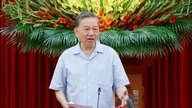
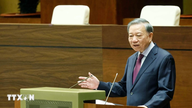
During the conference to disseminate Resolution No. 06-NQ/TW, Secretary General and President To Lam stressed that Vietnam’s development is inseparable from that of the region and the world. The close combination of national forces and the assets of the time, internal and external forces, constitutes not only an objective requirement, but also an essential condition for the realization of aspirations for national development.
It is also the common thread of our Party’s foreign policy and the thought of Ho Chi Minh, in particular since the beginning of the Doi Moi (Renovation) process in 1986 until the present day.
However, while previously the central task of foreign policy was to break the blockade and embargo, develop relations and create an international environment favorable to national development, the demands are now much higher.
And to achieve the goal of becoming a high-income developed country by 2045, the nation needs new resources in terms of capital, technology, knowledge, markets and high-quality human resources.
At the same time, the new development model, mainly focused on science and technology, innovation and digital transformation, requires a higher level of international connectivity than ever before.
This request is entirely justified if we consider the 40 years of the Doi Moi (Renovation) process.
From a once besieged and embargoed country, Vietnam today maintains diplomatic relations with 194 countries, has established 38 partnership frameworks and is an active member of more than 70 international organizations and forums.
Vietnam maintains economic and commercial relations with 230 countries and territories and participates in a network of 20 free trade agreements. From a struggling economy in 1986, its GDP increased nearly 100-fold, making Vietnam one of the world’s 32 largest economies, while per capita income rose from less than $100 to more than $5,000.
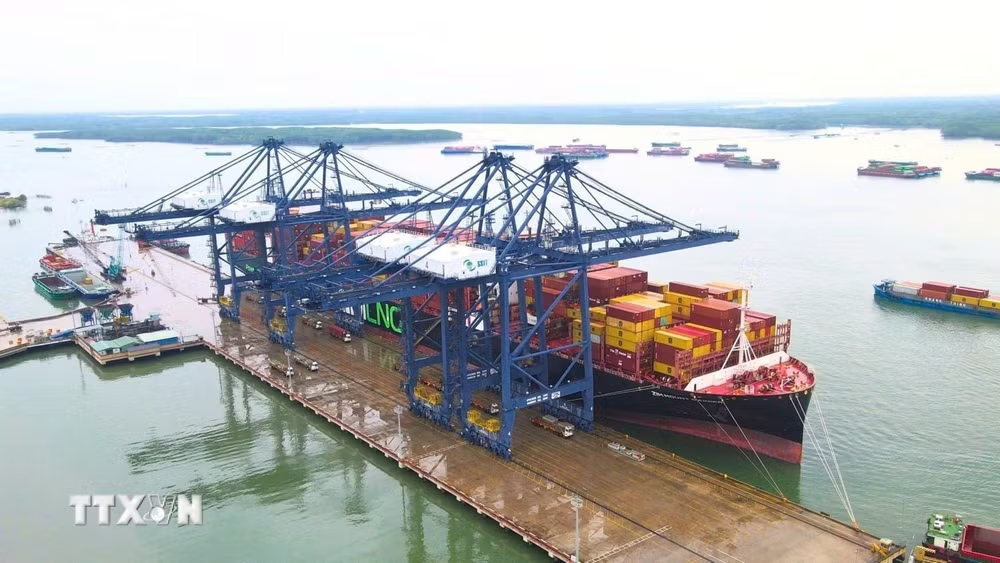
Since joining ASEAN in 1995, APEC in 1998 and the WTO in 2007, to its participation in next-generation free trade agreements such as the CPTPP, EVFTA and RCEP, Vietnam has not only expanded its markets, but has also gradually improved its competitiveness, attracted investments, acquired technologies and participated more deeply in global value chains.
You may like
International integration has truly become an important driver of national capacity building, effectively contributing to the country’s development, particularly in the fields of science and technology, education and training, and health care; thus allowing the Vietnamese economy to strengthen and integrate more deeply into the world.
These figures do not only reflect integration successes. More importantly, they show that each stage of the country’s development is linked to each stage of the expansion of its foreign relations.
Therefore, the most notable feature of Resolution No. 06-NQ/TW is that, for the first time, foreign affairs are identified as a “crucial and ongoing” task along with defense and security. national security.
This is a significant development in the thinking of the Party leaders!
In the past, foreign policy was primarily aimed at protecting a peaceful environment and taking advantage of international conditions favorable to development.
Today, foreign policy occupies a central place, helping to identify and prevent the risks of remote conflict, from their origin, while proactively creating the most favorable international conditions for national development. In other words, foreign policy is entrusted with a new and broader mission.
Secretary-General and President To Lam clearly indicated the need to move from a “diplomacy of protecting development space” to a “diplomacy of strengthening national development capacities”; from “market integration” to “market creation”; and from “participation in the rules of the game” to “contribution to the development of the rules of the game”.
This is the most significant development in the foreign policy orientations of the 14th Party Congress!
This vision stems from the new position and power of the country. Vietnam has built a vast network of relationships with key partners around the world, has a very open economy, where science, technology, innovation and digital transformation have become the main drivers of development, and faces increasingly strategic and technological competition. fierce, its foreign policy can no longer be limited to maintaining relations or attracting resources in the traditional way.
Foreign policy must actively engage in creating new spaces for development. This involves diversifying markets, partners and sources of supply. It is also about choosing FDI sources wisely, favoring high-tech projects, establishing close links with national partners and transferring technologies rather than focusing only on quantity.
This involves promoting technology diplomacy, including innovation, and building ties with key science and technology centers around the world. It also means actively participating in proposing and developing international frameworks, rules and standards in emerging areas.
This is also why Resolution No. 06-NQ/TW aims not only to guarantee national interests, but also emphasizes the responsibility to contribute to the common work of the international community.
As a country mainly involved in multilateral mechanisms, Vietnam is increasingly called upon to contribute to solving common problems and global challenges such as peacekeeping, combating climate change, food security, sustainable development, humanitarian aid and search and rescue operations.
You may like
It is the natural evolution of a country which has acquired new strength and power!
President Hô Chi Minh once said: “Strength is like the gong, diplomacy like sound. If the gong is good, the sound will carry far.” Inner strength always plays a decisive role. But to maximize this inner strength, it is necessary to make the most of favorable external conditions.
Resolution No. 06-NQ/TW is part of the continuity and development of the overall foreign policy of our Party and the thought of Ho Chi Minh.
If integration created an environment favorable to development, then today, external relations must lead the way, protecting and expanding this space.
All this aims to ensure that the country remains firm in its march towards 2045.
Source : https://www.vietnamplus.vn/khi-doi-ngoai-kien-tao-tuong-lai-cua-dat-nuoc-post1116167.vnp