lediplomate.media – printed on 05/21/2026
By Giuseppe Gagliano, President of the Carlo De Cristoforis Strategic Studies Center (Côme, Italy)
From Soviet mines to container villages: the hidden price of the mining miracle
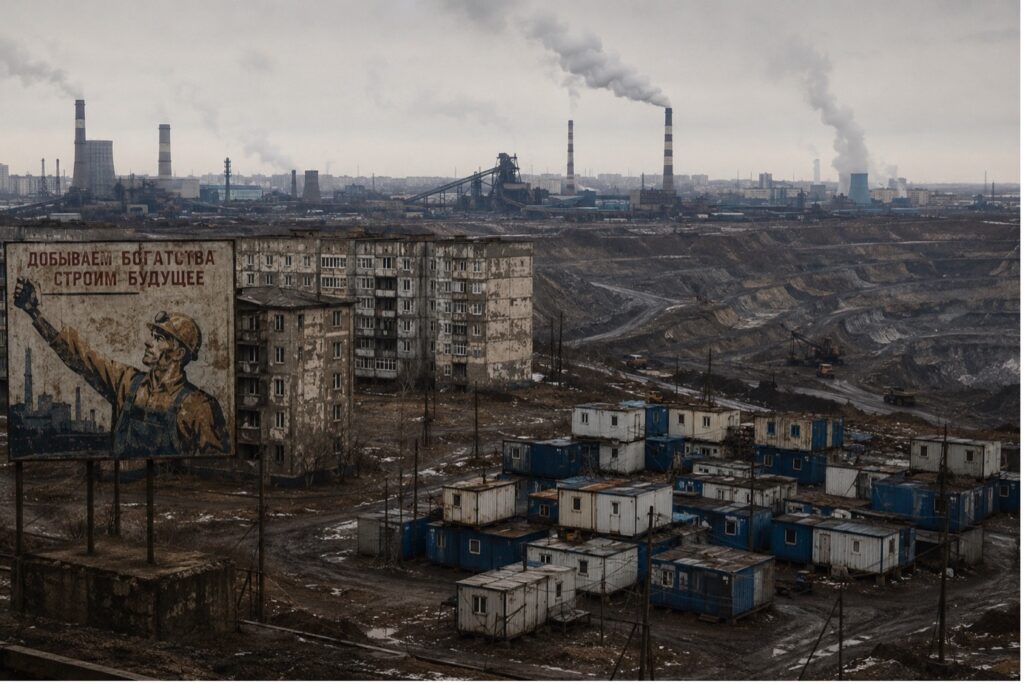
Kazakhstan is one of the great contradictions of our time. On paper, it is a mining, energy and strategic giant: uranium, oil, gas, coal, iron, copper, zinc, gold, rare earths, a crossroads between Russia, China, Central Asia and Europe. In the daily reality of many of its industrial cities, it is also a country where entire communities live next to exhausted mines, dilapidated installations, villages born to temporarily house workers and become, over time, social cages with no way out.
The key word is extractivism. Not simply resource extraction, but a development model based on the idea that a territory is worth first and foremost for what can be dug, pumped, refined and exported there. An old model, inherited from the Soviet Union, but updated in the language of global capitalism: foreign investments, privatizations, concessions, mining companies, international markets, energy transition, Chinese demand, Western value chains.
The result, however, is often the same: wealth leaves, pollution remains. Profits accumulate elsewhere, diseases concentrate in working-class neighborhoods. The balance sheets of companies are improving, the human balance sheets of families are deteriorating. Kazakhstan is not poor because it lacks resources. He is hurt precisely because he owns too many and because their management has been bent, for decades, to logics external to the lives of local populations.
The old Soviet industrial city, with its factory, its dormitory, its canteen, its school, its hospital and its worker discipline, was to embody progress. Today, in many cases, the shell remains: damaged buildings, burst pipes, closed or privatized mines, poorly paid workers, insufficient public health, compromised environment, young people on the run. Real socialism had built cities around the factory. Extractive capitalism has often transformed them into production waste.
The subsoil as a national destiny
Kazakhstan became independent in 1991 with a dual heritage. On one side, an exceptional geostrategic position: immense territory, borders with Russia and China, depth in Central Asia, decisive energy and mining resources. On the other, an economic structure heavily dependent on the extraction and export of raw materials.
During the Soviet period, Kazakh territory was treated as the productive hinterland of the empire: mines, steelworks, military bases, nuclear polygons, industrial cities, infrastructure built to fuel Moscow’s power. The priority was not social or environmental balance, but production. Coal served heavy industry. Iron and metals supplied the steel industry. Uranium and nuclear power responded to the strategic logic of the Cold War. The local population was displaced, concentrated, disciplined, integrated into an economic system whose decisions were made elsewhere.
With independence, Kazakhstan could have broken this dependence. In part, he tried to do this, by building a multi-vector diplomacy, attracting foreign capital, maintaining relations with Russia, China, Europe, the United States, Turkey and the Islamic world. But the deep structure has remained the same: export what the subsoil offers. Caspian oil, uranium for the world market, metals for global industry, coal for energy, rare earths and critical minerals for the new technological competition.
On the surface, this is fortunate. In reality, this can become a trap. When a state depends too much on raw materials, it risks building a fragile economy: rich when prices are high, vulnerable when crises arrive; able to attract investment, but less able to create diffuse development; strong in its relations with the great powers, but weak in the face of the companies which control technologies, capital and markets.
It is the resource curse, in its Central Asian version: not the absence of wealth, but the inability to transform this wealth into stable well-being, modern infrastructure, environmental protection, labor security and real economic sovereignty.
Cities born to produce, not to live
The drama of the Kazakh mining towns lies precisely there. Many were not born as autonomous communities, but as instruments of production. Their meaning was to serve a mine, a steelworks, a power station, a depot, a chemical installation. When production worked, the system held up. When the factory went into crisis, the whole town began to fall apart.
Temirtau, Karaganda, Jezkazgan, Zhanaozen, Ekibastuz and other industrial centers each tell this story in their own way. These are places where blue-collar work has built identity, pride and social cohesion, but also total dependence on the company. If the factory pays, the city breathes. If the factory cuts, privatizes, relocates or reduces investments, the city collapses.
The problem is not just economic. It is anthropological. When a community is built around a single sector, a single employer, a single sector, it loses its capacity to choose. The worker does not only sell his labor power. He entrusts to the company the destiny of his family, his house, heating, the children’s school, health, the possibility of leaving or staying.
In container villages and temporary neighborhoods that have become permanent, this dependence takes an almost physical form. The provisional becomes destiny. Housing created to temporarily house workers remains occupied for years or decades. Infrastructure is wearing out, pipes are freezing, heating is breaking down, roads are deteriorating, medical assistance remains insufficient. The city does not grow as a living organism, but as the residue of a productive cycle.
Extractivism doesn’t just destroy the environment. It also produces an urban planning of precariousness.
Frost, mines, pipes: when the State does not arrive
In Kazakhstan, climate is part of politics. Very harsh winters, extreme temperatures, immense distances, worn out infrastructure. In these conditions, heating is not a service: it is a question of survival. When a thermal power plant malfunctions, when a network of pipes explodes, when a neighborhood remains without heat, it is not a matter of discomfort. This is a life-threatening risk.
In recent years, several incidents have shown the vulnerability of urban and industrial infrastructures. Cities built during the Soviet era require constant maintenance, heavy investments and planning. But for too long, the system has lived on rent: exploiting old equipment, postponing repairs, dispersing responsibilities between the state, local administrations, private companies and concessionaires.
The result is that no one seems truly responsible until the moment of disaster. Then come the promises, the investigations, the temporary relocations, the resignations, the reciprocal accusations. But the structural problem remains: a country immensely rich in resources does not always manage to guarantee essential services to the communities that extract these same resources.
This is where the injustice becomes unbearable. Workers work in dangerous mines, breathe dust, live in polluted cities, support the national wealth with their own bodies, then find themselves without heating, without decent housing, without adequate wages, without sufficient health protection.
Extractive modernization produces exports. But it does not always produce citizenship.
Privatizations and foreign capital: the new mask of the old model
After 1991, Kazakhstan opened many sectors to foreign investment and privatization. It was inevitable, at least in part. The new state needed capital, technologies, skills, markets, financial access. But the way in which this process was conducted often reproduced the colonial logic of the Soviet era, with new actors in place of Moscow.
It is no longer the Soviet imperial center which decides on five-year plans, but transnational companies, local oligarchies, funds, intermediaries, mining companies and large industrial groups. The form changes; the substance remains similar: the territory is evaluated according to its capacity to produce exportable resources.
In theory, foreign capital should bring efficiency, technology, security, modernization. In practice, when controls are weak and the state depends too much on investors, the opposite can happen: cost compression, low wages, insufficient maintenance, outsourcing of risks, contractual opacity, marginalization of local communities.
The decisive question is always the same: who controls the annuity? If the value produced by the subsoil ends up mainly in the hands of companies, intermediaries and administrative elites, while workers only receive insufficient wages and occupational illnesses, then this is not development. This is an organized transfer of wealth.
Kazakhstan has tried over the years to strengthen state control over certain strategic sectors, but tension remains. On the one hand, it must attract investment; on the other, it must prevent these investments from transforming into private sovereignty over the territory. It is an extremely difficult balance, especially in a huge country, marked by strong regional inequalities and by large distances between the political capital and the mining outskirts.
Monoeconomy as a social prison
Mining towns are often monofunctional towns. They exist because a mine or factory exists. This makes them vulnerable to every shock: closure of a dealership, drop in international prices, business crisis, accident, strike, sanctions, technological change, energy transition.
When everything depends on a single activity, society loses its exit routes. The young person who wants to stay finds few alternatives. The laid-off worker cannot easily retrain. Women often remain trapped in informal economies or underpaid jobs. Utilities depend on the financial health of the company. Emigration becomes the only individual strategy.
Monoeconomy also generates political blackmail. If the company is the only source of work, challenging it means risking the survival of the city. If the state imposes rules that are too harsh, the company threatens to reduce its investments. If workers strike, they are accused of endangering the local economy. The community thus remains suspended between fear of closure and anger against exploitation.
This explains why social protests in Kazakhstan often have working and territorial roots. These are not abstract revolts. They arise from wages, the cost of living, security, housing, heating, pollution, the perception that wealth leaves the territory without return.
The Zhanaozen revolt in 2011, in the oil sector, and the broader protests of January 2022 showed that beneath the country’s apparent stability exists a deep tension. The implicit pact of Kazakh power – economic growth in exchange for political obedience – enters into crisis when growth no longer reaches the social base.
Environment: the discharge of modernization
Extractivism always leaves an environmental legacy. In Kazakhstan, this legacy is heavy. Mines, metallurgical installations, coal-fired power plants, Soviet industrial sites, waste, contaminated water, polluted air, compromised soils. Added to this is the even more tragic memory of the Soviet nuclear tests at Semipalatinsk, which marked entire generations.
The environment is not a secondary theme. This is the place where the truth of the economic model appears. If a country exports uranium, coal, oil and metals, but leaves local communities with respiratory diseases, cancers, dirty water and unusable land, then the official accounting is false. Gross domestic product increases, but ecological debt accumulates. Exports bring in foreign currency, but public health pays the bill.
The global energy transition risks worsening this contradiction. The Western world and China are always demanding more critical minerals for batteries, green technologies, electricity networks, defense, electronics. Kazakhstan can become a decisive supplier. But the question is: green for whom? Clean where? A technology can be ecological in the country that consumes it and devastating in the country that extracts its materials.
This is the new face of environmental geoeconomics: the decarbonization of rich centers can produce new extraction in mining peripheries. Electric cars, turbines, panels, semiconductors and batteries are not born in a vacuum. They are born from mines, water, energy, work, waste and sacrificed territories.
Kazakhstan risks becoming one of the dirty workshops of the global green transition.
Strategic and military assessment
From a strategic and military point of view, Kazakhstan occupies a crucial position. It is the largest state in Central Asia, shares borders with Russia and China, is close to the Caspian, has fundamental energy and mining resources, hosts sensitive infrastructure and retains a deep memory of the Soviet military presence.
Its resources are not only economic. They are strategic. Kazakh uranium is decisive for the global nuclear market. Metals and rare earths can become important elements in the defense, electronics, aerospace, communications and energy sectors. Coal, although contested on environmental grounds, remains fundamental for domestic electricity production. Oil and gas connect Kazakhstan to the Caspian, Russian, Chinese and European routes.
In a world marked by the war in Ukraine, sanctions against Moscow, the rivalry between the United States and China and the race for critical minerals, Kazakhstan is no longer a periphery. It is a strategic back zone. Every mine, every railway, every oil pipeline, every logistical passage acquires geopolitical value.
This makes the country vulnerable to external pressures. Russia considers it as part of its historical and secure space. China sees it as a fundamental land corridor for new Eurasian trade routes. Europe is looking for alternatives to Russian supplies. The United States is looking at its critical resources and the possibility of reducing the influence of Moscow and Beijing. Turkey cultivates the Turkish-speaking link. Gulf monarchies are investing.
Kazakhstan is trying to balance everything. But balance works as long as no power demands a definitive choice. If global competition were to stiffen, Astana could discover that its mineral wealth is not only an advantage: it is also a target.
Évaluation geopolitique
Geopolitically, Kazakhstan is a pivotal state. It cannot afford to break with Russia, because it shares borders, history, infrastructure, language, a Russian-speaking minority, security and economic interdependence with Moscow. It cannot afford to ignore China, because Beijing is a market, an investor, a neighbor and an infrastructural power. It cannot renounce the West, because it needs technologies, capital, legitimation and strategic alternatives.
This position produces a cautious, multi-vectored, often skillful diplomacy. Astana avoids abrupt gestures, seeks agreements with everyone, formally defends its sovereignty, but does not openly challenge the giants around it. After the Russian invasion of Ukraine, this posture became even more delicate. Kazakhstan has avoided recognizing Russian annexations, but it cannot transform itself into an anti-Russian outpost. It maintains growing relations with China, but does not want to become a Chinese dependency. He dialogues with Europe, but he knows that Europe is distant and often fickle.
The internal fragility of mining towns is part of this geopolitics. A state that wants to play on several levels must maintain its internal cohesion. But if the industrial peripheries feel abandoned, if the workers see wealth disappear without return, if the environment deteriorates and if services collapse, stability becomes more fragile. And in Central Asia, internal fragility can quickly be read, used or manipulated by external powers.
Kazakhstan’s sovereignty is not only measured in diplomatic summits. It is also measured in mining villages, in poorly heated houses, in dangerous mines, in repressed or ignored protests. A state that does not protect its workers can hardly claim to be fully sovereign over its resources.
Géoéconomique evaluation
Kazakhstan’s geo-economy revolves around one question: who will control the minerals of the future? Global competition no longer only concerns oil and gas. It concerns uranium, copper, lithium, rare earths, cobalt, nickel, zinc, metals necessary for the military, digital and energy industries. In this scenario, Kazakhstan can become an essential platform.
For Europe, the country represents a possible alternative to Russian and Chinese supplies. For China, it is a close and integrable land partner in its industrial chains. For Russia, it is a space not to be lost. For the United States, it is a card in the strategy of diversifying critical resources. For global businesses, it is a territory of opportunity.
But this centrality risks reinforcing the extractive model instead of going beyond it. If Kazakhstan limits itself to exporting raw materials, it will remain dependent on international prices and other people’s technologies. If, on the contrary, it manages to develop refining, industrial processing, research, training, infrastructure and environmental control, it will be able to transform mining revenue into economic power.
The difference is decisive. Exporting ore means remaining peripheral. Transforming it means moving up the value chain. Controlling the sectors means gaining sovereignty.
The risk is that the great powers talk about partnership, but above all seek secure access to resources. It’s the old colonial story with new words: cooperation, sustainable development, green transition, energy security. Behind these formulas may hide the same old question: who takes the value and who stays with the waste?
The social question: wages, security, dignity
The political heart of the Kazakh question remains work. Mine and installation workers are not asking for abstractions. They are asking for decent wages, heated homes, security, health, recognition, a possibility of a future for their children. They are asking that the wealth they extract not turn into luxury for a few and precariousness for many.
Safety at work is a central issue. Mining accidents, explosions, collapses, gas leaks, maintenance faults are the dark side of apparent efficiency. When production comes before life, the miner becomes a consumable material. When society accepts that certain territories pay the price of national wealth, inequality becomes geography.
Working dignity was one of the symbolic pillars of the Soviet era, despite all the contradictions of the system. Today, this dignity is often eroded by low wages, precarious contracts, subcontracting, privatizations and the absence of effective protection. The worker who was once celebrated by propaganda as the builder of socialism today risks becoming invisible in commodity capitalism.
This passage produces anger. Not a pure nostalgia for the past, but the perception of a loss: in the past, the factory at least guaranteed belonging, services, identity; today, the market only guarantees uncertainty. It is a social nostalgia, not an ideological one. And precisely for this reason, it is politically powerful.
*
*Â Â Â Â Â Â Â *
The twilight of a model?
Mining Kazakhstan tells a story that goes beyond Kazakhstan. It recounts the fate of many countries rich in resources and poor in distributive justice. It recounts the persistence of extractivism after the end of formal empires. It tells how globalization has replaced direct political command with dependence on markets, companies, capital and sectors.
The country has everything the world is looking for: energy, metals, space, position, corridors, uranium, coal, Eurasian access. But precisely for this reason, it must decide whether it wants to be only a mine at the service of others or a state capable of transforming the subsoil into national development.
The question is not technical. She is political. It means deciding who benefits from wealth. It means imposing rules on businesses. It means decontaminating the territories. It means investing in working cities. It means diversifying the economy. It means protecting workers. It means preventing the global energy transition from becoming a new form of mining colonialism.
The twilight of extractivism is not the end of mines. The world will still need minerals, energy and metals. But it marks the end of the illusion according to which we could dig without consequences, export without responsibility, enrich without returning, industrialize without caring, modernize without justice.
If Kazakhstan does not break with this logic, its mining towns will remain monuments to missed wealth: places where the subsoil produced billions and where the surface collected dust, cold and disillusionment. If, on the contrary, it knows how to use its position and its resources to build industrial sovereignty, social protection and territorial dignity, it could become not the mining periphery of other empires, but one of the laboratories of the new Eurasian autonomy.
For now, the country remains suspended. Between old Soviet mines and new global investors. Between inhabited containers and mining wealth maps. Between workers who demand respect and powers who seek access to resources. Between the freezing of industrial cities and the rhetorical warmth of the energy transition.
It is there, in this distance, that the truth of contemporary Kazakhstan is measured: an underground giant which has yet to demonstrate that it knows how to become a nation for its citizens, and not only a strategic reserve for the world.
#Kazakhstan,#KazakhstanMining,#Extractivism,#Mining,#Uranium,#Rare Earths,#Energy Transition,#Geopolitics,#Central Asia,#Russia e,#China,#Europe,#Energy,#Coal,#Oil,#Gas,#CriticalMetals,#Mining,#Sovereignty,#Geoeconomics,#Capitalism,#Tra vagrants,#SocialJustice,#Pollution,#Zhanaozen,#Karaganda,#Temirtau,#Jezkazgan,#Astana,#GreenTransition,#Economic Colonialism,#War economic, #Natural Resources, #Industry, #Miners, #Multipolar World, #MichelGeopolitics, #Eurasia, #TheDiplomat, #GiuseppeGagliano