- Brève introduction
- The war in Iran costs the world at least $25 billion
- A drone hits the Barakah nuclear power plant: the ceasefire with Iran is a dangerous fiction
- WHO declares international health emergency due to Ebola Bundibugyo virus in Congo and Uganda
- Britain is dividing: Labor’s terminal crisis and the rise of Reform
- Trump returns from China with stability and paralysis: Reuters analysis
- Media rack
- Editorial commentary
Brève introduction
May 18, 2026 concentrates within itself a multitude of interdependent crises which define, with brutal clarity, the state of the international order in this second half of the decade.
The war in Iran – which began on February 28 with American and Israeli attacks – has already gone beyond the stage of a regional conflict to become a global economic shock of major importance: according to the analysis published today by Reuters, companies around the world have already accumulated at least $25 billion in direct losses, and the bill continues to rise. At the same time, a drone that broke through Emirati anti-aircraft defenses and struck the outer perimeter of the Barakah nuclear power plant – the only nuclear power plant in the Arab world – demonstrates that the ceasefire with Iran is a dangerous fiction and that the jihadist oligarchy of Tehran and its terrorist proxies continue to bank on escalation. Thousands of kilometers away, the World Health Organization yesterday declared a maximum international health emergency due to the Bundibugyo variant Ebola outbreak – for which there is no approved vaccine or treatment – which is spreading from the Democratic Republic of Congo to Uganda. In the Pacific, Reuters’ analysis of the Trump-Xi summit sums up what happened in Beijing with a formula to which this analyst fully subscribes: apparent stability and structural paralysis.
And at Westminster, Mr. Starmer’s Labor government is collapsing at an accelerating pace: a coalition of 97 MPs from his own party publicly calls on him to resign, while Nigel Farage’s populist right wins a landslide victory in local elections and the United Kingdom accelerates its internal disintegration.
Five news items. Five vectors of the same diagnosis: the international system based on norms, multilateralism and peaceful economic interdependence is subject to simultaneous tensions that no existing institution is able to absorb in isolation. The task of rigorous analysis – which is the only honest response to this scenario – requires calling things by their name, with the precision that the gravity of the moment requires.
The war in Iran costs the world at least $25 billion
Facts
A comprehensive analysis released today by Reuters — based on a review of financial filings from companies listed in the United States, Europe and Asia since the start of the conflict — estimates cumulative direct losses by companies around the world due to the war in Iran to be at least $25 billion. At least 279 companies cited the conflict as a trigger for defensive measures aimed at mitigating the financial impact, including price hikes, production cuts, suspension of dividends and share buybacks, social plans, fuel surcharges and requests for emergency aid from governments. The transmission channel of economic damage is threefold: the rise in energy prices – the price of gasoline in the United States exceeded 4 dollars per gallon on March 31 after a 30% increase –, the increase in prices and the interruption of maritime transport routes due to the blockade of the strait of Hormuz, and the breakdown of global supply chains.
The general director of Vitol, the world’s largest crude oil trader, estimated that the conflict would lead to a total loss of one billion barrels of oil production. Goldman Sachs predicts pressure on the margins of European companies which will begin to be fully felt in the second half of 2026, once financial hedges (hedging) have expired. The Suez Canal is experiencing a drastic drop in traffic, with losses estimated by the World Bank at $10 billion for Egypt. Qatar, whose liquefied natural gas (LNG) liquefaction plant at Ras Laffan was damaged in an Iranian attack, invoked force majeure on its contracts with buyers, leading to a 140% rise in spot LNG prices in Asia.
Implications
The $25 billion calculated by Reuters is, almost certainly, a conservative figure: it only represents the direct losses declared by listed companies in their financial reports and stock market press releases. They do not include the overall macroeconomic cost — the International Monetary Fund projects that combined tariffs and energy disruptions could reduce global growth by one to two points in 2026 – nor the impact on small and medium-sized businesses, nor the costs deferred reconstruction of supply chains.
The scale of the economic damage makes the lack of a coherent resolution plan on the part of the Trump administration all the more incomprehensible. A war presented as an instrument of strategic pressure intended to modify the behavior of the Iranian regime has transformed, more than two months later, into a global economic hemorrhage with no visible horizon of resolution. European allies – including Spain, whose ports and energy companies are exposed to the impact of LNG prices – are suffering significant collateral damage without having been consulted at any stage of the process.
Perspectives et scénarios
The cumulative economic cost puts increasing pressure on the Trump administration to reach some kind of agreement with Iran before the macroeconomic deterioration – already visible in the downward revisions of the S&P 500 and Eurostoxx 600 margins – begins to take hold. translate into a national electoral impact.
If the blockade of Hormuz extends beyond the summer, models from Goldman Sachs and JP Morgan predict a scenario of moderate recession in Europe and a significant slowdown in the United States. The paradox is obvious: Trump launched the war to demonstrate his strategic strength, but each week that passes without an agreement highlights the limits of military power as an instrument of political resolution in the face of a regime that does not respond to the logic of rational incentives.
Map showing the Strait of Hormuz, also known as Madiq Hurmuz, along with 3D printed oil barrels – REUTERS/ DADO RUVIC
” src=”https://www.atalayar.com/media/atalayar/images/2026/04/08/2026040812175989877.webp”>
A drone hits the Barakah nuclear power plant: the ceasefire with Iran is a dangerous fiction
Facts
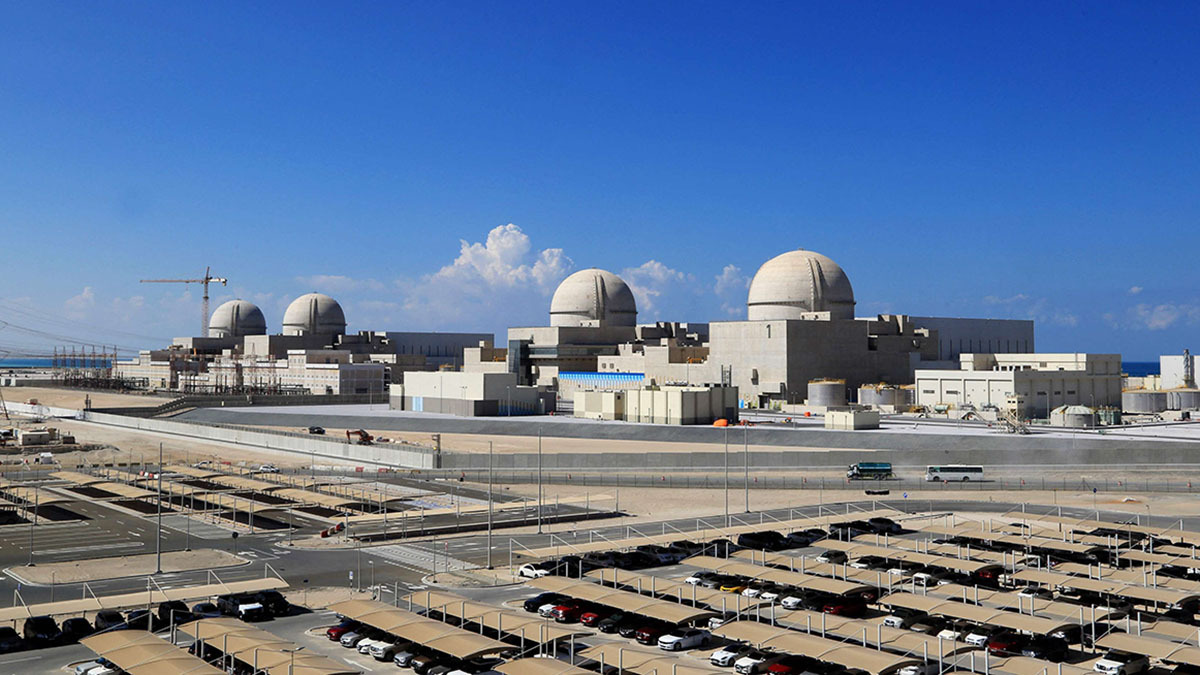
On Sunday May 17, a drone struck an electrical generator located in the outer perimeter of the Barakah nuclear power plant, in the emirate of Abu Dhabi, causing a fire. It was the first time that the plant – valued at $20 billion, built with the help of South Korea and operational since 2020 – had been attacked since the start of the war. UAE authorities confirmed that radioactivity levels were not affected and that there were no casualties.
The International Atomic Energy Agency (IAEA), headed by Rafael Grossi, said emergency diesel generators were supplying electricity to the number 3 reactor and demanded “maximum military restraint” near any nuclear installations, expressing his “grave concern”. The United Arab Emirates’ Federal Nuclear Regulatory Authority confirmed that the plant continued to operate normally. Three drones crossed the United Arab Emirates’ western border with Saudi Arabia; two were intercepted by anti-aircraft defenses and one reached its target. No one immediately claimed responsibility for the attack, and Abu Dhabi has not officially named anyone responsible, although it has previously denounced Iranian attacks and those of pro-Iranian Shiite terrorist militias in Iraq.
Saudi Arabia, for its part, intercepted three drones coming from Iraqi airspace on the same day. The Emirati president’s diplomatic adviser, Anwar Gargash, called the attack a “dangerous escalation”, whether it was carried out by “the main actor or through one of his proxies”. Trump posted on his social media that Iran “must act FAST or it will have nothing left.”
Implications
The attack on Barakah constitutes an exceptionally dangerous event in the war led by Iran, for at least three reasons.
First: this is the first time that a civilian nuclear installation in the Arab world has been the target of a direct armed attack, which constitutes a flagrant violation of international law, the Charter of the United Nations and international humanitarian law, even if it caused no casualties and did not result in a radioactive leak.
Second: The United Arab Emirates has concluded a nuclear cooperation agreement with the United States – known as “Agreement 123”, which expressly prohibits the enrichment and reprocessing of uranium – which involves a security architecture and guarantees that Washington can hardly ignore.
Third: The trajectory of the drones — originating from the UAE’s western border, i.e. the territory of Saudi Arabia or Iraq — raises questions about the logistical sophistication of pro-Iranian terrorist proxies, who appear capable of operating in geographic corridors complicating direct attribution of responsibility in Tehran. Regardless – and this is what matters strategically – the Iranian regime and its satellite terrorist organizations have crossed an unprecedented line in this conflict. If Tehran – directly or through its proxies in Iraq – can attack with impunity the only nuclear power plant in the Arab world, the scenario of an escalation towards installations with greater strategic impact – crude oil export ports, telecommunications infrastructure, American military bases – is entirely plausible.
Perspectives et scénarios
The paradox of beheading takes on a new dimension here: Iran’s terrorist proxies – Iraq’s Shiite militias, which the United Arab Emirates and Saudi Arabia implicitly designate – are operating with increasing tactical autonomy in the power vacuum generated by the military weakening of the IRGC. If the IRGC cannot or will not discipline its satellite militias, the proxy war risks intensifying without there being an Iranian command center truly capable of ordering a ceasefire.
It is the strategic nightmare of a conflict without a plan for the post-conflict: the secondary actors that we thought we could control from Tehran make their own operational decisions. The United Arab Emirates has warned that it will retaliate, which introduces a new direct actor into an already extremely volatile equation.
WHO declares international health emergency due to Ebola Bundibugyo virus in Congo and Uganda
Facts
The Director-General of the World Health Organization (WHO), Tedros Adhanom Ghebreyesus, declared a Public Health Emergency of International Concern (PHEIC) on Sunday, May 17 – the maximum alert level under the International Health Regulations, the same as that used during the COVID-19 pandemic – due to the Ebola epidemic caused by the Bundibugyo variant (Bundibugyo ebolavirus, BVD) in the Democratic Republic of Congo and Uganda. The outbreak was detected on May 5 in the Mongbwalu health zone, Ituri province, DRC, with deaths among health personnel. As of May 16: eight laboratory-confirmed cases, 246 suspected cases and at least 80 suspicious deaths in Ituri, spanning at least three distinct health zones.
In Kampala – the Ugandan capital, with two and a half million inhabitants and benefiting from excellent international air links – two confirmed cases with no apparent link between them were identified on May 15 and 16, both from the DRC. The Bundibugyo variant is particularly serious because, unlike the Zaire variant – responsible for previous major epidemics and for which there are approved vaccines and treatments – it has no approved therapeutic or preventive measures.
Case fatality rates during the two historic BVD outbreaks have fluctuated between 30% and 50%. The WHO indicated that the epidemic did not reach the pandemic emergency threshold and expressly advised against closing international borders.
Implications
The combination of three factors makes this epidemic a risk scenario that deserves priority attention: the variant for which no control measures are available, the operational context of Ituri – one of the most unstable provinces in the DRC, with devastated health infrastructure, multiple armed groups and massive flows of people displaced persons who complicate contact tracing – and the confirmed presence of cases in Kampala, a city served by regular flights to Europe, Asia and the rest of Africa.
The lesson learned from previous outbreaks — from the 2014-2016 West Africa Ebola outbreak, which cost more than 11,000 lives because it was ignored during from its first weeks, to the COVID-19 pandemic itself – could not be clearer: the cost of late intervention is exponentially higher than the cost of timely intervention. The WHO is also faced with the chronic problem of its underfunding and the low capacity of the DRC’s health systems to carry out an effective autonomous response. The fact that the epidemic affects the province of Ituri – where dozens of armed groups operate simultaneously and where humanitarian access is systematically hampered – makes controlling the epidemic extremely difficult on the ground, even with sufficient resources.
Perspectives et scénarios
The ESPII declaration triggers the mechanism for mobilizing international resources and coordination between member states. Immediate priorities are the deployment of rapid response teams to Ituri, exhaustive contact tracing of the two Kampala cases, and the launch of accelerated clinical trials of possible experimental treatments. If the epidemic is not brought under control in the next two to four weeks, the risk of spread to other countries in central and eastern Africa is real.
The international community – and in particular European governments and the main donors to the WHO system – must react with the urgency and means that the situation demands, without waiting for the geometry of risk to become unmanageable. The world can no longer afford to discover too late that ignoring a health emergency in the heart of Africa ends up costing much more than preventing it.

Britain is dividing: Labor’s terminal crisis and the rise of Reform
Facts
Prime Minister Keir Starmer’s government is going through the most serious political crisis since the Labor Party came to power in the July 2024 general election with a majority of 172 seats. After the devastating results of the May 7 local elections – in which the Labor Party lost control of more than 35 councils and almost 1,500 local councilors, while Nigel Farage’s right-wing populist Reform UK party won more than 1,400 seats – the internal crisis of party has taken on existential proportions.
A total of 97 Labor MPs have publicly demanded Starmer resign or set a timetable for his departure. Four ministers have resigned, including Health Secretary Wes Streeting – a leading figure seen as the natural candidate for succession – who, in his May 14 resignation letter, said he had “lost confidence” in Starmer. Potential candidates for succession include former Deputy Secretary-General Andy Burnham, Angela Rayner and Streeting himself.
In Wales, Labor’s disaster is historic: after a century of uninterrupted hegemony, the party has fallen to third place in the Senedd, behind the independence party Plaid Cymru and Reform UK itself, and the Prime Minister Welsh Eluned Morgan lost his own seat – an unprecedented event in British political history. Starmer refuses to resign and says he will continue to “govern”. The picture emerging from the polls is damning: only 17% of national voters would vote for the Labor Party today, Tied in third place with the Conservatives.
Implications
What is happening in the United Kingdom is not a simple crisis of leadership – these are contingent and surmountable – but the symptom of a deeper phenomenon: the accelerated fragmentation of traditional two-partyism and the emergence of a new political map on which Reform UK has occupied the space left vacant by the Conservative party in complete decline, while nationalist and independence parties dominate Scotland, Wales and Northern Ireland.
The result is a country where none of the four territories making up the United Kingdom have the central government as their primary political force. This situation, without precedent in modern British history, places additional pressure on the territorial integrity of the state. The rise of Reform UK – Trump’s ideological ally, based on Brexit, built around Farage’s anti-immigration and anti-establishment rhetoric – is part of the same populist phenomenon that has reshaped politics in the United States, France, Italy, Netherlands and Germany.
The difference is that, in the British case, the single-constituency majoritarian electoral system could transform Reform’s current electoral capital into massive parliamentary representation in the next general election, which must be held before May 2029. Starmer’s crisis further worsens the UK’s weak position on the geopolitical scene: a country whose government is in a political interim situation makes it difficult to make decisions on the Ukrainian front, in negotiations with the EU and in its position vis-à-vis the war in Iran.
Perspectives et scénarios
For a leadership contest to be officially launched, at least 81 Labor MPs must support an alternative candidate. The arithmetic threshold has been practically reached, but the problem lies in the lack of consensus on the candidate: Burnham, favorite in the opinion polls, currently holds no seat in Parliament; Streeting benefits from the support of the right wing of the party, but arouses rejection among the activist base; Rayner benefits from the support of the unions, but carries his own baggage of scandals.
In this context of fragmentation of potential successors, Starmer could survive politically for longer than his detractors would like – but it is difficult to imagine that he will lead the party in the next general election. The United Kingdom is heading towards a period of weak government, endless internal debates within the Labor Party and the continued rise of Reform. The question at hand which no one answers is that of the political model of a party which governed Great Britain for a hundred years in Wales and which today has no coherent project to regain the confidence of its historic voters.
The first British minister, Keir Starmer – Peter Nicholls/Pool via REUTERS
‘ src=”https://www.atalayar.com/media/atalayar/images/2026/02/10/2026021015364666877.webp”>
Trump returns from China with stability and paralysis: Reuters analysis
Facts
The analysis published on May 16 by Reuters — signed by Michael Martina, David Brunnstrom, David Lawder and Mei Mei Chu from Washington and Beijing — summarizes in a memorable formula the outcome of the Trump-Xi Beijing summit (May 14-15): « stabilité et impasse » (« stability and a stalemate », in English).
Two days of talks between Trump and Chinese leader Xi Jinping produced modest results by any historical standard of non-US summits. The only deal specifically confirmed was China’s commitment to buy 200 Boeing planes – a figure well below the 500 planned and the 300 agreed during Trump’s 2017 visit to Beijing, which then generated contracts and memorandums of understanding worth $250 billion No progress has been made on the sale of Nvidia H200 chips to China, much to the relief of Republican and Democratic hawks in Congress. of Taiwan could cause “clashes, even conflicts”.
Trump did not confirm the $14 billion arms sale to Taiwan, saying he would make a decision “in a relatively short period of time.” Craig Singleton, a China expert at the Foundation for Defense of Democracies, sums up the result this way: “The summit projected an image of stability, but left the paralysis intact. “It has produced modest, marketable, controlled results, which is all the US-China relationship can stand for now.”
Implications
Reuters and all academic analysis and Anglo-Saxon think tanks converge on a diagnosis that this analyst shares: the Beijing summit was an exercise in managing the status quo of systemic rivalry, and not an opening towards a new architecture of strategic cooperation. Both leaders needed something to show their respective publics. Trump got an order for 200 Boeings and Xi’s declaration that China will not arm Iran – if that commitment is kept, it is the most significant strategic gain of the trip, but one that will need to be watched closely.
Xi obtained from Washington the implicit recognition that the bilateral relationship is the structuring pivot of the international system, not a relationship between an equal and a subordinate, but between two leading powers. Trump’s ambiguity on Taiwan, however, is deeply worrying: in the deterrence equation, ambiguity is not synonymous with strategic flexibility – it is a potential invitation to miscalculation. Tokyo, Seoul, Manila and Canberra are watching the situation with growing concern.
Perspectives et scénarios
The extension of the October 2025 trade truce will remain in effect without formal consolidation. China has the most powerful instrument of asymmetric pressure in the Sino-American rivalry: control of 75 to 80% of global production of rare earths and 95% of refining capacity – without which it is impossible to manufacture advanced semiconductors, magnets for electric motors, systems guidance of missiles or batteries Beijing has learned the lessons of the experience of Trump’s 2025 tariffs – declared unconstitutional by the American Supreme Court in February 2026 –: direct commercial pressure triggers in Washington. judicial and legislative response mechanisms which limit it.
His preferred strategy – positioning China as an indispensable trading partner for a global economy that needs its exports and raw materials – is significantly more sophisticated. Xi will visit Washington in the fall: then we will know whether Trump’s “fantastic deals” have any concrete documentary basis.
US President Donald Trump participates in a welcoming ceremony with Chinese President Xi Jinping at the Great Hall of the People in Beijing, China, on May 14 2026 – REUTERS/ EVAN VUCCI
‘ src=”https://www.atalayar.com/media/atalayar/images/2026/05/14/2026051411093764777.webp”>
Reuters / AP / AFP / Bloomberg (agencies and financial media)
Reuters is today the reference source with three major articles: the analysis of the cost of 25 billion for global companies, the coverage of the attack on Barakah and the “stability and stalemate” analysis of the Beijing summit. Bloomberg deepens the economic analysis of the war in Iran with data on LNG prices in Asia and the pressure on the margins of European companies. AFP covers the WHO ESPII statement in detail.
The New York Times / Washington Post / PBS / CNN (États-Unis)
The NYT devotes its front page to the attack on Barakah, stressing that it is the first time that an Arab nuclear power plant has been attacked. The WP analyzes the political significance of the attack on the prospects of the agreement with Iran. CNN publishes in real time developments in the crisis within the British Labor Party. PBS is devoting a special report to the Ebola epidemic and its implications for global public health.
Financial Times / The Economist / The Times / The Telegraph / The Guardian (Royaume-Uni)
The British media are entirely dominated by the Starmer crisis. The Times and The Telegraph publish analyzes of succession scenarios. The Guardian, close to the Labor Party, emphasizes that the crisis is a leadership crisis, not an ideological one, and that the party has a sufficient parliamentary majority to govern. The Economist covers Barakah and the Iran war with the publication’s characteristic analytical depth.
Le Monde / Le Figaro / Libération / LCI / BFM (France)
The French press pays particular attention to the economic cost of the war in Iran for European companies, placing particular emphasis on the impact on the French energy and aeronautics sectors. Le Monde publishes an analysis on the implications of the attack on Barakah for international nuclear law. BFM and LCI cover the British political crisis live, highlighting its impact on Franco-British bilateral relations.
FAZ / Die Welt / Die Zeit (Allemagne)
The FAZ publishes an analysis on the implications of the attack on Barakah for the security of civilian nuclear installations in conflict zones, in the context of the German debate on the return to nuclear power. Die Welt covers the Starmer-Reform crisis as part of the European populist phenomenon. Die Zeit devotes an analysis to the overall economic cost of the war in Iran.
Al Jazeera / Al Arabiya / The National (UAE) / Asharq Al Awsat (Arab and Gulf world)
The United Arab Emirates media – The National, Gulf News, Khaleej Times – devoted their front page to the attack on Barakah, in a tone of suppressed indignation and demanding a response. Al Jazeera, faithful to its usual line, puts the seriousness of the attack into perspective and questions its attribution to Iran. Al Arabiya and Asharq Al Awsat, with a Saudi profile, cover both the attack on Barakah and the drone interception in Saudi Arabia, expressing explicit concern about the escalation.
South China Morning Post / China Daily / Xinhua / WION (Asie-Pacifique)
The SCMP and China Daily hail the Beijing summit as a stabilizing success, emphasizing the warm personal relations between Xi and Trump. Xinhua fully reproduces the Chinese statement calling the discussions “historic” and “constructive.” WION highlights the impact of the blockade of Hormuz on the energy supply of India, which obtains nearly 60% of its oil there.
Kyiv Independent / Ukrinform (Ukraine)
The Ukrainian press is observing with concern the shift of American diplomatic attention towards China and Iran, pointing out that the war in Ukraine is receiving less attention from the Trump administration every week. SIPRI data on Russian military spending – $190 billion, or 7.5% of GDP – is being put forward as proof that Moscow has no intention of negotiating.
IAEA / WHO / IISS / RUSI / CSIS (international organizations and think tanks)
The IAEA issued emergency declarations regarding the attack on Barakah, demanding maximum military security at nuclear facilities and offering technical assistance to the UAE. WHO has activated its ESPII protocols with real-time publication on its health alert portal. The IISS and RUSI track naval movements in the Strait of Hormuz. The CSIS publishes an analysis on the fragility of the Iranian ceasefire in light of the attack on Barakah.
The five pieces of information that make up today’s report share a characteristic that superficial analysis fails to grasp: all are direct or indirect consequences of the same decision – that of attacking Iran on February 28 without a coherent plan for the next day. This observation is not a criticism of the strategic justification of the operation itself; the terrorist regime in Tehran deserved a firm response in the face of decades of export of terrorism, regional destabilization and persistent nuclear threat The criticism – which I formulate without ambiguity – concerns the absence of vision. systemic, on improvisation erected into doctrine, on the confusion between military force as a tactical instrument and military force as a substitute for politics.
The 25 billion dollars calculated by Reuters – and which constitute, we repeat, a minimal figure – are the price of this improvisation. The blockade of Hormuz was not an unpredictable scenario: it was the most obvious and costly scenario in global economic terms. That, two and a half months after the start of the war, the strait remains closed – with a double, two-way blockade where both sides apply their own restrictions – is an eloquent demonstration of the limits of military power when not supported by a coherent exit strategy. Trump started the war to show strength; what he demonstrated was the capacity to harm without the capacity to resolve.
The attack on Barakah adds a new and worrying dimension to this picture. For the first time in the history of 21st century conflicts, a civilian nuclear facility has been attacked with conventional weapons as part of an ongoing war. The IAEA director general called for “maximum military restraint.” It’s diplomatically impeccable wording, but it’s also one that says nothing relevant to the IRGC’s terrorist proxies who operate from Iraq with increasing autonomy.
The paradox of decapitation manifests itself here in its most dangerous variant: it is no longer the IRGC generals – weakened, dispersed, whose chains of command are interrupted by military attacks – who take the riskiest operational decisions, but their satellite militias in Iraq and Yemen, who act with tactical autonomy without any Iranian center of authority being able or willing to slow them down. A war without a post-conflict plan inevitably generates this type of uncontrollable secondary actors. And it is historically these uncontrollable secondary actors who provoke the escalations that no one wanted.
On the Starmer crisis and the rise of Reform: what is happening in the United Kingdom is not exceptional – it is the most advanced case of a phenomenon which affects the whole of Western democracy. The Labor Party has promised change and competitiveness in 2024; it has delivered textbook poor management and scandals. Reform promised textbook populism; it delivered spectacular electoral results. The lesson is not that populism is right – it is not – but that liberal democracies cannot stand. allow for poor governance When center-left and center-right parties fail on the essentials – cost of living, security, coherence between promises and results – the space they leave vacant is inevitably occupied by someone ready to exploit the frustration of citizens without proposing. of serious alternatives. Farage is the symptom, not the disease, the disease is the mediocre and complacent political class which has been promising changes for decades which have not materialized.
And about the Beijing summit: Reuters is right. “Stability and paralysis” is the most accurate description of what happened in Zhongnanhai. The systemic rivalry between established power and ascendant power – with incompatible models of political and economic organization – has found no resolution mechanism in Beijing: only a managed postponement. Xi will return to Washington in the fall. Until then, all we have is the promise of 200 planes and the warning about Taiwan. The first can be verified in a few months; the second will take years to manifest its consequences. But when they manifest themselves, they will be consequences of historic magnitude. Democracies in the Indo-Pacific region – as well as European allies who depend on the stability of global trade – should keep this in mind when assessing the real value of deals announced amid applause and without written documentation.


/2026/06/10/6a297b4d35a80814198766.jpg "Les États-Unis frappent l'Iran après la destruction d'un hélicoptère : \"Donald Trump n'avait pas le choix\", selon un spécialiste")