lediplomate.media – printed on 05/17/2026
By Giuseppe Gagliano, President of the Carlo De Cristoforis Strategic Studies Center (Côme, Italy)
The height of strategic courtesy
Donald Trump’s visit to Beijing was expected to produce immediate results: a trade signal, a concession on rare earths, a Chinese gesture on Iran, perhaps even an agreement likely to be presented to American public opinion as proof of firmness in negotiation. Much less happened than that. The American president left China with many praises addressed to Xi Jinping, a few vague promises, certain economic commitments still to be verified and no real breakthrough on the major issues which oppose the two powers.
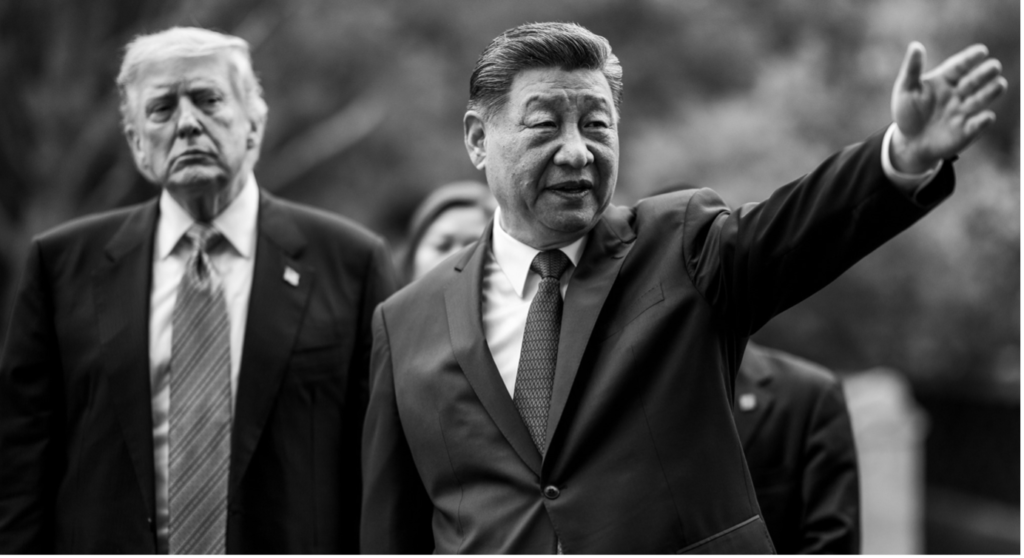
The summit brought together all the elements of the great diplomatic show: solemn ceremonies, parades, banquets, imperial gardens, smiles in front of the cameras, conciliatory formulas. But behind this liturgy of power, a harsher reality imposed itself: Beijing did not concede much, Washington did not obtain what it was looking for, and Xi Jinping used the meeting not to follow Trump on the ground of the spectacular announcement, but to recall the limits within which China intends to tolerate pressure American.
The result confirms more than it transforms. The United States and China do not want to go as far as an open break, because the economic cost would be immense for both camps. But neither is ready to give in on the essential nodes: Taiwan, semiconductors, rare earths, energy, Iran, technological supremacy, control of routes and strategic supply chains.
Xi sets the perimeter: Taiwan remains the red line
The most important part of the summit was not commercial, but geopolitical. Xi Jinping warned Trump that mishandling the Taiwan issue could lead Sino-US relations into an extremely dangerous zone. This is the clearest message of the entire meeting. For Beijing, Taiwan is not just another controversy, but the heart of its unfinished sovereignty.
Trump, usually given to extemporaneous statements, chose silence or at least caution. He did not revive, he did not publicly challenge Xi, he did not transform Taiwan into rhetorical theater. It was Marco Rubio who recalled that American policy remained unchanged. The distinction is significant: Trump favors the personal relationship with Xi and transactional management; the American strategic apparatus reaffirms the continuity of the United States’ commitment in the Pacific.
For Beijing, Taiwan is the point on which there is no real compromise. For Washington, Taiwan is at the same time a political symbol, an indirect military platform and a technological node, since the island remains central in the global semiconductor chain. China knows that a crisis around Taiwan would not only be military. It would be economic, industrial, financial and technological. It would strike the heart of globalization progress.
The economic war behind the smiles
The real content of the summit is economic war. Not the one that declares itself with tanks, but the one that is carried out with customs duties, export controls, rare earths, semiconductors, planes, agricultural products, energy logistics and market access.
Trump was looking for immediately exploitable results: orders from Boeing, agricultural purchases, trade management mechanisms, perhaps Chinese relaxation on rare earths. He got some announcements, but no real trend reversal. The order for 200 Boeing planes, if confirmed, is not negligible, but it remains well below market expectations. It is not enough to transform the summit into an industrial victory. It is not even enough to convince investors, as the negative reaction of Boeing shares has shown.
Even more important is the silence on rare earths. This is where Chinese geoeconomic power is measured. Beijing controls a critical portion of the processing and refining of minerals essential to semiconductors, aerospace, defense, batteries, green technologies and advanced military systems. Chinese export controls are a response to US tariffs and technological restrictions, but they are also more than that: a demonstration that China has structural levers that are difficult to neutralize quickly.
The United States has long used dollar dominance, sanctions, critical technologies and financial networks. China responds with control of strategic raw materials, advanced manufacturing production and essential segments of global chains. This is the new grammar of economic warfare: it is not a question of destroying the adversary, but of making him dependent, vulnerable, obliged to negotiate.
Semiconductors and technological power
The lack of breakthrough on advanced chips intended for artificial intelligence confirms that the heart of the confrontation is no longer traditional trade. It is technological supremacy. The case of Nvidia’s H200 chips shows the American dilemma: selling to China makes it possible to reap profits, preserve market share and to satisfy large American companies; limiting access amounts to slowing down Beijing’s technological and military capabilities.
Trump would probably also have wanted to transform this file into an object of negotiation. But the American strategic apparatus knows that advanced semiconductors are now an essential component of future warfare: artificial intelligence, surveillance, high performance computing, electronic warfare, drones, command and control, operational simulations. It’s no longer just about selling civilian technology. It’s about deciding who will have access to the cognitive infrastructures of power.
China, for its part, has been working for years to reduce its dependence on Western technologies. Every US restriction accelerates Chinese technological nationalism. Each ban pushes Beijing to invest more in self-sufficiency. This is the paradox of economic warfare: it can slow down the adversary, but it can also strengthen its desire for emancipation.
Iran, Hormuz and the limits of Chinese influence
Trump hoped Xi could put real pressure on Iran. But Beijing has no interest in sacrificing Tehran to offer Washington a diplomatic victory. Iran is for China an energy supplier, a strategic partner, a pivot of anti-American pressure in the Middle East and an important element in the great Eurasian game.
China wants stability of energy routes, of course. The Strait of Hormuz is vital to the global economy and to Asian supplies. But stability does not mean alignment with the United States. Beijing can support a negotiated solution, demand an end to the war, and declare itself in favor of the reopening of the roads. But he is unlikely to use all his influence to weaken a country that represents a counterweight to the American presence in the region.
China’s apparent interest in greater purchases of US oil should be read with caution. Diversifying does not mean changing sides. This means reducing vulnerability. For China, the lesson of Hormuz is clear: no great power can depend on a single corridor, a single supplier, a single route. Energy security becomes national security. Geoeconomics becomes applied geopolitics.
Military strategic assessment
On the military level, the summit does not reduce structural tensions. Taiwan remains the main detonator. The South China Sea remains a theater of friction. The Western Pacific remains the space where the United States and China measure their naval, ballistic, aerospace and technological capabilities every day.
China does not necessarily seek immediate confrontation. It builds strategic depth: high seas navy, anti-ship missiles, cybernetic capabilities, space systems, air defense, logistics bases, industrial power. The United States, for its part, seeks to preserve an increasingly costly global superiority, while having to simultaneously manage Eastern Europe, the Middle East and the Indo-Pacific.
The American problem is that of strategic dispersion. Washington wants to contain China, support Ukraine, manage Iran, protect Israel, reassure European allies and preserve its technological primacy. But each front consumes political, military and financial resources. Beijing knows it. And that’s why he’s in no hurry. The Chinese strategy is often that of active waiting: avoiding rupture, accumulating power, exploiting the contradictions of the adversary.
Trump seeks agreement, Xi seeks time
The difference between the two leaders is obvious. Trump is looking for immediate, communicable and electorally useful results. Xi seeks stability, continuity, structural advantage. Trump thinks in terms of visible agreements. Xi thinks in terms of long-term equilibrium. The first wants to be able to say that he has obtained something. The second wants to avoid conceding too much, while keeping the channel with Washington open.
This explains why the summit seemed cordial but lacking in substance. For Beijing, success was not in signing major agreements, but in preventing the meeting from degenerating while reaffirming its red lines. For Trump, the problem is the opposite: without strong Chinese concessions, the visit risks appearing as a series of solemn images devoid of strategic content.
Personal diplomacy, in this case, is not enough. Trump can praise Xi, invite him to the White House, talk about positive and productive meetings. But the deep structures of Sino-American rivalry remain intact.
Geopolitics of the new imperfect bipolarism
The Beijing summit confirms the existence of imperfect bipolarism. The United States and China are rivals, but interdependent. They clash, but trade. They accuse each other, but negotiate. They are preparing conflict scenarios, but fear the collapse of global chains. It is a competition without peace and without total war.
China is no longer just the world’s factory. It has become a center of technological, financial, infrastructural and diplomatic power. The United States is no longer the undisputed hegemon, but it remains the leading military, monetary and technological power in the international system. The result is an unstable equilibrium, in which each file becomes a piece of the same game.
Taiwan, Iran, Hormuz, Boeing, rare earths, semiconductors, agriculture, customs duties, human rights in Hong Kong: everything fits together. There are no longer any watertight compartments. Every economic question has a strategic reflection. Every military question has a financial consequence. Each raw material becomes a weapon. Every technology becomes a battlefield.
The real assessment of the visit
Trump returns from Beijing with few things in hand. He obtained courtesy, not decisive concessions. He received promises, not structural guarantees. He showed a personal relationship with Xi, but he did not change the balance of power.
Xi, on the other hand, can claim a more subtle result: he welcomed the American president as an equal, he recalled the centrality of Taiwan, he did not give in on rare earths, he did not promise concrete pressure on Iran, he did not truly opened up the issue of advanced chips and kept China at the center of the world diplomatic scene.
The summit was not a spectacular failure, because it avoided rupture. But it was also not a substantial success, because it solved nothing. Instead, he offered a faithful snapshot of our time: great powers forced to talk to each other, incapable of trusting each other, ready to trade while preparing for confrontation.
So the real news is not that Trump showered Xi with praise. The real news is that, behind this praise, the competition between the United States and China has entered a mature phase: less spectacular than open war, but much deeper. An economic, technological, energy and geopolitical war in which each diplomatic smile serves above all to mask the harshness of the real conflict.
#Trump,#XiJinping,#China,#United States,#Tawan,#Geopolitics,#Semiconductors,#Rare Earths,#Iran,#Hormuz,#Boeing,#Nvidia,#Economic Warfare,#IndoPacific,#Diplomacy,#Washington,#Beijing,# Technology,#AI,#GlobalPower,#GlobalTrade,#Pacific,#Strategy,#Xi,#DonaldTrump,#GlobalEconomy,#TechnologyConflict,#InternationalRelations,#Defense,#NewGlobalOrder


/2026/06/14/6a2ef59cbf8cd592764043.jpg "The G7 is a \"world postcard\" for Évian-les-Bains believes the mayor of the city")