-
For more than a century, the word “fascism” has been used to castigate any authoritarian regime, when in fact it only applies to a particular country and era. Lucien Jaume refuses this semantic inflation and restores the radical singularity of the Mussolini project.
-
Far from being a simple political opportunism or a conservative reaction, Italian fascism was a coherent ideology carrying a project of total transformation of man and society – a cultural revolution that even Mao had not dreamed of.
-
An original philosophical contribution which fills a gap in French historiography, at a time when the geopolitical news of 2026 makes the question more urgent than ever.
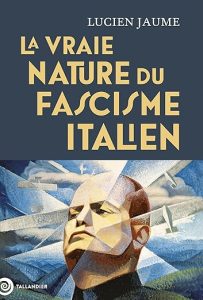
The true nature of Italian fascism, Lucien Jaume, Éditions Tallandier, 2026, 24.50 €
For more than a century, the word fascism has been used to castigate any authoritarian or dictatorial regime, when in fact it only applies to a country and a particular era. Even the most experienced historians for the most part ignore the intellectual creation, by Mussolini himself, of a vision of man and society the equivalent of which is found nowhere in Europe between the wars. Lucien Jaume, an established historian and one of the best experts in the modern articulation between politics and religion, refuses this semantic inflation which dilutes the concept by applying it to any authoritarian regime. Italian fascism constitutes a specific historical and ideological phenomenon that must be analyzed in its singularity.
Mussolini’s journey: from the far left to nationalism
An extreme left activist and follower of revolutionary trade unionism before the First World War, this autodidact projected himself into frenzied nationalism and warmongering during the conflict. This political trajectory is essential for understanding the hybrid nature of fascism: Mussolini does not completely reject his revolutionary past, he transposes it into a project of radical transformation of Italian society, but by means opposed to those of internationalist socialism.
The fascist doctrine: an assumed totalitarian state
Fiercely hostile to political and economic liberalism, Mussolini advocated a revolution from above, that is to say by the state becoming all-powerful. He affirmed that freedom really existed and lived: in the totalitarian state (Totalitarian state). Totalitarian freedom consists of executing, of achieving, what the collective conscience, installed in the State, orders to do for the power of the Italian people. This collective consciousness speaks through the mouth of “conductor”du Duce (du Latin to leadto drive).
The fundamental axiom of the regime, “Everything is in the State, nothing outside the State, nothing against the State”summarizes this totalizing concept where the State fully absorbs civil society. Mussolini’s claim was not only to control bodies and behavior, but to profoundly transform the mentalities and culture of the Italian people.
“The rigorous supervision of the entire population, from birth to death, and the repression of opposition are the foundation of a cultural revolution that even Mao Zedong never dreamed of. HAS”
Read also: The totalitarian world order
An unprecedented cultural revolution
We idolize war for its own sake, we exalt futurism to better break with the world before, because fascism wants to be modernism. The cult of violence and war is not a simple instrument of foreign policy, but a constitutive dimension of fascist anthropology: the new man must be forged in conflict and sacrifice. Historical fascism has continually praised war, for the benefit of the officially called totalitarian state and the martyrdom of the individual.
An original methodological approach: ideopraxie
The originality of Jaume’s approach lies in his philosophical and conceptual approach. Rather than focusing on historical events or political structures, it analyzes the fascist system of thought in its internal coherence, starting from doctrinal texts and official speeches. This method, inherited from his work on Jacobin discourse, allows us to grasp the deep logic of a regime which was not only an authoritarian dictatorship, but a total ideological project.
From this approach, Lucien Jaume defined the « idéopraxies » as configurations where ideology and political practice are articulated in an inseparable manner. This notion applies particularly well to Italian fascism, where doctrine and action are intimately linked: each political gesture is simultaneously a doctrinal act, and each ideological assertion immediately calls for coercive implementation.
“Imperialism is the translation of the unlimited will and freedom that a nation and its leader attribute to themselves – as our geopolitical news of 2026 still shows.”
Read also: Totalitarianism: lessons from yesterday to understand today
A pioneering book in French historiography
This work fills a gap in the French historiography of fascism. While Anglo-Saxon works – notably those of Roger Griffin or Stanley Payne – have long insisted on the ideological and modernist dimension of fascism, French research has often remained focused on the sociological or event-related aspects. By mobilizing his dual skills in political philosophy and the history of ideas, Lucien Jaume offers an in-depth analysis of what he calls the “intellectual factory” of Mussolini fascism.
It demonstrates that far from being a simple political opportunism or a conservative reaction, Italian fascism was a coherent and radical ideology, carrying a project of total transformation of man and society. At a time when the geopolitical news of 2026 makes the question more urgent than ever, understanding the specific nature of the fascist phenomenon allows us to better identify the current dangers – and not to trivialize the term by applying it to any authoritarian regime.
Read also: The banality of evil: what Arendt really wrote