
Scrolling through your news feed. A geopolitical crisis erupts, a political reshuffle is looming, the Federal Reserve (the American central bank) hesitates on its rates. In the past, you would have simply read the analysis of a journalist or an expert. Today? Hundreds of thousands of people are already betting millions of dollars on the outcome of these events.
Welcome to the era of predictive markets!
Since the American presidential election of 2024, platforms like Polymarket and Kalshi have exploded. They are transforming global news and even your favorite sports events into a huge trading floor. Grab a coffee, settle in. Together, we will decrypt how these tools are changing our relationship with information, technology, and business without falling into incomprehensible jargon.
The Information Market: How Does It Work?
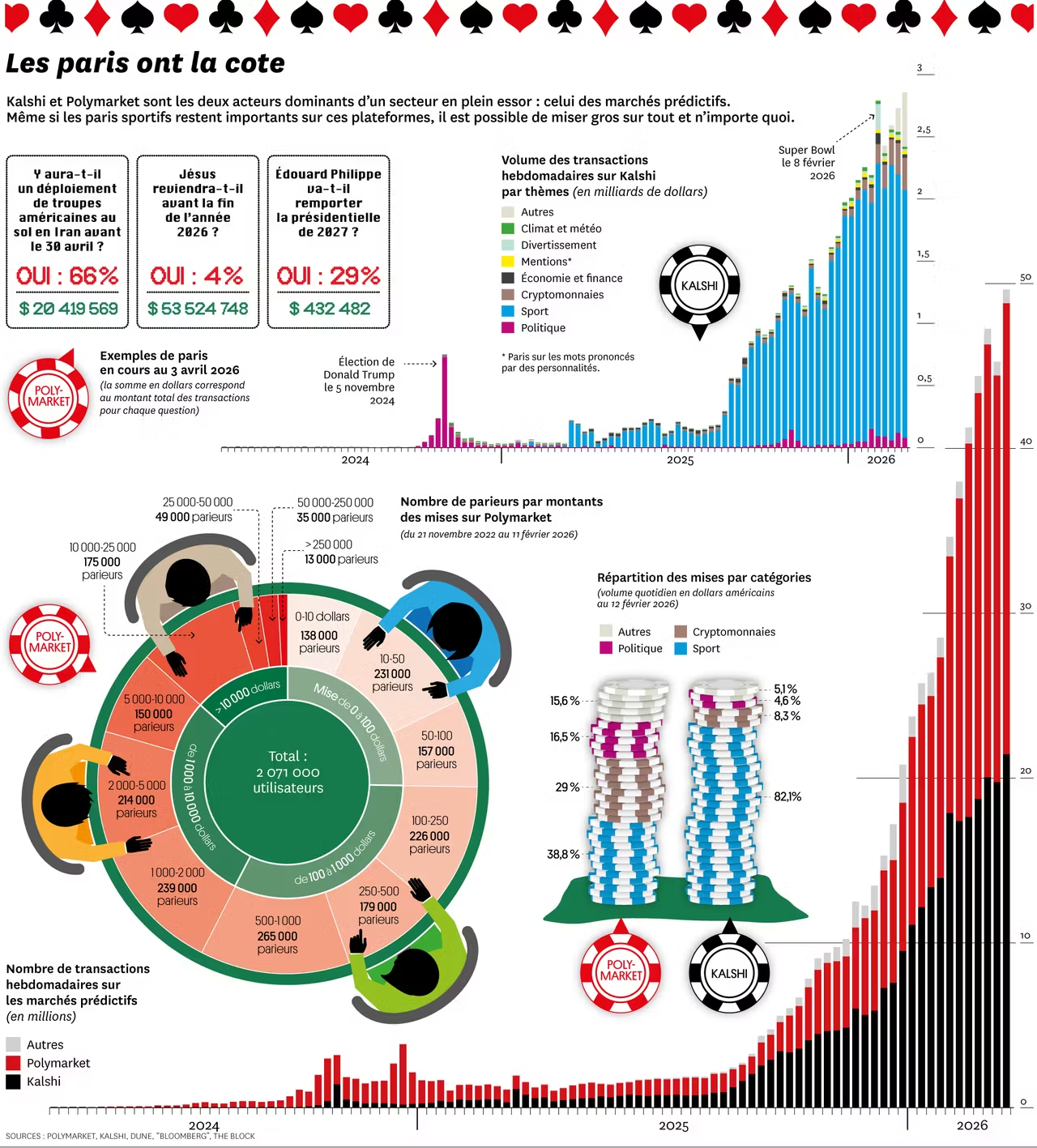
Sources: Polymarket, Kalshi, Bloomberg, Dune, The Block
The concept of a predictive market is simple: you are asked a closed question (Yes/No) about a future event. “Will Emmanuel Gregoire win the mayoral election in Paris?” or “Will a ceasefire be signed before December 31st?”.
Users buy “shares” of probability. The more likely an outcome is judged by the crowd, the higher its odds. If you are right at the close of the event, you win the bet.
While the concept is not new, its scale at the beginning of 2026 is staggering:
- $37 billion in total betting volume recorded in 2025.
- +1,680% growth for the Kalshi platform between 2024 and 2025.
- 600,000 active traders in February 2026 on Polymarket.
Behind this hypergrowth, we find heavyweight players in tech and finance, a dynamic reminiscent of the strong impact of fintech projects on the modern economy. In the United States, these platforms have achieved a regulatory feat: they have convinced the CFTC (the agency regulating financial markets) to classify them as derivative product markets, not just gambling sites.
In France, the situation is different: the ANJ (National Gaming Authority) banned these platforms at the end of 2024 to protect consumers. But in practice, the use of VPNs maintains a very active base of French-speaking users.
The Big Blur: When Finance Replaces Sports Betting
Here’s where things get juicy. Behind the political debates, the real focus remains on sports. According to The Guardian, on the last Super Bowl Sunday, Polymarket and Kalshi alone generated $1.2 billion in transaction volume.
Why such enthusiasm when there are already excellent traditional betting sites that can be easily compared via a guide like StakeMaker? The answer lies in one word: regulation.
- Less constraints: In the United States, traditional sports betting requires being 21 years old and is banned in major states like California. Predictive markets, considered “financial event contracts,” are accessible from the age of 18 and everywhere.
- The investment illusion: Young users no longer see this as gambling. It’s not “against the house,” but rather trading options against other users.
However, the threat of insider trading (or fixed matches) looms. To reassure authorities and prove its good faith, Polymarket has strengthened its game. As reported by Le Monde in March 2026, the platform has partnered with Palantir, the American giant of data analysis, to track suspicious behaviors and fraudulent sports bets through artificial intelligence.
The Match: Polymarket vs Kalshi
To understand the ecosystem, here is how the two leaders, capturing 80% of the market, position themselves:
| Characteristic | Polymarket | Kalshi |
|---|---|---|
| Currency used | Crypto-currency via Stablecoins (USDC, index on the dollar) | Traditional currency (US Dollars) |
| Positioning | Global, decentralized, anonymous, and very focused on web/crypto culture | Very institutional, regulated, and transparent in the United States |
| Hot topics | Geopolitics, pop-culture, sports, crypto, global elections | Economy, legislation, Fed interest rates |
When the Media Teams Up with Bettors
The precision of these markets is such that traditional press is taking note. The premise? The “wisdom of crowds”: the idea that a large group of financially motivated individuals will make better predictions than a single expert.
Studies from the prestigious MIT show that in major elections, these markets often outperform mathematical models. As a result, giants like CNN, The Wall Street Journal, or the Associated Press (AP) now integrate Kalshi or Polymarket odds directly into their articles, as a new objective data point.
But this symbiosis raises real ethical points:
- Insider advantage: In these markets, information is valuable. If 70% of the winnings are pocketed by 0.04% of players, it’s because big investors often have access to privileged information before everyone else.
- Impact on the field: Journalism becomes the referee of the bet. Recently, a journalist was harassed by anonymous bettors demanding he change the terms of one of his articles on a military strike because this text served as evidence for a $14 million contract validation.
- Goodhart’s Law: “When a measure becomes a target, it ceases to be a good measure.” If news becomes a means to enrich oneself, the risk of actors funding actions solely to win a bet becomes a tangible reality.
Betting on Our Attention
Thought betting on politics or football was daring? Get ready for attention markets.
In March 2026, Polymarket partnered with Kaito AI to launch bets on mindshare (the volume of conversation generated by a topic) and sentiment (the positive or negative tone of a trend). A logical shift when observing how quickly the impact of AI on brand reputation becomes a real-time analyzable metric.
Traders can now speculate on virality. “Will Elon Musk’s perception improve this month?” or “Will the engagement around Anthropic’s new AI surpass that of OpenAI?” Digital engagement, a real fuel for social networks in 2026, becomes a financial asset. In the future, content creation could be steered by hedge funds seeking to capitalize on a TikTok trend they themselves wagered on.
Key Takeaways for Your Watch
- Information becomes transactional: Don’t just look at what’s newsworthy, observe how the market monetizes it. Prediction odds have become an essential trend indicator.
- Data is power: The wisdom of crowds now competes with traditional polls. For marketing or PR professionals, monitoring these markets provides a real-time pulse of public opinion without the veneer of declaration.
- Sports as a Trojan horse: Sports betting serves as a gateway product to democratize complex financial mechanisms among a new generation.
- Ethics as a shield: Faced with news gamification, brands and media must double down on transparency to prove the integrity of their sources.
The question is no longer whether this financialization of information will prevail but how we will adapt to it. Share this article with your colleague or leadership team to fuel your next reflections on the evolution of tech and media.







:fill(black)/2026/06/10/6a294e3fc793d039607152.jpg "Coupe du monde : un couvre-feu pour les moins de 16 ans à Clermont-Ferrand")