– Advertisement –
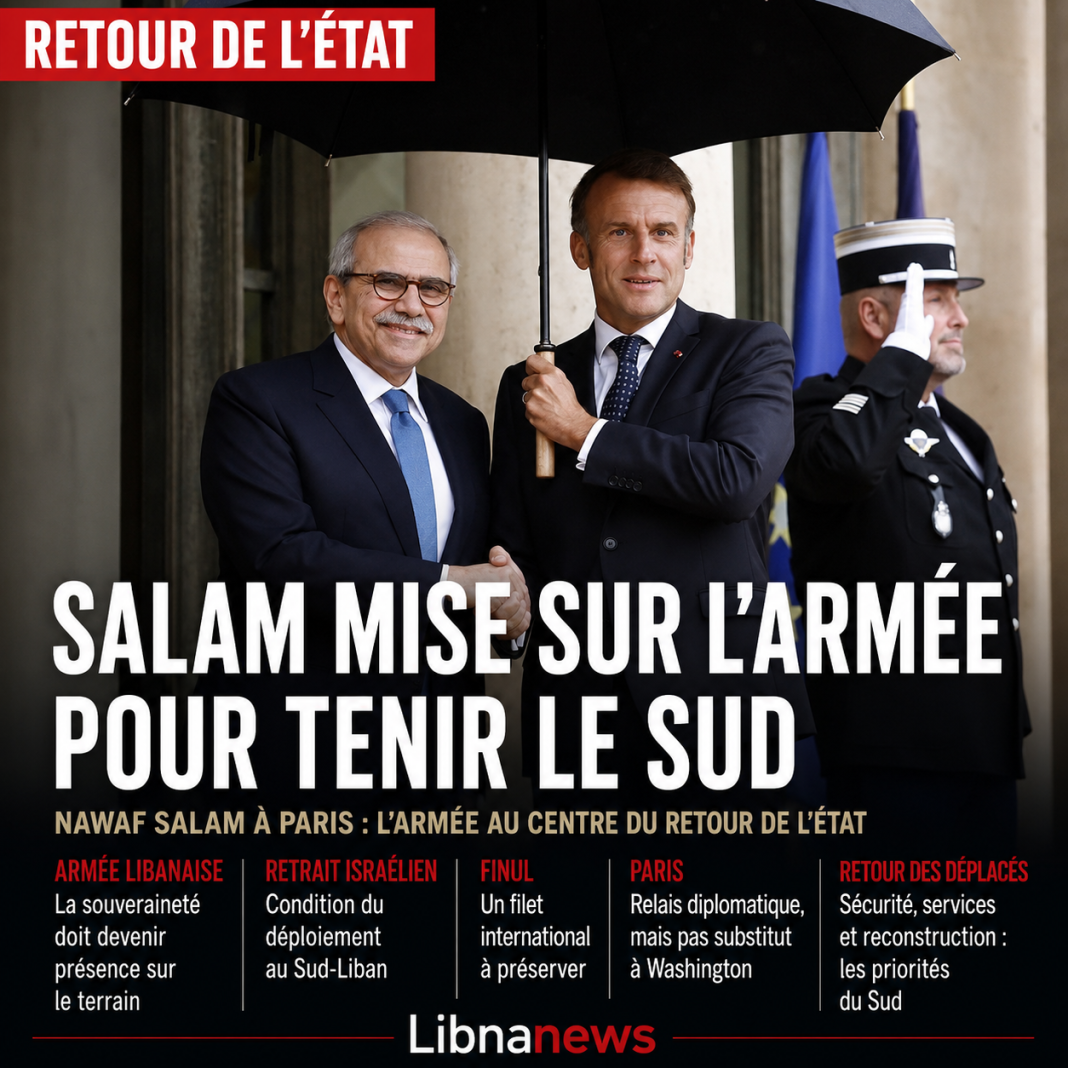
Nawaf Salam in Paris not only places the Lebanese army at the heart of a bilateral discussion with France. He places it at the center of a much larger equation: Israeli withdrawal from the South, future of the international force, return of the displaced, reconstruction of villages and reestablishment of the state as sole authority on its territory. In a sequence dominated by the regional agreement between Washington and Tehran, the Lebanese prime minister seeks to translate sovereignty into concrete means. To reassure families in the South For the State to return, we need a national force capable of being present, equipped, paid, mobile and politically covered.
The Parisian visit comes as South Lebanon remains unstable. According to press information, Israel is discussing with the United States the maintenance of a military presence in certain areas of the South, despite the provisions of the regional agreement which reaffirm Lebanese territorial integrity. This data weighs on all conversations. Beirut cannot speak of a return to normal if the Israeli army maintains its positions. Paris cannot speak of stabilization if villages remain under the threat of drones, strikes or a de facto imposed security zone. Nawaf Salam’s diplomacy therefore starts from a simple observation: the Israeli withdrawal and the strengthening of the Lebanese army are not two separate issues. They form a single condition of sovereignty. Â
A French visit in a tipping point
Paris offers Nawaf Salam a useful political relay. Emmanuel Macron has already received the Lebanese Prime Minister at the Élysée in a sequence marked by persistent tensions in the Middle East and by the fragility of the ceasefire in Lebanon. The Élysée then recalled the French attachment to full respect of this ceasefire, while linking the stabilization of the country to its sovereignty, its reconstruction and its reforms. This French line today serves as a framework for the new diplomatic moment. Â
Salam’s trip is not only aimed at obtaining statements of support. Lebanon has already received many. He is looking for abilities. The country must face a series of simultaneous tasks: supporting the return of displaced people, documenting the destruction, restoring essential services, defending its position in the Security Council, maintaining coordination with UNIFIL and preparing the wider deployment of its army. Each of these tasks requires resources, a clear chain of command and international political protection.
France can act on several levels. It can plead with its European partners. It can support the Lebanese army with equipment, training and diplomatic mobilization. It can defend the role of the international force. It can also remind Israel that maintaining a military presence in South Lebanon contradicts any logic of stabilization. But Paris cannot replace Washington. The United States remains the actor with the most direct leverage over Israel.
This French limit explains the usefulness, but also the insufficiency, of the visit. Salam seeks to multiply the points of support. He cannot be satisfied with just one godfather. Paris brings the language of sovereignty. Washington can influence the Israeli army. Doha can contribute to the financing. The United Nations provides the legal framework. The Lebanese government is trying to hold these channels together without losing its autonomy.
The Lebanese army, pivotal in the return of the State to the South
The Lebanese army is at the center of discussions because it is the only institution capable of embodying the State in the South. The ministries can manage the aid. Municipalities can record the damage. Diplomats can negotiate. But on the roads, in the villages and near the Blue Line, sovereignty takes a concrete form: units deployed, posts manned, regular patrols, coordination with the inhabitants, a capacity for reaction and an organized relationship with UNIFIL.
This function is more political than military. A weak or absent army leaves the field to other actors. Israel can then justify its presence by the security vacuum. Hezbollah can justify its weapons by the inability of the state to protect villages. Foreign powers can discuss Lebanon without him. Conversely, a visible, supported and recognized army gives the government an argument: the territory can be held by the state, not by a foreign force or by an armed party.
This reasoning does not mean that the army can resolve the Hezbollah issue alone. The debate on weapons remains political, national and regional. It cannot be imposed by a simple administrative decision. But the army can create the necessary framework for this debate. It can secure the ground after an Israeli withdrawal, reduce the pretexts for foreign military support and offer a national alternative to the logic of the militias.
This is why the question of means becomes central. The Lebanese Armed Forces need vehicles, fuel, transmissions, spare parts, surveillance assets, engineering units, mine clearance capabilities and sustainable logistics. They also need sufficient salaries to preserve internal cohesion. In a country marked by financial collapse, supporting the army is not just about delivering equipment. We must keep an institution standing.
At the END, security thread or transition fragile
Salam’s visit to Paris also comes at a time of uncertainty around UNIFIL. The United Nations force remains one of the few international instruments present in South Lebanon. It does not replace the Lebanese army. It did not prevent all violations. It is subject to Israeli criticism and operational constraints. But its sudden weakening would create a dangerous vacuum.
Nawaf Salam has already affirmed, during a trip to Paris reported by AFP, that Lebanon would still need an international presence, preferably UN, after the departure or transformation of UNIFIL. This position is based on a realistic observation: the South cannot move in a few weeks from open war to entirely national security without external support. An international force, even if imperfect, offers surveillance, a liaison channel and a form of neutrality that Beirut needs.
The question is therefore not to choose between the Lebanese army and UNIFIL. You have to combine the two. The army must be the sovereign actor. UNIFIL must be the international supporter, observer and liaison mechanism. This complementarity can only work if the mandate is clear, if the rules of engagement are understood and if international partners do not treat the UN force as a substitute for the state.
Paris has a direct interest in this matter. France is participating in the international force and has paid a human cost in South Lebanon. The death of peacekeepers in the region has increased concerns about the security of the mission and the conditions for its maintenance. In this context, supporting the Lebanese army also becomes a way of protecting the future of a useful, but vulnerable, international presence.
Israeli withdrawal: the condition without which everything blocks
The centrality of the army must not mask the main prerequisite: Israeli withdrawal. Without withdrawal, the Lebanese deployment will remain incomplete. Without withdrawal, Hezbollah will retain its main argument. Without withdrawal, the inhabitants of the South will remain suspended on the military decision of a neighboring state. Without withdrawal, Paris, Washington and the United Nations will be able to talk about sovereignty, but the ground will say something else.
Israeli officials justify maintaining positions in the South by security considerations. They talk about strategic zones, the protection of northern Israel and the need to prevent Hezbollah from reestablishing itself near the border. This reading responds to a real concern of Israeli society. But it collides with Lebanon’s right to control its territory.
For Beirut, the logic must be reversed. The Israeli withdrawal should allow the deployment of the army, then the opening of a national debate on weapons and defense strategy. If we first demand the disarmament of Hezbollah while Israel remains present, the Lebanese state risks an internal explosion. If we never talk about the weapons after the withdrawal, the state will remain incomplete. The difficulty is not only the principle. She is the calendar.
Salam’s diplomacy therefore consists of defending a sequence. Step One: Verifiable stopping of strikes and violations. Second stage: complete Israeli withdrawal. Third stage: reinforced deployment of the army with international support. Fourth stage: return of the displaced and reconstruction. Fifth stage: national dialogue on the monopoly of force and the defense strategy. This sequence can be contested. It has the merit of avoiding the trap of a debate launched under occupation.
Financial needs that Lebanon cannot cover alone
Sovereignty has a cost. The Lebanese state, weakened by years of financial crisis, cannot alone assume the rise in power of its army or the reconstruction of the South. According to information reported during previous Franco-Lebanese exchanges, Nawaf Salam spoke of considerable humanitarian needs for the months to come. These needs are in addition to the military, social and administrative expenditures necessary for stabilization.
International aid must therefore avoid two errors. The first would be to finance only the humanitarian emergency without strengthening the State. This would relieve families, but leave the safe terrain unchanged. The second would be to finance only the army without responding to civilian needs. This would create armed but socially fragile sovereignty. The South needs both: security and daily life.
The Qatari dimension can play a major role here. Doha has financial resources and mediation capacity that Beirut can use. Qatar can help support sales, equipment, logistics or civilian programs related to return. But this aid must be part of a national roadmap. It must not produce a new dependency nor multiply parallel circuits.
France can serve as a platform. A conference in support of the Lebanese army and the security forces, mentioned by several media and officials, could bring together European, Arab and international commitments. But a conference will not be enough if it does not lead to deliveries, multi-year funding, monitoring and precise indicators. The Lebanese army does not need a family photo. It needs operational resources.
Salam between external support and internal balance
Nawaf Salam must also manage an internal political equation. Talking to Paris, Washington or Doha is not enough. The prime minister must convince the Lebanese forces that the strengthening of the army is not aimed at one faction against another, but at the state against a vacuum. This nuance is decisive. If support for the army is seen as Western pressure against Hezbollah before the Israeli withdrawal, it risks further polarizing the country. If it is presented as an instrument of sovereignty after the withdrawal, it can bring people together more widely.
Salam’s position is based on institutional prudence. He does not promise that the army will resolve all Lebanese contradictions alone. He seeks to give it a central place in a transition. This approach may seem slow. However, it responds to the fragility of the country. Lebanon cannot support an internal war on the issue of weapons at a time when the South is destroyed, when the displaced are returning and when Israel retains a strike capacity.
This caution must not become inaction. The government must quickly produce a plan. It will have to indicate where the army must be deployed, with what means, within what deadlines, under what coordination with UNIFIL and with what international commitments. He will also have to prepare a political framework for the future. Sovereignty cannot remain a formula repeated on every official trip.
The stakes are all the higher as the regional agreement between Washington and Tehran could change the balance of power. If the United States imposes de-escalation on Israel and if Iran encourages Hezbollah’s restraint, a window will open for the Lebanese state. If one of the two sponsors fails, Lebanon risks returning to confrontation. Salam therefore seeks to prepare the state to seize an opportunity which may be short-lived.
The credibility of the State will be played out on the ground
The article can be summarized as follows: the Lebanese army is at the center of diplomatic discussions because it is at the center of the return of the State to the South. Without it, the Israeli withdrawal could create a vacuum. Without removal, it cannot fully deploy. Without UNIFIL or an international presence, it risks being exposed. Without funding, it will remain fragile. Without political consensus, it will be exploited.
Paris is a useful passage, but not a final destination. The true measure of Nawaf Salam’s visit will not be the press release from the Élysée. It will be visible in the villages of the South: reactivated posts, secure roads, reassured residents, coordination with municipalities, documentation of violations, gradual return of services and capacity to prevent the war from resuming by incident.
France can help structure this transition. It can push its partners to support the army. It can defend an international presence in the South. She can recall that the disarmament of Hezbollah must be handled by the Lebanese and not imposed under occupation. But Lebanon will have to define the sequence itself, take responsibility for the choices and prevent external aid from replacing the national decision.
Salam’s trip to Paris therefore says something about the Lebanese moment. The country wants to once again become the subject of its own security. It no longer wants to be just the space where Israel strikes, where Iran negotiates, where the United States arbitrates and where France pleads. The army is called upon to become the concrete face of this ambition. It remains to be seen whether Lebanon’s partners will give it the means to exist in the South, and whether the Lebanese forces will accept that the return of the State is no longer just a promise, but a visible organization on the ground.
– Advertisement –