“Escalation would benefit no one: Europe would face greater costs, while China would take the risk of closing an essential market.”
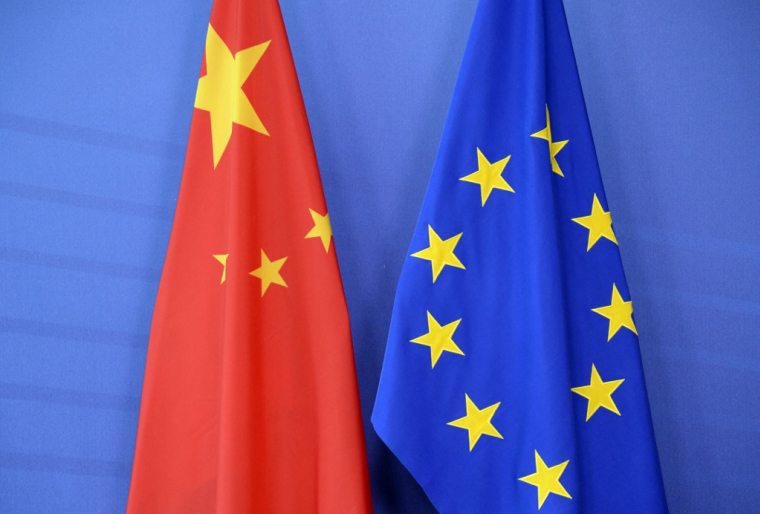
(AFP / THIERRY CHARLIER)
Faced with a widening trade deficit and the flood of cheap products – sometimes heavily subsidized – in all industrial sectors, the European Union wants to arm itself with protective tools, at the risk of a trade war.
European leaders meeting at a summit on Thursday should discuss solutions to protect the industry of the Old Continent. Beijing advocates dialogue, but says it is ready to retaliate.
An “unsustainable” trade deficit
The EU’s trade deficit with China has become “unsustainable”, the European Commission said last month.
For the month of April alone, the deficit (for goods only) was 31.9 billion euros, according to Eurostat, the EU statistics service.
That’s more than a billion euros per day on average.
“Our trade relationship with China has reached a point that requires
a reset.
Not a confrontation, but a rebalancing,” European Trade Commissioner Maros Sefcovic declared on Monday.
Chinese Ambassador to the EU Cai Run wrote at the end of May that his country was “fully aware of the strong concerns” of Europe, had “never deliberately sought a trade surplus” and was
“ready to do our part to help solve this problem.”
Calling for “dialogue”, he listed the measures already taken: greater openness to European agricultural products, removal of VAT rebates for Chinese exporters of photovoltaic products, restrictions on exports of Chinese electric cars.
On the defensive, China affirmed at the beginning of June that the success of its companies was based on innovation, economies of scale and its industrial fabric,
rejecting accusations that it comes from huge public subsidies.
Relationships that become strained
Relations have deteriorated since the beginning of 2026 because
Brussels wants to strengthen its legislative arsenal against China.
The EU fears that the dominance of Chinese companies in certain sectors
(electric vehicles, batteries, chemistry, green technologies)
does not undermine its industry. It also requires greater opening of the Chinese market.
China is up against a so-called “industrial acceleration” bill. It would exclude certain products manufactured outside the EU from public procurement and restrict the takeover of European companies.
The European Commission also presented
a review of its cybersecurity rules.
They aim in particular to exclude suppliers deemed to be high risks, such as the Chinese Huawei, from telecommunications networks.
Electric vehicles “made in China” have been targeted by additional customs duties since 2024.
China’s Ministry of Commerce has promised “countermeasures” if the “industrial acceleration” plan is adopted.
Are we heading towards a trade war?
We’re getting closer.
“Tempers are heated and the situation remains unstable.
The risk of a trade war is very real”
says Xu Dingbo, professor at the China-Europe International Business School (CEIBS) in Shanghai.
“It is essential today for Europeans to display their determination and create a balance of power,” said Elvire Fabry, specialist in the geopolitics of trade at the Jacques Delors Institute.
Zhu Tian, economist at CEIBS, believes, however, that both sides may have an interest in appeasement: “Escalation would not benefit anyone… Europe would face greater costs and see its green transition slowed down, while
China would take the risk of closing an essential market.
China’s potential retaliation
“China could respond with anti-dumping investigations, a tightening of regulatory controls, restrictions in certain sectors, or even by putting pressure on European products with high political sensitivity”, envisages Zhu Tian. After previous European measures in recent years, China had imposed anti-dumping duties on cognac as well as investigations on pork and dairy products, shaking up these sectors.
Zhu Tian parie sur
“a calibrated answer
: firm enough to make it understood that the EU measures have a cost, without going as far as a complete break.
The EU is particularly concerned that Beijing will impose restrictions on the export of rare earths, essential for its cutting-edge industries.
Important business partners
The EU is China’s second largest trading partner, a crucial market for its companies facing sluggish domestic consumption.
China “needs access to the European market while the American market closes”
notes Elvire Fabry.
Are compromises to be expected?
“Increasing imports from Europe would help ease the relationship and prove that China takes the EU’s concerns seriously,” said Zhu Tian. He also advocates more Chinese investments in the Old Continent, generating jobs.
Beijing can still avoid a trade war, but “by really opening up and not by pretending, because
China has been talking about opening up for 20 or 30 years.”
says Joerg Wuttke, expert at the cabinet DGA-Albright Stonebridge Group and ex-president of the Chamber of Commerce of the EU in China.